Ahead of Ireland v Argentina we meet the Irish GAA community in South America
EASY like a Sunday morning. And Buenos Aires does them easier than most places. So when little Luisa Marie Connery, all 15 months of her, accompanies her father Michael into a drinking den on Sunday morning draped in a tricolour, few will bat an eyelid.

Ahead of Ireland v Argentina we meet the Irish GAA community in South America

Ireland and Argentina will go into combat in Cardiff with a World Cup semi-final in the balance. On the other side of the world, in enemy territory but a land where the Irish are far from alien, a father and daughter will be all in green.

“She’ll be supporting Ireland for sure,” Michael Connery, who has lived in Argentina for seven years now, tells the Irish Examiner. “We’re outnumbered, so we need her!”

It’s one of the world’s great cities, Buenos Aires. A place everyone should have a chance to get utterly lost in at one point or another. Often bewildering, always bewitching, this cultural cauldron, the Paris of the Americas, lives up to the hype – and then some.

The natives, all 12 and a bit million of them, are Porteños, the people of the port. It’s a moniker that fits. Because even for those who consider themselves Buenos Aires purebloods, a quick peeling back of the layers, an exfoliation of the generations, will reveal their roots actually lie in the port on the estuary of the Rio de la Plata, in a ship that docked into this city having left another on the opposite hemisphere.

Centuries of European immigration have ensured Buenos Aires is a melting pot never far from the boil, always full to the brim and simmering away. The only thing for it is to grab a spoon and dig in.

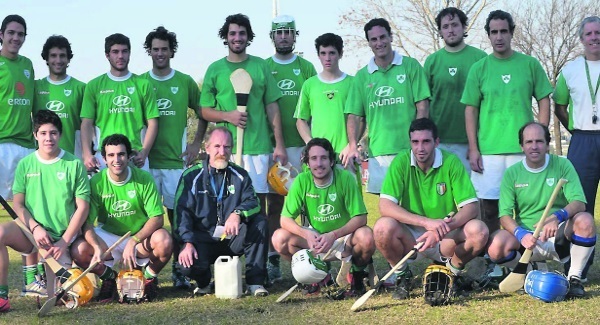
That’s exactly what Connery did when he first pitched up seven years ago. He relocated with his Argentine wife Victoria in early 2008, just in time for St Patrick’s Day. The Kilkenny native eschewed the paddywhackery of the downtown taverns in favour of something much closer to home – the Hurling Club.

The Irish tribes may not have travelled to Buenos Aires in nearly the same numbers as Spanish or Italians but there was nonetheless enough of them to make their presence felt. Experts can’t agree (they rarely do) but it’s generally accepted upwards of 50,000 Irish left for a new life in Argentina in the mid-to-late 1800s, hordes of them setting themselves up in the nation’s capital. The majority came from Offaly and Wexford so speckled in among the street football of the early 20th century was the sliotar.

The Hurling Club was born in 1922 and the game had its admirers amongst the local intrigued. However, a cut-off in both the supply of equipment and of fresh immigrants around World War Two saw things come to a shuddering halt. With its shamrock crest, the club was still a home of the Irish- Argentine community, but in a sporting sense it was now a home of rugby and hockey. Gaelic Games was in its distant past. So it seemed.

“I came out here pretty much as soon as I arrived, on Paddy’s Day, and there was an announcement they were hoping to start up playing Gaelic games again at the club on a more regular basis,” explains Connery. “I just wanted to be involved in that in any way I could.”

Connery picked the right time. The GAA were inbound for a hurling All-Stars tour and they opened the supply lines again, sending equipment and expertise in the direction of Buenos Aires.

Things tend to flow in opposite directions on the other side of the equator and so it proved for the Hurling Club. While the slow creep of rugby into GAA heartlands had so many worried at home, Connery and co. found the oval ball gave new life to Ireland’s native sports – even in this unlikely outpost.

Michael Connery and daughter Luisa Marie.

While it was natural some of the club’s hockey contingent swapped stick for hurl, hurling’s rugby players picked things up too. Clinics with Wexford hero George O’Connor and other apostles dispatched from Croke Park helped keep the flames burning. The club were invited to Galway in 2013 for an international festival as part of The Gathering and made it all the way to the final.

But rugby really helped once a light was shone on the other code. “We had always been throwing in a bit of Gaelic football in at the end of [hurling] training sessions but we got much more involved in it when the chance came around to go to the World Games in Abu Dhabi,” says Connery, proud player-coach, of the March event when his Argentinian side won the lot.

“We really got stuck into it then and it just came alive. Any of the rugby boys who were involved loved it. It was just like this boom for Gaelic football. The football is now at a stage where it’s more popular than the hurling. I think it’s because most of the lads who come to the club in the first place are rugby lads.”

There are as many as one million Irish descendants in Argentina, our fifth biggest global ex-pat community and largest in a non-English speaking country. Bernardo Andres Deveraux is one of the million. A former Hurling Club hockey player, a rugby diehard and in more recent times a hurler and Gaelic footballer. His heart first drew him to these games of his ancestors – his granduncle was one of the original pre-war hurlers at the club – but now he’s hooked.

“I can’t lie to you. Hurling is a really interesting sport for ex-hockey or rugby players but it of course makes us feel closer to our heritage,” says the 41-year-old IT specialist. “We are an Irish club, we have really strong roots. We keep a lot of the [Irish] culture in the Argentine community. It’s hard because we don’t have much fresh immigration. It all happened so long ago. Here’s an example, my father was the first of his generation who married someone who wasn’t an Irish descendant. My grandfather and all other immigrants here married other Irish. It all meant that until, say the 1960s you went into the Hurling Club and you feel like you were stepping into Ireland.”

It provided a familiar feeling to the Ireland rugby team as recently as last year when Joe Schmidt’s side trained at the Hurling Club during their summer tour which featured two Test victories over the Pumas. The players mingled with the ex-pats, Paul O’Connell and Conor Murray had a puck around with the Porteno hurlers. But this weekend the clubhouse will be less hospitable to Irish hopes, in some corners at least. There will be a split. Deveraux, whose ancestors hail from Wexford and Westmeath stock [both of which he visited on that 2013 trip], is still torn.

‘This should be a big game but then they are always big games,’ he says. “We always get down there at the Hurling Club for a big Ireland-Argentina game and people try their best not to shout too much. No matter what happens, it all ends with us drinking beers and having a great time.

“But this one is going to be the toughest of all the Pumas-Ireland matches at the World Cup. They both have injured players so they are two teams that are on a very close level. The team that makes a mistake is going to be the one to lose.”

There is still plenty of time for pre-match sledging before Michael and little Luisa make their way into town to watch the chaos that will unfold at the Millennium Stadium. Tomorrow morning offers the best chance when upwards of 25 converted rugby players will converge on the Hurling club for a double session, in both Gaelic games codes.

“I haven’t had any stick from them yet,” laughs Connery. “But we’ll see how that all changes on Saturday. A few of the lads I know well keep telling me that [Sunday] is going to be 2007 all over.”

That World Cup defeat in Paris is in the past for Ireland and then victors Argentina however. Now is only about the present. On a training field in west Buenos Aires tomorrow, a showdown in Cardiff will dominate the discourse - two tribes going to war, allegiances, heritage and heart strings all pulled two ways. For these people of the port, it’s the perfect sporting storm.

x

More in this section

Sport

Newsletter

Latest news from the world of sport, along with the best in opinion from our outstanding team of sports writers. and reporters

Cookie Policy Privacy Policy Brand Safety FAQ Help Contact Us Terms and Conditions

© Examiner Echo Group Limited