NUMBER CRUNCH: Do the stats back Ireland's scrum-half decision?
All the signs have been there: the pre-tournament contract extension, the ominous warm-up performances, the stalled momentum…

NUMBER CRUNCH: Do the stats back Ireland's scrum-half decision?

Is Joe Schmidt going to follow in the footsteps of Kidney and O’Sullivan, and every other Ireland World Cup squad since 1987, in failing to make the semis?

Not alone that, have we witnessed the Joe Schmidt paradox, a risk-averse brand of rugby but a risk-taking squad selection?

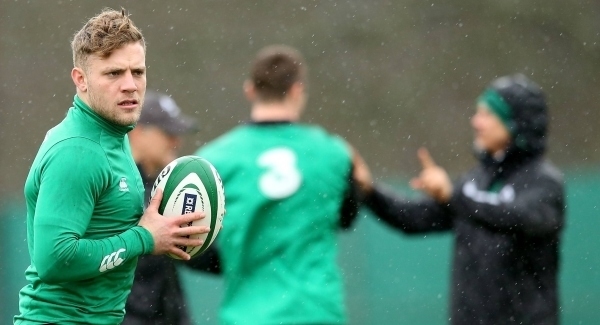
This worry has surfaced since Schmidt’s gamble in taking only two specialist scrum-halves, with Ian Madigan, thanks to his superpower of versatility, filling in should the concussion-afflicted Conor Murray and Eoin Reddan both be struck down.

That’s the nuclear situation, one discussed all the more after Murray’s meeting with Joe Marler saw Ireland’s favoured number nine head into the concussion bin for a third time in 10 months.

But how much game-time might Madigan face feeding scrums?

Rugby statistician Russ Petty has done some calculations to help quantify the risks of shortcuts at the specialist positions of scrum-half and hooker.

According to his data from the 2011 World Cup, third-choice scrum-halves across the 20 teams faced an average of 25 minutes on the field, five minutes of that coming out of position.

Isaac Boss, the odd man out this time around, was selected as third choice in 2007 and 2011. However, he only played 25 minutes under Eddie O’Sullivan, coming on twice as a substitute, and 66 minutes at the latter tournament, where he started against Russia.

Only eventual champions New Zealand used their third scrum-half more in 2011 – Jimmy Cowan getting 140 minutes on the field.

Schmidt said of his selection dilemma: “To cover all your options with 31 players, it’s not possible really. As soon as you have three hookers, you can only have two of everything else.”

But, rather than assume that three hookers is the optimal strategy, how useful is Richardt Strauss likely to be to the cause?

Returning to the 2011 example, no third-choice hooker saw more than 50 minutes of game-time overall, with the average being 15 minutes.

Ireland’s Jerry Flannery scored par with his meagre 17 minutes of action before being injured in training. His replacement Damien Varley was unused.

In 2007, Frankie Sheahan saw five minutes of competition, filling in for a bloodied Flannery.

On that evidence, it would appear that a third scrum-half is much more useful than a third hooker. However the weight that such stats hold has been changed by the added penalties for failing to contest scrums.

These go as far as potential points deductions for uncontested scrums, with all front-row replacements required to be “suitably trained and experienced.”

These risks have most notably been taken by Group A rivals Wales and Australia, where Warren Gatland and Michael Cheika opted for only a pair of designated hookers. Argentina, who could potentially meet Ireland at the quarter-final stage, are tip-toeing along a similar tightrope, although they successfully managed that trapeze act in 2011.

Argentina, like Australia, have gone for the double jeopardy selection of two scrum-halves and two hookers.

Murray’s clean bill of health following his England knock reduces the likelihood that marginal calls at the fringes of Ireland’s squad will have a major bearing on our chances, and reduces the chances of seeing Ian Madigan showing off his box kicks before the month is out.

“I think if we didn’t gamble there we were gambling somewhere else,” said Schmidt. Whether his top pair holds up as other teams show their hands is yet to be confirmed.

For now, at least, it all seems to be helping to very effectively play down the pre-tournament hype.

More in this section

Sport

Newsletter

Latest news from the world of sport, along with the best in opinion from our outstanding team of sports writers. and reporters

Cookie Policy Privacy Policy Brand Safety FAQ Help Contact Us Terms and Conditions

© Examiner Echo Group Limited