How a Rugby World Cup dream can literally go down the toilet
When Ireland take the field at the Rugby World Cup next weekend you expect all the bases to be covered. Tactics and the opponents’ weaknesses. Strength and conditioning. Gear and accommodation. Everything’s got to be right, tuned to perfect pitch, to ensure the trained-to-the-inch, super-healthy athletes can realise their potential.
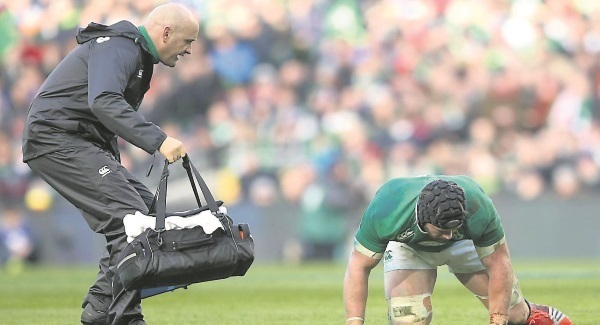
Dr Eanna Falvey, the team physician to the Irish Rugby squad, agrees about the health of the players. Up to a point.
“That’s an interesting way to put it, super-healthy, because there’s good research to suggest that there’s a curve on which your immune system works,” he says.
“If you’re unfit, your immune system doesn’t work properly, while if you exercise it improves your immune function, and that continues to rise with the amount of exercise you do until you get up to very high intensity exercise, when it falls off again.
“It’s a bell curve, essentially, so when you go beyond high-level exercise, very high-level exercise can actually predispose you to infection.”
You become like one of those Olympic middle-distance runners, finely tuned to perform miracles on the track but liable to break down completely when the smallest thing goes wrong?
“One of our props would have gotten sick in the last week of pre-season every year. He’d just gotten to that level, so we had to cut out a session or two for him in pre-season so he didn’t get overcooked, so to speak.
“In your immune system we know the gut microbiota play a huge role - the largest organ in your body is your gut, and funnily enough you’re more exposed to the outside world through your gut than you are with your skin.
“These guys are super-fit, but that’s when they’re most vulnerable. They’re also taking in a high-protein diet, which may have implications for them getting bunged up, or the opposite.”
That diet is a key element in the professional rugby player’s preparation, of course. Falvey says they’re “reasonably tuned in that way.
“One big advance is the likes of Ruth Wood-Martin (nutritionist) being employed by the IRFU, and all the provinces have nutritionists, and those guys are very much aware that ‘we are what we eat’.
“There’s also been a significant move away from supplementation. Supplements are used but the mainstay now is a healthy diet. The feeling that someone has to be supplemented isn’t necessarily correct.”
That doesn’t mean they all eat the same meals: Falvey points out that different players need different results from the fuel they’re taking on board.
“It’s horses for courses. Some guys’ intake is aimed at maintaining lean muscle mass, while others have such a high metabolic rate that you just need to get some calories into them. They need those calories to perform. To put on muscle mass properly you do need some carbs, but too much doesn’t work. Similarly, you can only use a certain amount of protein - if you take on too much, it just comes out the other end.
“In that regard, you see guys in the gym who do fifteen minutes and then take a supplement - if they did half an hour and then had a sandwich they’d be far better off. It’s the work you do.
“These guys (pro rugby players) use supplements because in pre-season they’re having breakfast, lunch and dinner, and a snack after every session. They’re eating five or six times a day.
“I remember Trevor Hogan once wore a calorie counter on a pre-season trip to Poland and he burnt nearly 9,000 calories in a day. It’s very hard to eat that much good food, physically, so guys rely on supplements.
“The other side of that is someone like John Hayes never took a supplement. He’d have a banana and a bottle of water after a session because if he took supplements he’d just carry around extra size he didn’t need. Again, totally horses for courses.”
How does the menu break down for these guys, though?
“In July you’ll have guys eating four eggs and a few rashers for breakfast,” says Falvey. “At eleven a chicken wrap, a full lunch - meat, potatoes, two veg - and maybe skewers in the afternoon. In the evening they’ll have a roast and maybe a sandwich again that night.”
“In broad terms it depends on the body type. You have people who tend to be lean and big, who have to bulk up, and they tend to lose weight very quickly. They’ll fall away in terms of muscle mass quickly.
“Then you have larger, bigger guys who’ll lose muscle mass, they’ll tend to get fatter. They’ll have to train hard to prevent that, but those guys love to train anyway.”
Keeping them fit isn’t just a matter of reps in the gym or laps of the field either. The gut microbiota Falvey mentioned are significant in maintaining general health, which is why the IRFU have enlisted Cork firm APC to supply them with Alflorex, a probiotic which maintains good gut health. It’s a small thing, but if you were one of the New Zealand players who woke up with diarrhoea the morning of the 1995 Rugby World Cup, you’d know it’s a significant thing. An upset stomach is easy to pick up. “Remember, you’re still going to eight different hotels, you’re moving every four or five days - so there are a lot of different foods and a lot of different exposures for the players which we’re trying to normalise.
“You’re talking about players who may have had an eleven-week preparation, they’ve trained very hard and put on a couple of kg of lean muscle mass, they’ve lost body fat and are at the peak of their fitness. They have worked extremely hard to be selected for the RWC squad and represent their country - then two days before a game they get a bad bout of diarrhoea and lose 3kg and can’t play.
“Early on in my time with the Irish team, a seasoned international back row with had bad diarrhoea the day before a game. It cleared up the day of the game and at the time we had no measures really for how he was, apart from the fact that he’d lost some weight. He was very keen to play, a very good player, so he lined out but he didn’t go well.”
With so much at stake they’ve aligned themselves with APC to ensure the men in green jerseys will be ready come kick-off.
“This is cutting-edge research,” says Falvey. Professor Mick Molloy and his team in CUH are also looking at this research in terms of chronic diseases like rheumatoid arthritis and conditions like obesity, but in rugby we’re delighted to be able to use the technology and to be involved in the research being performed.”
If it helps one or two players over the line, then it’s winners all round.

CONNECT WITH US TODAY



Be the first to know the latest news and updates