A knockout blow for concussion?
Regrettably, some of the dominant images thus far of Six Nations 2015 have related to concussion.
These incidents have stoked medical and legal comment. A number of sports physicians led by Dr Barry O’Driscoll, Brian’s uncle, have argued vehemently that existing pitchside concussion protocols may not be of a standard that sufficiently protects player welfare.
While in legal terms, if rugby’s concussion protocols are inadequate, a vulnerability to medical negligence litigation may arise for the sport’s governing body, World Rugby.
Rugby’s authorities are, rightly, sensitive to criticism on the matter of head injuries, the incidence of which rose 59% in English rugby in 2013-14 compared to the previous season and thus making concussion the most common match injury for rugby players for the third straight year.
The IRFU, for example, took the unprecedented step of issuing a press release on the “medical management” of Jonathan Sexton, noting his return to play for Ireland had been sanctioned by numerous, independent neurologists both here and in France.
Similarly, the RFU highlighted that when England full back Mike Brown was knocked out, following a collision with Italy’s Andrea Masi, he was attended to by 13 England support staff.
In addition, in the aftermath of George North’s injuries in both halves against England World Rugby has promised that television match official technology might be expanded to identify head injuries.
All of this risk prevention is welcome but all of it applies, almost exclusively, to the elite level. The vast majority of those who play rugby do so at an amateur level.
They are unlikely in their career to be assessed by as many medics as Sexton has had access to in the past weeks. Multi-angle video replays are available only in a handful of stadiums.
This is not to be facetious about the matter because, after all, a concussive injury is one of brain trauma, the acute and chronic impact of which can be devastating. In 2011, a schoolboy from Northern Ireland, Benjamin Robinson, died after losing consciousness in a game for his school.
A subsequent coroner’s inquest attributed his death to second impact syndrome — the first holding of its kind in Britain and Ireland — which is when the brain swells rapidly after a person suffers a second concussion before symptoms from an earlier hit have subsided.
In 2014, the High Court approved a €2.75m damages settlement to another Irish schoolboy who suffered serious head injuries playing rugby. Liability for negligence was admitted by his school and for his hospital treatment.
The boy had been hurt in training 18 days prior to coming on as a substitute in the game, despite protocol indicating he should have been sidelined for 23 days.
A key aspect of the debate on concussion in rugby and other sports is, therefore, how it is being dealt with at the lower, but more player–populated, levels of the game.
Research this year in the British Journal of Sports Medicine has estimated a probability of 11.4% of a child or adolescent rugby union player in England sustaining a concussion over a season, equivalent to between one and two players in every school or club youth rugby team sustaining a concussion every season on average.
Speaking to an Oireachtas Health Committee meeting on concussion in sport last October, Professor John Ryan, a consultant in emergency medicine at St Vincent’s hospital and Leinster’s team doctor, said the number of 14-to-18-year-olds reporting with head injuries increased by 41% between the 2012/13 and 2013/14 sporting seasons.
A recent editorial in the British Medical Journal excoriated the ethos of school rugby as contributing to “a tribal, gladiatorial culture that encourages excessive aggression, suppresses injury reporting, and encourages players to carry on when injured”.
Those comments were echoed this week by former international Alan Quinlan who wrote about the all-consuming, win-at-all cost mentality that pervades schoolboy rugby.
Outside of the medical perspective, there may also be legal implications to the concussion debate. The NFL in the US is in the process of concluding a $1 billion collective settlement of about 250 lawsuits taken by about 5,000 former NFL players.
The original lawsuits had accused the NFL, over a period of decades, of hiding what it knew about the impact of head injuries on players.
The NFL, although not admitting legal liability under the settlement, has admitted that it expects about one-third of its near 20,000 retired players to suffer from diseases such as Alzheimer’s or moderate dementia.
In contrast to the NFL settlement, the argument in rugby is not that World Rugby is failing to adequately warn players of the dangers posed by concussions — far from it — more the argument is whether existing concussion protocols are sufficiently cautious of long term player welfare.
How is it, for instance, that in the sport that attracts most criticism regarding brain trauma — professional boxing — a boxer stopped in a bout is suspended for at least 28 days and sometimes 45 days, considerably longer periods than in rugby?
Fundamentally, the issue of concussion in rugby is not one for the lawyers. Rule changes and protocols reflecting the best medical advice and research is key.
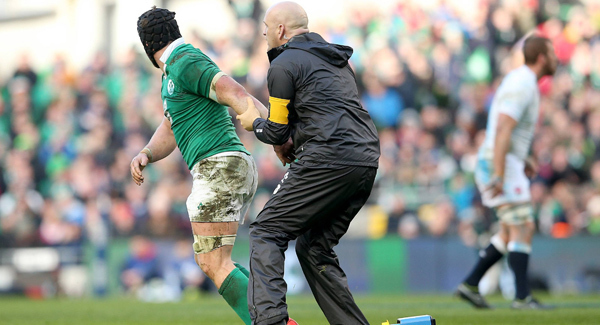
And that is why the image of Dr Eanna Falvey dragging a disoriented Sean O’Brien away from play in the game against England game has done the sport some service because it reinforces the message that when it comes to head injury, in any sport and at any level; if in doubt, sit it out.
CONNECT WITH US TODAY



Be the first to know the latest news and updates