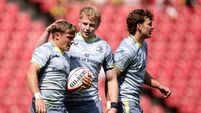
‘One of the greatest nights in Irish sporting history’
While things have moved on since those wild days, there was a part of me that hoped Poidevin’s successors in the famous gold jersey would experience a similar feeling after Saturday’s pool encounter here in Auckland.
They got that and more.
With the New Zealand bookies predicting an Australian 20 points win, this Irish squad were left in no doubt as to how they are rated in these parts, despite all their domestic success in the Heineken Cup and Magners League.
And were not happy about it.
It left this Irish side entering a massive contest written off, with a monumental chip on their shoulders and a fear factor they could be in for a hiding. That type of preamble usually suits our mentality, even if this crop of players feel they have progressed beyond that stage. Feeling bitter and twisted before a big game has never done us any harm.
Confirmation on the morning of the game ace poacher David Pocock had withdrawn due to a back problem was just the fillip Ireland needed. Now, all of a sudden, Ireland’s back row looked more than a match for their Australian counterparts. When it was confirmed an hour before kickoff first choice hooker Stephen Moore was also a late withdrawal due to illness you just felt the omens were swinging in Ireland’s favour.
What transpired however was even better than we dared to dream. This was one of the greatest nights in Irish sporting history and that it was witnessed and inspired in part by such a sizeable emigrant contingent was highly emotional. No wonder such great warriors as Brian O’Driscoll and Ronan O’Gara were reduced to tears after the game.
Let there be no talk either Ireland’s historic win was down to Australian adversity due to the absence of Pocock and Moore. After all Ireland’s first choice open side David Wallace along with Jerry Flannery were key losses to the Irish squad. Yes, the loss of Pocock changed the dynamic of the breakdown and allowed Ireland a little more scope. There is no point however in being handed an opening if you are not in a position to capitalise on it. In this respect the Irish back row were magnificent. Sean O’Brien was immense in so many areas with his explosive ball carrying creating havoc. However it was his crucial tackle on the darting Will Ginea off the side of a defending five metre scrum with just over six minutes remaining that proved his most significant contribution of the night. Add in that Chabal moment in the opening half when Ginea was picked up and driven ten metres back initially by Stephen Ferris and then by half of the Irish pack and you get the feeling Ginea could now appreciate the picture Poidevin was attempting to paint during the week. How ironic too the foundation for this incredible result was laid by an Irish scrum that dominated the Wallabies throughout. Only 18 months ago Irish scrummaging was in disarray with both Munster and Leinster ripped apart on successive days in Heineken Cup semi-finals.
Things have changed dramatically since then with the emergence of Mike Ross and Cian Healy introducing a new mindset to the Irish scrum. In the build up to this game I emphasised just how crucial a role the set piece would play in this test. In the first-half Australia denied Ireland a lineout platform — just two throws in total — by refusing to kick to touch. The wet conditions and Ireland’s magnificent use of the choke tackle meant that there would be sufficient scrums to make that phase count. Nine points from scrum penalties tells its own story and had Jonny Sexton brought his kicking boots it could have been even more. Of equal importance however was the psychological advantage of seeing your opponent bend the knee in every engagement. The crowd sensed it too and every scrum was greeted with euphoria in the stands.
It is difficult to escape the feeling that Australia underestimated this Irish side and didn’t pay them the respect they deserved. I left the Wallaby press conference last Thursday thinking that they had been sucked in by those recent poor Irish performances but this was a game Declan Kidney and company had been focusing on for the last six months.
As if emotions weren’t running high enough with the presence of so many Irish in Eden Park and their deafening rendering of Ireland’s Call, the ground rules for the clash was set 24 hours earlier when a distraught Jerry Flannery presented his teammates with their jerseys.
The thing that separated this display from anything we have seen recently was the Irish approach to the contact area. For some time now I have bemoaned the fact that Ireland were not committing sufficient numbers to the breakdown and were not aggressive enough in cleaning out bodies. That all changed on Saturday night. Ireland were wonderfully committed from start to finish and for once Eoin Reddan was presented with ball on a plate with the Australian defensive line forced to backpedal.
The key difference between the two sides in the final quarter when Ireland extended their lead to nine points was that they had the composure and the experience to close out the game.
At long last Ireland has achieved something really special at a World Cup and that near miss against the same opposition in that epic 1991 quarter-final can now be consigned to history. Celebrating success makes much more sense.
The ramifications of this result will be felt far and wide and have turned the World Cup on its head. While the New Zealanders were ecstatic at the sight of their great rivals being unceremoniously smashed, reality dawned on them that in all likelihood Australia had now been rerouted to their side of the draw. It also means that the chances of a Six Nations side contesting the final looks almost a certainty. The challenge for Ireland now is to build on this result and set their sights on a first World Cup semi-final.
FOR once an Irish team had no difficulty being labelled ‘Chokers’.
This Irish side literally choked their way to victory with a technique borrowed from rugby league playing a key role in this famous win. The fact it was introduced and developed by an Aussie — Irish defence coach Les Kiss — who coached many of the Wallabies during his days with the New South Wales Warratahs, made it even more ironic.
With many of the top attacking sides dependent on quick ball at the breakdown, Ireland have developed a technique whereby they refuse to allow the ball carrier go to ground and form a ruck.
The ball is targeted in the contact area by one Irish defender while another wraps up the player in possession and keeps him on his feet. This ensures a maul develops as opposed to a ruck. By preventing the ball from being recycled, possession transfers to the defending side who are awarded a scrum for their efforts.
Given Ireland’s scrum was so dominant the tactic proved immensely beneficial. It will be interesting to see now how Ireland’s upcoming opponents set about dealing with it and indeed if others look to replicate the ploy. Either way the secret is out of the bag.