The life of Brian
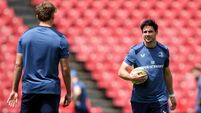
AFTER an hour in the company of Ireland’s rugby captain at the epicentre of the team’s training base at Carton House, for the first time in years, I miss not being directly involved in the game. Brian O’Driscoll’s enthusiasm is that infectious and despite everything he has achieved over the past 12 seasons, his desire to succeed at the cutting edge of the game is as strong and transparent as ever.
The most decorated player in the history of Irish rugby is set to establish two additional milestones over the next few weeks. Already Ireland’s most capped player, record try scorer and with a record number of appearances as captain, O’Driscoll will become the first player to represent Ireland at four World Cups and the first to captain the squad in two tournaments. Short of lifting the Webb Ellis trophy itself, there isn’t much more for him to achieve in the game. Not that you would notice. With the end in sight, he is more determined for success than ever and plans to maximise the time he has left in the game to add to an already incredible list of achievements. But let’s start at the finish...
RUGBY has been such a part of Brian O’Driscoll’s life for so long now at the very highest level. How does he get his head around a life without it?
“I’VE been looking at that for the last year to 18 months. I have seen guys finishing and then deciding what they want to do and I realise there is a transition period where you need to have yourself set up with something for when you move on from this career to the next. I am trying to do that while playing so that there isn’t the shock factor of looking at your bank account and realising that you don’t get that monthly installment any more.
“You have to have an understanding you are not going to be able to replace the buzz of matchday, of 80,000 people, of a packed Aviva or Croke Park or Millennium Stadium. That is a feeling that is irreplaceable so it is about trying to find something that gives you a purpose and a reason to get up every morning. Something I hope I will enjoy doing. I see so many people not enjoying work and I’ve been so lucky to have enjoyed it for 12 years that it would pain me to work for another 25 years in a job that I hated doing. It’s about trying to find that role or outlet.”
A role in rugby? “I don’t know. From a coaching perspective, not at the moment. I definitely think I need to get away from the game for a small period of time and be able to live a slightly different life. I have talked before about that itinerary lifestyle of ‘do this, do that, be there’ and this is what you have to do in this job. I’d love to just be able to have a bit of my own time and book a skiing trip in December and know that I can go on it. It might seem small and maybe I will miss that structure but I think a part of me wants to experience something else. I would love one day to be able to go for lunch and decide, you know what, I will have a bottle of wine with lunch and I will stay out for dinner and leave the car in town.
“Just to have that option.”
Keith Wood said before he retired he would definitely not get involved in coaching. Where do you stand?
“I would never say never. I would have told you five years ago that I was of the same opinion. I don’t know if I am going to be a frustrated watcher of sport. If you don’t have somewhere to channel your ideas, do you just shout at the television or do you try and hand on what you understand and know to the next generation? I don’t know. I will have to wait and see but I hope I’ll have other things in place that will allow me the flexibility of deciding if that is for me or not.”
THE last three years? Pretty special.
“IT really kicked off — a second coming as such — which was great. It threatened to tip over the edge in 2007 and 2008 but then thankfully things that you crave as a professional athlete, essentially trophies and medals, came good in the last three years. It seems almost frustrating in a way with the young guns that have come through in the last few years... they already have two Heineken Cups and a Grand Slam. I’m like ‘Hang on… I had to do nine seasons before I got that’.”
Does it mean more to you as a result of that? “I don’t know. It would be hard for those things to mean more to someone else than me anyway because I feel as if I really just craved that. It was nice to eventually have achieved, to have ticked a couple of boxes that you want to do as a professional. To win very tough competitions, it says it all; Ireland’s record in winning Slams, then beating 23 of the best European teams to win a Heineken Cup. They are achievements that rank very highly because of the level of difficulty.”
And to think they came within weeks of each other. “2009 was an action-packed year. I definitely believe that winning the Grand Slam gave those involved that edge that perhaps was theretofore lacking (with Leinster). They were able to spread that belief through the squad. We had a couple of experienced guys in key positions playing serious rugby so it all just worked out well.”
The Grand Slam arrived just weeks before Leinster’s first Heineken Cup success, so standing under the posts when Stephen Jones was taking that penalty to deny Ireland the Slam... you are nine years playing in Six Nations, what were you thinking?
“It’s the start of heartache, knowing that winning the championship will be absolutely meaningless. We had that won at that point as Wales needed to win by a bigger margin. It was just a case of were we going to lose the game and lose the Slam? It was a kind of aching feeling even though it all happened so quickly because Stephen Jones doesn’t mess around between the time he lines up and takes a kick. This was our moment.
“All teams are cyclical. You have that youthful enthusiasm that comes into a squad, then you go through different experiences and then it comes to a point where you need to win things and use that experience to your benefit. That was our time. The 2007 World Cup was the real start of it, that real heartache and the hurt we felt with that.”
AN UNMISTAKABLE figure on the Dublin social circuit in the early noughties, O’Driscoll managed to combine his meticulous attention to detail in terms of preparation and training without ever abandoning his close friends. When the time was right, he knew how to enjoy himself.
Mid-20s, captain of Ireland, captain of the Lions, the madness of Celtic Tiger Dublin?
“I was living in the moment and didn’t know any different. A lot of life is about not knowing any different. You are just living the one you are given, forging a path for yourself. Sure you see other people in different situations and some people have more than you and some have less than you but I don’t think you stop and think — this Celtic Tiger stuff is wild, isn’t it? — no one did that — or at least very few people did. So I was just living in the now and I suppose I haven’t changed that dramatically.”
Well you did get rid of the highlights! “Ok, besides all the highlights stuff. Obviously you look back to when you were a young fella and I’ll always see those pictures and go — the naivety of youth. But I do remember at the time thinking too that I was restricted by certain things within the Union (IRFU) and told to be here at a certain time, do this, do that. Maybe that was the one thing I was in control of, my hair. It was my opportunity of being a little bit rebellious. I did look at it that way and maybe the more people told me I looked ridiculous, it was my way of giving them two fingers without having to, which is silly in a way but I was a young fellow and I got a bit of a kick out of it.”
A part of growing up? “Exactly. Put your hand up if you have had a flawless life. You shouldn’t see too many hands up in the air. So look, I will always look back and, touch wood in years to come, my kids will look back and see those pictures and I’ll get abuse from them about the shocking hair. But who knows, in 20 years time that look will be back.”
WHATEVER about his fashion sense, nobody could ever question O’Driscoll’s bravery on the field, at times displaying a reckless disregard for his personal wellbeing.
Revered by his peers for that defiance and commitment, especially in the contact area, I wondered where did that attitude come from. Was O’Driscoll ever afraid on the field?
“I was afraid when I was about 14. I was still very small and I can remember playing Under 14 against the second string Junior Cup team in Blackrock College against all those big guys and just thinking ‘this is hard for a small guy like me’. How am I meant to compete with this? Then I grew when I was 16 and 17 and hated being considered ‘afraid’. I just thought it was a weakness I didn’t want to have and I actually developed physically and tried to expel that from my mindset. I thought — what’s the worst that can happen to me? I know it’s dangerous talk on a rugby field, but you break a bone or something. So be it. It’s part and parcel of it.
“I probably have lived a bit off that and it is part of my game I can rely on — if you are not thinking about pulling out of something (then) you are 100% committed to the cause. That is a big thing for me. I would say I am committed to a lot of things in my life, not just rugby. I am a bit of an all or nothing person so once I grew into my body that was something I felt I could call on.”
For all aspiring young players struggling to make the cut in schools rugby, take heart. O’Driscoll failed to make the Junior Cup side in Blackrock and in his first season on the senior side was dropped for the Leinster Schools Cup semi-final. Yet within a period of three years he was marking a World Cup-winning Wallaby legend in his international test debut in Brisbane.
“It was crazy. The year I got capped — 1999, I played on the Irish U21 side. We lost to Wales who won the Grand Slam and I got substituted with about 15 minutes to go. At that point to be subbed off, uninjured, means you haven’t done a great job. Then before I knew it I was a sub against Italy in the Six Nations after skipping the ‘A’ set-up and was selected for the summer tour of Australia. They had Tim Horan and Dan Herbert in midfield. I never had a real chance to take it in at all. It happened so fast it really was a crazy period.”
Which continued upon his return home. “My folks had a bit of a party in the house when I came home. It had a rugby theme and people wore rugby regalia and what not and I remember thinking this is mad, how long can this last?”
WHILE he is hesitant to discuss the incident that shaped O’Driscoll’s previous visit to New Zealand, he realises that the All Black ‘Spear Tackle’ from 2005 is bound to resurface over the next few weeks in New Zealand.
From this remove, does the Irish man wonder was he a publicity pawn afterwards for Clive Woodward or, even more so, by the tour media officer and former advisor to Tony Blair, Alastair Campbell as a means of deflecting attention from what was a disastrous opening test hammering by the All Blacks?
“At the time I didn’t really look at it that way. Whether they wholeheartedly thought and believed in what they were saying or whether it was the fact Alastair was the doctor of spin. The connection between the incident and attempts to airbrush that first test defeat... trying to separate the two and concentrate on one... Maybe that all ties in with him (Campbell) whereas you would be hopeful that with Clive, he genuinely felt for his player and his captain rather than worrying about what the media was going to talk about the rugby match.
“Perhaps it got out of control and I remember getting a text message from Ray McLaughlin — the former Ireland captain who, ironically, was the victim of another famous physical assault on the 1971 Lions tour to New Zealand which also ended his tour. He is someone I hold in very high regard. I remember him just saying this incident has the potential to take away from the Lions tour and it need to be buried. So I decided that was the end of it, no more talking to anyone about it or no more interviews. I wasn’t held back by the management. Another media guy might have held me back from talking to people. I was shown who to speak to.”
In the context of your experience now and your ability to deal with the press would you approach things differently? “Yes, but it doesn’t necessary mean that I didn’t feel a bit hard done by at the time but I would deal with it a bit differently. I don’t subscribe to the view that the incident was premeditated but it was careless and, as a result of that incident, there has been completely new rulings brought into the game. Any spear tackle these days is an immediate red card. Players are better protected because of that dislocated shoulder. The thing that disappointed me was the inability to just apologise, to just say there was no intent but it was careless. That is all I was after but I didn’t really get that. That’s all I want to say on the incident.”
O’Driscoll has confirmed his intention to cash in his chips in two year’s time. That ties in beautifully with the beginning of his Lions journey back in 2001 in Australia. Would that amount to the perfect ending?
“I don’t really allow myself to think that far ahead, genuinely. I understand — more so in the last couple of years than in the 10 beforehand — of how fickle things can be and how, at the drop of a hat, things can change, particularly with injury. I have lived a lot in the moment and I don’t see any reason to change that. What can be gained by looking ahead to the summer of 2013? I stopped day-dreaming about winning Lions series and World Cups a long time ago. I did it as a young fellow but no good comes from it. Only disappointment. So at this stage, I go week to week, game to game and thinking about what is in the immediate future from a rugby context. That has served me well so far and I don’t see any reason to change it massively.”
I put it to Brian that the timing of the World Cup offers a massive advantage to the southern hemisphere teams. It’s something I’ve nagged on about but what’s the Irish captain’s view? Would he prefer to play at the end of the northern hemisphere season (as it was in 1987 and 1995) or is he okay with the current timing?
“IF I had a choice I would prefer May/June. Of course you would have to play a Six Nations too, but I do think you are trying to speed up a process of trying to get match-fit in this defined window. Look at how different teams are trying to get up to speed: some playing two games, some three. We are playing five as a reaction to 2007. For me, I’d say I only start to get up and running after four or five games. I think a big part too is that you can’t replicate what you do in a game on the training field but there is a need for more match-like stuff and simulated game situations. That is the error we made four years ago. We started playing rugby far too late. I didn’t touch a ball for the first five weeks. The mentality at the time was we were smaller and needed to get bigger and stronger. If we were to compete with France and Argentina, we were going to get as big. It was a big error as our skill level was down and when it came to being match hardened, we were off the pace.”
At what stage did that reality dawn? “The Italian game in Belfast. After the first game against Scotland it was a case of ‘okay, we are a bit behind but you don’t play on that negativity. You try and go, next time around we give ourselves a positivity that go and perform against Italy and bring that to the World Cup. Then we’ll be in a good place’.
“That didn’t happen. We scraped a win in dubious circumstances with that disputed ROG try. I remember being in that dressing room afterwards and while there was no real panic, some stern words were said and you don’t really want that a fortnight before your first World Cup game.”
Ireland and the World Cup: what’s the problem? “My general feeling to date would be one of disappointment and under achievement. In my three World Cups we have made it to one quarter-final in which we got a real beating — against France in 2003. It frustrates because it is the ultimate stage.
“2003 was comfortably my most enjoyable tournament. I really enjoyed being down in Australia. I enjoyed our base in Terrigal. We trained hard, could have beaten Australia but then got pasted by France. I think we had a particularly poor game plan that day. I don’t know if Eddie (O’Sullivan) would admit to it but it was one of the few big errors he made in his coaching career. In general he had a fair understanding of the way we needed to play the game. We played a different game plan that day and it completely played into their hands. We played really narrow and didn’t challenge them at all. I managed a few scores late that completely flattered us.”
What constitutes success for you and Ireland?
“Doing better than we have done in previous World Cups and representing ourselves to the level we know we are capable of on a world stage. I’m not going to get drawn into giving a tangible outcome to where we are going to end up. I don’t see any benefit in that but if we play the way I know we can, we will be a hard team to beat and I can take any result that comes off the back of that. If that means we don’t get out of the group stage then so be it, but I don’t believe that will happen. So it is about trying to match some of the best stuff we have played over the last two or three years and if we can do that consistently then we will be in the hunt.”
CONNECT WITH US TODAY



Be the first to know the latest news and updates