Munster face age time-bomb
Following the failure of the current side to qualify for the knockout stages of the Heineken Cup for the first time since 1999, the writing is on the wall for a number of the older players. The end of one of the greatest eras in the history of Irish rugby is also in sight.
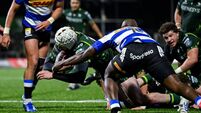
Saturday’s 20-14 defeat by Harlequins said all that needed to be said about the one time greats of the European game.
Several great players are approaching or have passed their sell-by date, with even those closest to the scene for a decade and more accepting that they let themselves and their followers down very badly in the Thomond Park sunshine.
The margin in the English side’s favour could and indeed should have been appreciably wider than six points.
This Munster team has grown old together and will require a massive amount of rebuilding if the province is to be a major force in the game in the future. Ten of Saturday’s side are now on the wrong side of the 30 mark.
Where would Munster rugby have been for the past decade and more without the likes of John Hayes, David Wallace, Ronan O’Gara, Marcus Horan and Peter Stringer.
The service they have given Munster and Irish rugby and what they have achieved for the game in the process has been enormous and their record speaks for itself.
But the respective ages of the quintet are 37, 34, 34, 33 and 33. Donncha O’Callaghan, Mick O’Driscoll, Doug Howlett and injured hooker Jerry Flannery are all 32; Paul O’Connell, 31. Thirty six year-old Alan Quinlan retires at the end of the month and Paul Warwick and Tony Buckley are on their way to Stade Francais and Sale Sharks.
It would, of course, be ridiculous to suggest that all of these players have actually reached the end of the road.
It is a near certainty that O’Gara, Wallace, O’Callaghan and O’Connell will play leading roles during Ireland’s World Cup campaign next September and October. Equally, though, it could hardly be denied that time is not on their side and that the levels the team reached against Harlequins were a long way short of what they were once so comfortably capable of attaining.
Those who still see a future in the current squad will understandably point to the 15 point lead they carry into the final round of the Magners League next weekend. It is a valid point but you have to wonder if it says as much about the strength of that competition as Munster’s ability to compete at the very highest level.
In my view, the Magners comes some distance behind the Heineken and even the current Amlin where intensity and physicality are concerned. And that’s why Munster are out of both competitions.
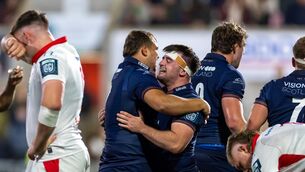
Peter Stringer was just one of those forced to shake his head in frustration as he attempted to explain the poverty of Saturday’s performance. He has been obliged to play a secondary role over the past few weeks but this clearly didn’t diminish the pain of the defeat for the great hearted number nine.
“I don’t think the end of an era comes into it. A defeat is a defeat and you take it in the context of 15 guys taking the pitch and guys coming off the bench and you really don’t see outside of that. It’s a defeat and it’s bitterly disappointing but it’s only one game. We’ve been going well this season, we’ve fought hard since Christmas to get where we wanted and to play the type of rugby that we’re proud of playing. But it just didn’t happen today.”
Harlequins had good reason to be kicking themselves for having only a seven point lead having run the show for the first forty minutes. When Felix Jones went over for a fine try that Ronan O’Gara converted just on half-time and Paul O’Connell arrived immediately on the restart the Red Army and those around him were clearly lifted. It looked as if the momentum was heading Munster’s way. But they were quickly back to making the most elementary errors, especially in the area of handling and passing.
Not surprisingly, referee Romain Poite saw little good in anything Munster did while turning a blind eye on Quins’ many indiscretions, especially where constantly encroaching beyond the offside line was concerned. The one thing that can be stated in his favour is that he is in no way intimidated by the Thomond Park atmosphere. On the contrary, he seems to delight in driving the fans to distraction.
Thankfully, however, McGahan wasn’t prepared to blame the referee for his side’s failures.
Stringer also faced up to reality: “We came up against a good side and let ourselves down. We didn’t control the game the way we would have wanted, a lot of mistakes, and at the end of the day, we have only ourselves to blame.”
As a collective unit Munster failed, individually there was hardly a single player to earn a plus mark. There was no cutting edge in the middle of the park where the search for a world-class centre must intensify.
McGahan and his management team must also examine their own part.
They and their players must be fearing what the remainder of the season could hold with every possibility of Leinster coming to Thomond Park for a Magners League final at the end of May.
On current form, there could be only one outcome.
CONNECT WITH US TODAY



Be the first to know the latest news and updates