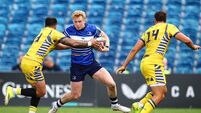
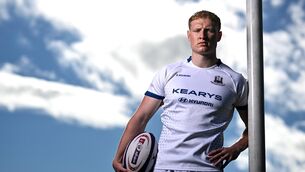
Fitzgerald ready to prove full-back credentials
The 23-year old has endured a couple of lengthy stints on the sidelines in recent years but at least his latest came to an end prior to the Six Nations and at a time when there was a vacancy at his cherished full-back slot.
However, the sight of the recuperating Rob Kearney walking around the team’s Dublin hotel in his Irish tracksuit yesterday was a reminder that he could soon come calling for the jersey again.
Fitzgerald hasn’t done much wrong in the fixtures against Italy, France and Scotland but nor has he stamped his imprint on the jersey. The onus is very much on him over the next two weekends to make his point more forcefully.
He accepts as much: “Yeah, I do. It’s about getting more touches on the ball and putting pressure on the coaches to keep selecting me when everyone is fit. If I get more touches in attack, definitely. I just need to keep putting pressure on coaches to keep picking me by doing well.”
By and large, he is happy with his form. He is feeling more and more comfortable in the position with every game but he admits that his record under the high ball — a sector where both Kearney and Geordan Murphy excel — needs to improve.
“It’s not an area that’s weak in my game,” he stressed. “On certain occasions, when the ball has been coming short, there have been guys competing and I haven’t been able to get as high as I’ve wanted.”
Ask any member of the Irish squad or management team to sum up their recent performances, whether individual or collective, right now and the odds are that their answers would chime with Fitzgerald’s.
Forwards coach Gert Smal was certainly reading from the same script when asked specifically about the team’s efforts at the breakdown and lineout so far. Bottom line? “I’m not satisfied,” said the South African.
Far too much has already been said dissecting Ireland’s propensity to give away penalties.
Smal’s assessment of the disciplinary plague was interesting.
Popular opinion has it that Ireland’s problems at the breakdown can be traced back to the change in interpretations brought about midway through last year’s Six Nations.
Hogwash, said Smal.
“We have changed the way to suit our team,” he said. “At the breakdown, we don’t want to change much of what we’re doing. The players have faith in our defensive system and we haven’t conceded many tries.
“It’s about speaking to the players consistently and trying to be a little more accurate and, when the ref speaks to you, just listen. We’re constantly looking to improve, individually and as a team.”
South Africa’s Jonathan Kaplan takes charge in Cardiff on Saturday and the hope is that the southern hemisphere interpretations seen in the Super 15 in that competition’s opening weeks, will be more to Ireland’s liking.
“I was looking at Jonathan Kaplan at the weekend,” Smal explained. “I watch a lot of Super Rugby and a lot of those teams struggle with not releasing. That’s not an excuse for us to be the same, we just need to be more accurate.”
The Millennium Stadium will tell us more and, whatever about the caveats haunting their progress to date, Ireland will at least return to the Welsh capital for the first time since sealing the 2009 Grand Slam with few injury concerns.
There were no spectators at yesterday’s RDS training session. Tomás O’Leary came through 40 minutes of running while the expectation is Leo Cullen will overcome a groin strain in time for the weekend.
Declan Kidney names his starting side today at lunchtime.
“In terms of playing, we’re on the cusp,” said Fitzgerald. “In attack, we’ve looked very, very dangerous. We’ve scored a lot of tries. I think we’ll continue to do so.”
CONNECT WITH US TODAY



Be the first to know the latest news and updates