Gibbes wary of Kelleher threat
Kelleher first established himself as a world-class operator with the Otago Highlanders and Waikato Chiefs and came to global prominence by winning 57 caps for the All Blacks before making the move to France three years ago.
The 33-year old may only stand 5’9” tall but he is something akin to an auxiliary flanker with his incredible physique and willingness to get his hands dirty, while his tendency to make breaks around the fringes of rucks make for an unpredictable adversary.
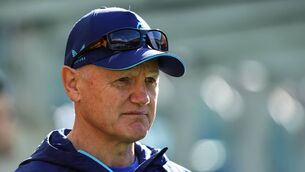
“We certainly talked about Byron,” said Gibbes, “and the threat that he brings. He’s the perfect kind of nine for Toulouse and the way they want to play. He’s a bit of a handful. He’s not one of the old-school number nines that you could throw around a little bit.
“He can give it back as well. We’re not changing anything about our defence, but you focus on a few things. We know we’re facing a world-class nine who’s physical, so we need to be sharp around the ruck and not get caught watching too much.”
Kelleher may be a star but he is just one in a galaxy of them in that rugby hotbed and predicting their probable starting 15 is a risky, even a foolish business.
That said, while their personnel can change from game to game, the challenge for the opposition does not.
The warning signs for Leinster are obvious. Michael Cheika’s side were fortunate in the extreme to claim a one-point quarter-final win over Clermont Auvergne who, with their teak tough pack and standout backs, bear some resemblance to Guy Noves’ side.
“Studying (Toulouse) for the last two weeks, they’re well-drilled, experienced and they have played together quite a lot. They’re big, they’ve a good scrum and well-resourced line-out. The positive that I can take is the Clermont game and coming up against their pack. I mean, we just don’t play big teams like that in the Magners.
“We perhaps got caught watching a little bit, letting Clermont play too much and it hurt us. We’ve taken that experience on and learned from it. We’ll face the same thing again with Toulouse, a well-drilled big side who are competent in the set-piece.
“One of the things was our body height against Clermont. We sat back on our heels, we got high and we watched. The thing we’ve tried to work on is our height, going forward, attacking and not watching. That’s the best way to counter them. If we sit back and watch again, they can do a lot of damage.”
Like Munster, who face Biarritz in San Sebastian in the far side of the draw, Leinster approach their European semi-final in less than convincing form after their recent experiences in the Magners League and, in particular, last week’s loss away to Connacht.
Despite fielding a near full-strength side, Leinster slumped to a defeat that leaves their hopes of a home berth in the Magners League semi-final very much up in the air with one round to play as they turn their attention to the retention of their European crown.
“I sympathise with not having your head on every game,” said Gibbes.
“That’s no excuse for dropping your level like we did. I sympathise with it, it’s no excuse, but I understand how it happens. But if you can’t get excited about playing Toulouse in Toulouse, you’re in the wrong business.”
As might be expected at such a late stage of the season, both sides have had to deal with a selection of injury concerns this week.
What could not have been forecast was the fact that Leinster’s ailments would all be suffered by their backs.
Gibbes’ pack is in fact almost devoid of knocks – if not aches and scrapes – despite the heavy workload and the hardening ground, something the Kiwi has attributed to good fortune and effective squad rotation.
With the backs suffering such a rate of attrition and the word on Jonathan Sexton’s fitness so glum, it would be understandable if Cheika decided to scale down the game plan to a less than multi-dimensional forward-driven blueprint.
Not the case, said Gibbes.
“There are a few fundamentals that have to be addressed when you play Toulouse. As far as altering tactics go, there hasn’t been too much of that. Shifts of focus perhaps, but that would have happened anyway given the opponents we face and what they bring to the table.”


CONNECT WITH US TODAY



Be the first to know the latest news and updates