John Fogarty: The integration baton hasn’t been passed on. It’s been dropped
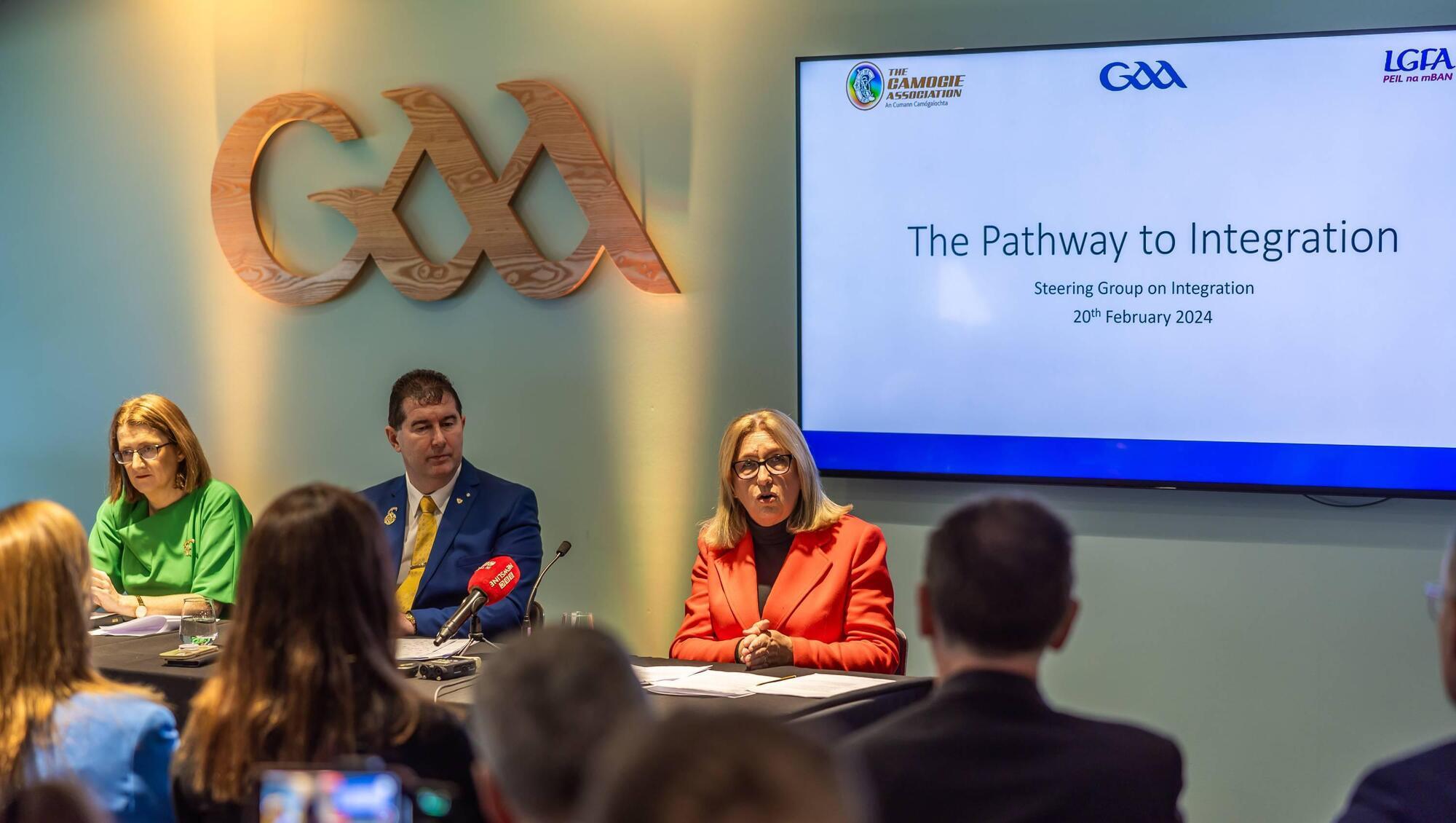
PASSING ON THE BATON: Camogie Association President, Hilda Breslin, Mícheál Naughton, LGFA President and now former Chairperson of the Steering Group on Integration, Mary McAleese. Pic: ©INPHO/Morgan Treacy
It may have been the last Friday before Christmas but December 19 last was a hectic day for the GAA’s Management Committee.
On that afternoon in Croke Park, they endorsed the ethics and integrity committee’s recommendation to continue their commercial relationship with Allianz.
A cold statement confirming as much on a Friday evening where it is hoped bad news goes to die, it suggested the GAA’s highest authority were rushing to get out the door before the festive period.
They were anything but. A presentation by Mary McAleese, chairperson of the steering committee on integration, was also on the agenda.
There McAleese had first threatened to resign after rejecting the committee’s assessment that the 2027 deadline for integration was “unrealistic”.
"During the subsequent discussion, it was acknowledged that the project is of utmost strategic importance for the Association,” the minutes of the meeting read. “A great deal of work has been undertaken, and significant progress has been made.
Read More
"However, the consensus of Coiste Bainistíochta was that 2027 represents an unrealistic target for full and complete integration. Their considered view was that a phased implementation would represent a more measured approach, in order to better manage any risks and accommodate any reasonable reservations that may be abroad in the Association.
"The view was rejected by the Independent Chair, who expressed her disappointment at the view of the Coiste."
GAA director general Tom Ryan later played down the difference of opinion and ultimately McAleese didn’t step down.
She was part of the roadshow that followed, which was aimed as much at gathering feedback as informing people about the proposed roadmap for integration. In a communications vacuum all of their own making, it was one of the most positive steps taken by the steering body.
What McAleese read in a letter by the GAA on Monday wasn’t much different to what she was informed 10 months earlier. In diplomatic terms, 2027 was aspirational. Risk had to be avoided. A phased approach was the way to go.
So, her decision to step down on Tuesday wasn’t as surprising as the timing of it. The Ladies Gaelic Football Association (LGFA) had mentioned in their statement that there had been “constructive discussions” at last Monday evening’s steering committee meeting, which had been about revised timelines. “The feeling was significant progress had been made,” said a source.
Such was the choreography around McAleese’s departure and the high calibre used in her parting shots that some in Croke Park felt it had been planned for some time.
Her claim that there were people “who are not entirely happy about the idea of including women in decision-making at the top level of Gaelic sports” offended female members of Coiste Bainisti.
But what they found most appalling was her description of the committee as “less than impressive” and “lacking in vision”. Especially when it was McAleese’s performance at that December meeting that some of them felt left much to be desired.
There, the work of the steering body was challenged by the female members of Management Committee. McAleese was asked if facilities and financial audits had been done. Her thoughts on what the governance model would look like under an integrated GAA organisation were also sought. She was also quizzed on how the steering body envisaged closing the gap between the expenses and support available to the inter-county men and women’s players.
The exchanges became heated on a number of occasions. According to one member, McAleese said she had been shown no respect and described the body as “cowardly”. “And that’s where the rot set in,” said one official.
McAleese’s exasperation was understandable. It was the GAA who had approached her. At that stage, she had given just over three years to the project. She was the only independent person on her committee, and she was determined to deliver integration in the timeline that had been set out.
But from the very first press conference in September 2024, the feasibility of the 2027 deadline had been challenged. Two days before December GAA’s Management Committee, McAleese had told an Oireachtas joint committee that 2027 was attainable despite concerns from some members.
But it simply wasn’t. Not enough had been achieved. Not enough factors were considered. Aside from the financial demands at inter-county level, ladies football is growing at such an exponential rate that the risk of arresting it by subsuming it in a larger organisation has to be avoided.
If there is to be equality, as set out in the original motion, it will take several millions – and that doesn't take into account pitches. Several clubs’ toilet and shower facilities are only unisex because there are none assigned for females.
When Jarlath Burns mentioned the €500m cost of integration last year, he explained that was the eventual price tag of “compulsory provision” of facilities for females.
Similarly, his claim that the inter-county costs would double to €90m was an end-of-line projection because that’s what equality or “parity of esteem”, as his predecessor Larry McCarthy mentioned in the September 2024 press conference, means.
The one club model is regarded with some validity as proof that integration is already in existence at grassroots level, but Croke Park believes they may only represent 20% of the clubs in the country. And they obviously exclude those ladies football and camogie clubs who draw from different clubs in the other code.
“Simply thinking you could put a structure on top of the three organisations shows no understanding of how important Gaelic sports are to people,” said one source. “It’s like putting lipstick on a pig and then saying it’s not a pig.”
If it took Golf Ireland five years to bring together a membership of less than 250,000, it was aspirational to think the three Gaelic bodies with a combined membership of close to 900,000 were going to unite in just over four. McAleese should have known that but then the GAA, LGFA and The Camogie Associations were responsible for continuing to subscribe to what was a charade of a timeline.
Perhaps, as Minister for Sport Patrick O’Donovan has suggested, McAleese’s departure will focus minds. It has certainly put back on the agenda (at least for now) a subject so many of this week’s handwringers had little interest in or simply forgotten about until the former President of Ireland scorched the earth.
But her words have unquestionably left a mark. “I think what she did was vicious,” said one high-ranking GAA figure. “I think it was vindictive, I think it’s ego taking over. If she truly cared about integration, she would have gone into the minister and said, ‘These are the things I’d like to see addressed.’”
McAleese’s successor has a job on their hands because so much more must be done. Kevin Foley, former chairman of the Labour Court, has been floated as a possible replacement. Given his success with the Football Review Committee, Jim Gavin’s name has been mentioned too.
The baton for integration hasn’t been passed on: it’s been dropped. It will first have to be picked up before the process can begin to run.

CONNECT WITH US TODAY



Be the first to know the latest news and updates