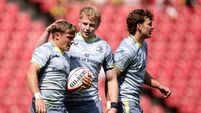
2006 Final? The one that got away
VISITORS to Biarritz’s Stade Aguilera complex this weekend in the wealthy seaside town will notice the name of the club written on the side of the stand in big letters – Biarritz Olympique Pays Basque. Nothing unusual in that but in the town of Biarritz the name has added connotations that reflect the history of this proud club.
Several years ago however, the night before a vital Top 14 derby match against neighbours Bayonne, several Bayonne supporters, in an act of what could only be described as drunken antics, stole the letter ‘y’ from ‘pays’ leaving the signage reading out ‘Pas Basque’ or ‘Not Basque’.
It didn’t, as you might imagine, go down well. Biarritz has always been a proud Basque club yet that has often been hotly contested by its neighbours, whose Jean Dauger ground is located a matter of kilometres from Aguilera.
Rugby came to Biarritz and Bayonne in the early years of the 20th century, thanks to the wine trade with Britain and with the two towns just a few kilometres apart, the rivalry soon became bitter. Then came a golden period during the inter-war years when both clubs dominated the French rugby landscape, with Biarritz winning its first French titles in 1935 and 1939.
There followed a lull of more than 60 years before they won again in 2002. By then, all had utterly changed; the amateur game and the club’s greatest player Serge Blanco had come and gone, without ever winning a title. In fact, the noughties remain the club’s most cherished period with three titles won in five years. In 2006, their high-water mark, they won the French Championship once more and of course made it to that fateful Heineken final in Cardiff that no Munster supporter will ever forget. There are many in Biarritz who still see that game as one that got away because since then, the club’s decline as a major force in the French game has been inescapable. Their seventh place this season meant missing the Top 14 playoffs and they go into the semi-final with Munster on Sunday as underdogs from a French media point of view but none of that worries backs coach Jack Isaac too much.
“I don’t attach any importance to it at all,” counters Isaac. “It changes nothing at all and it doesn’t motivate us anymore. What does motivate us is knowing that we’ll be in a Heineken Cup final if we triumph over the 80 minutes.”
Isaac is a former Australian sevens player who played for the Basque side as a centre between 2000 and 2004. He returned there in 2007, this time as a backs coach, having missed out on the latter end of Patrick Lagisquet’s successful reign and would love nothing more than to return the club to its glorious recent past.
“Look, I know the battle is going to be tough on every front,” he stresses. “Munster have centres that are physically very strong, fast wingers, a big backrow, world class second rows, a good scrum and are great at the breakdown. There aren’t many teams with that kind of capability.”
Times have moved on since that fateful day at the Millennium Stadium in 2006. Biarritz have, if truth be told, struggled in recent years and this weekend’s semi final represents a new opportunity for the club to finally announce their arrival at the European top table. Yet beyond that, Europe also holds out the promise of helping the club transform from small-towners to a provincial giant, all based around that ‘Pay Basque’ part of the name. To do that, more games in Anoeta are needed to grow the fan base, the Basque brand and most importantly, the turnover.
“In Europe, everything changes and the team transforms,” says Serge Blanco, who became president of Biarritz last year, thus returning to the club of his playing days. “It’s like the team shows a different face. I’ve no doubt that the semi-final will be a magnificent occasion.”
Hence the club’s decision to take their 2005 quarter-final against Munster to San Sebastian, the first occasion it had been tried. The idea of a regional Basque identity being built around the club went hand in hand with tapping into new, lucrative revenue streams derived from relocating the game to Estadio Anoeta in the non-rugby playing Basque country of northern Spain. This year saw four games moved down south yet there have been few real signs of reciprocal movement north to Aguilera from the new generation of supporters. Indeed, for many inhabitants on the Spanish side of the border, Biarritz will forever remain a French side posturing in pan-Basque clothing, complete with beret and red scarf, following a game that continues to have limited impact on the Iberian Peninsula.
Still, Biarritz continue to move forward as best they can and with the influential Blanco back at the helm, the club is attempting to put a structure in place which will safeguard its future. Much work has been put into the development of the academy at Aguilera, something that already seems to be paying dividends. Speaking to the Sud Ouest newspaper, the former full-back was philosophical about the season and the problems they’ve encountered.
“We had problems at the beginning of the season and the series of injuries that we suffered. When those players came back, we played some good matches. But the team has rarely been at full strength. But that’s rugby.
What Blanco and Isaac both understand is that in the hard world of professional rugby, only results count. It remains to be seen if they can steer their team to the Promised Land.

CONNECT WITH US TODAY



Be the first to know the latest news and updates