Our cups Overflowth
These characteristics are no longer the sole preserve of Munster. In a pulsating Heineken Cup final, Leinster answered all the questions posed of them in the build up to this game with an emphatic second-half fightback that now sees every trophy on offer in northern hemisphere rugby in Irish hands.
There was a perfect symmetry to this contest as Leinster completed their journey to European glory on the ground where it all started last October with a bonus point win against their tournament bogey side, Edinburgh, all be it in different circumstances in front of a meagre audience of 5,372 patrons.
Then again in the context of Irish rugby a lot of ghosts have been laid to rest these last few months. On this occasion an audience of 66,503 – the vast majority it must be said flag bearing; blue clad Leinster supporters – witnessed a fascinating encounter. Finals, including this one, are seldom classic affairs but there was a pulsating intensity to this one that captivated even the neutrals right to the final whistle.
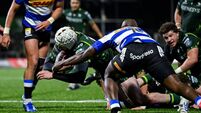
This was a victory fashioned in adversity as Leinster, after dominating proceedings for the opening 30 minutes, were left with heads bowed as they retired at half time. Leicester, playing their fourth successive high octane game in as many weeks, looked dazzled and bewildered on the half-hour mark after a composed and confident opening by Leinster. The sight of four of the Tigers pack bent over with hands on hips after twenty minutes suggested a game too far.
Yet with the smell of blood in the nostrils when Stan Wright suffered a temporary brain freeze and tackled Sam Vesty without the ball (resulting in a yellow card), Leicester went for the kill, scoring 13 unanswered points while the Cook Islander warmed the bench. All of a sudden it was the Tigers who were sprinting to the dressing room with a four point lead that their first-half performance hardly merited. The worry for Leinster was that to beat Leicester you must maximise your points return when in the ascendancy. While they did manage to achieve a margin of six points at one stage it was hardly reflective of their total dominance. Leicester knew that too.
Ask any English based player how to beat the Tigers and he will tell you that you have to match them in the physical exchanges, you do not allow them to build a lead of any consequence, you must be ahead at the break and you do not concede silly penalties. Leinster still managed to win despite being guilty of three of those errors.
Over the years Leinster’s much maligned front five have had to live in the shadow of some of the most gifted backs this country has produced. However, on the day it mattered most, it was the set piece accuracy of Leo Cullen’s pack that laid the platform for this famous triumph. Their scrum, an obvious target for Leicester throughout, was rock solid and provided the perfect launch pad for Jamie Heaslip to showcase his talents.
In addition the lineout was a revelation with Leinster not only winning their own ball with ease but also managing to either disrupt or pilfer several of the Tigers throws in the first half. That doesn’t happen too often. The introduction of Louis Deacon with Tom Croft moving to the back row when Jordan Crane was forced off injured rescued Leicester in this phase to some degree.
The fact that Leinster prevailed in this decider without the considerable presence of both CJ Van Der Linde and Felipe Contepomi will stand to Michael Cheika’s side, and, by extension, Ireland in the long run. The performance of their respective replacements, Cian Healy and Jonathan Sexton, played a major part in keeping the Heineken Cup in Ireland for the third time in four seasons.
There was considerable pressure on the young shoulders of Sexton. But his performance bore all the hallmarks of a star of the future. His tactical kicking was far superior to his opposite number Vesty while his game management was also spot on. A drop goal from all of 50 metres was truly inspirational while his winning penalty goal with 10 minutes left on the clock was the stuff of dreams.
Nine years ago Ronan O’Gara, in the early stages of an outstanding career, stood over a similar kick to push Munster ahead in similar circumstances in their first Heineken Cup final appearance against Northampton. It shaved the post. Sexton went one better on a day that he finally confirmed his credentials as a contender for O’Gara’s No 10 shirt on the international stage.
Up front Healy served notice that he is also ready to throw down the gauntlet to Marcus Horan with a spectacular performance against the might of both Martin Castrogiovanni and Julian White. It is hard to believe that this guy is still only 21 years of age. With careful management he will become the cornerstone of Irish packs for a generation to come.
While two of the foreign contingent were surplus to requirements due to injury it is doubtful if Leinster would have lifted this prize without the indomitable presence of Rocky Elsom. When Leinster were vulnerable after conceding a hat-full of points with Wright in the bin, the Wallaby colossus grabbed the game by the scruff of the neck and literally carried Leinster forward. For a player who has spent less than nine months in the capital city he played with a fanaticism and commitment that would suggest that he had lived beneath the spire in O’Connell Street all his life. There is something inspirational and gratifying about the honesty of rugby that a foreign import can buy into a cause with such selfless passion. Indeed the same can be said for the contributions of the New Zealand triumvirate in Munster’s success last season.
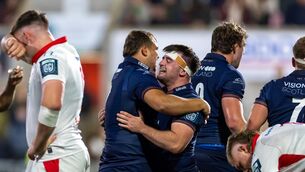
Only six months ago, perhaps with the realisation that time is not on his side, Brian O’Driscoll expressed his frustration that the tangible rewards which define a successful career had eluded him. He has been a man on a mission all season and hunted the medals to match personal achievement. His cabinet is now full. The smile on his face as he collected his Heineken Cup medal said it all from a personal and team perspective.
Toulouse, Wasps, Munster and Leicester have long been considered the powerhouses of European rugby based on their achievements in this wonderful competition. In a season where Leinster beat the latter three on the road to destiny nobody can argue with their arrival at the top table.
Mission accomplished.
O’Driscoll has been a man on a mission all season and hunted the medals to match personal achievement. His cabinet is now full. The smile on his face said it all from a personal and team perspective.