Read it & keep
FROM an Irish sporting viewpoint the year 1884 carries with it huge connotations. In Thurles, Tipperary, that was the year the GAA was founded, the biggest and most influential sporting organisation in this country, by far.
1884 was also a big deal in New Zealand sport, however; on May 22, in a game against a Wellington XV, a man called James Allen became All-Black number one, and is now officially recognised in New Zealand rugby as such.
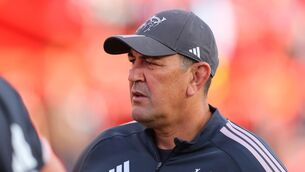
Last Saturday week in Edinburgh Kieran Read became the latest in a line that now stretches back through over 1,080 All-Blacks; in a sports mad country where rugby is as much a religion as are gaelic football and hurling in Ireland, that is a fantastic achievement, appreciated as such by the man himself.
“There’s so much talent — the Air New Zealand Cup (equivalent to the All-Ireland championship in GAA) is at such a level now, very high. The All-Blacks (internationals) don’t play in the earlier rounds so you get a lot of younger guys, very talented, heaps of talent. There are players at B grade who could be doing it for a living, but it’s really tough to make it to the next level.”
That isn’t just national bias from Kieran; in Ireland, in Munster especially, the truth of that statement is known. Winger Doug Howlett is an All-Black legend, all-time leading try-scorer, and he is continuing that form for Munster, but the likes of Mafi and Tipoki, currently forming a magnificent centre pairing, never made the All-Blacks, while Leinster fans still have a soft spot for Kiwi out-half David Holwell, another who never made that final All-Black breakthrough. Below those, layer after layer of hugely talented players, in every position, all of whom have the dream — wear that jersey, the most famous shirt in world rugby.
Read was no different. Growing up in Papakura, just south of Auckland way up in the north island, rugby and cricket were the sports he played in his back garden, and he excelled at both. A fine top-of-the-order batsman, initially it seemed that cricket would be his calling, and along with current Kiwi international star Daniel Flynn he made all the local underage representative sides, up to and including the national team. Rugby? Though he had the build for the game (he’s now a rock solid 6’4”, 16st 7lbs), he didn’t see this one coming, but on October 26, his 23rd birthday, he got a present — he was on the tour squad. Then last Saturday, heaven itself — his All-Black debut, and as a starter to boot.
“I moved to Canterbury from Counties Manukau, my local team, which at that time was in the second division, and it kind of took off for me from there. I was in the Academy, the next year I made the Canterbury side, the next year I was in the Super-14 with Crusaders; now, to make the All-Blacks at 23 — pretty awesome.”
He’s a back row, is Kieran, currently operates on the blindside, but has also played at seven and eight. So highly rated is he that in the season just past he was named as captain of Canterbury, a side that includes All-Black captain Richie McCaw, on the other side of the scrum. So how the hell did that happen? And how does it feel, as a youngster still cutting his teeth in the pro game, to be in a position of bossing possibly the greatest all-round player in world rugby, certainly the best forward? Or does he, in fact, have the cheek to exert any of that captain’s authority? From the grin that greets the question, the answer is already obvious. “No, definitely not! When we started the season the All-Blacks weren’t there, and we had a few injuries also, so I was lucky enough to be chosen as captain. When they came back I was kept on in that position, keep the consistency I suppose, but there isn’t much involved in captaining a side with Richie McCaw in it! Obviously he’s a great captain of the All-Blacks, and when he came back he gave me a lot of advice, helped me out.”
Nevertheless it was a singular honour, a pointer towards why he has not made the breakthrough with the All-Blacks. “It was a great honour, following in the footsteps of Richie, Reuben Thorne, Todd Blackadder — to be in that company is a great honour, and to get the win then, the Air New Zealand championship, that was special.” Ah yes, the win — an end of season end-to-end thriller, finished 7-6 in favour of Canterbury, poor old Wellington denied yet again. Defence was the signature element of Canterbury’s game plan all season, Kieran Read a central plank in that. So what gives him greater pleasure, the big hit or the big carry, defence or attack? “That’s a tough one. If everyone is doing their job and the backs score in the corner, that’s immensely satisfying, but if your defence holds up for an entire game, as happened in that final, that’s pretty good too, shows great character. I suppose if you win turnover ball in defence and a try is then scored off that, that’s the most satisfying of all, defence turned into attack in one move!”
None better at that, then, than the aforementioned McCaw. But how does he do it? He’s not a big man, the All-Black captain, not particularly tall, not particularly heavy for a modern back row, yet he’s the key to the All-Blacks. With McCaw starting, the All-Blacks haven’t lost since the World Cup, with him sitting out, they lose. What is his secret?
Raw courage, selflessness and fearlessness, says Kieran. “Out on the track he’s going to do everything he can to put himself into position to do the best for the team; somehow he manages to get into good position in the ruck, get over the ball, get on his feet quickly, clean out some people — it’s amazing how he can do that, time after time.” Amazing also how much punishment he’s willing to ship. “Exactly, that’s the thing about him, he’ll take it, but then he’ll beat them to the next ruck again, and do the same thing again. Technically, he’s pretty efficient.”
A little bit of New Zealand understatement, that one.
Kieran has played a bit of seven himself, has won kudos from even the hoary and hardened critics inside New Zealand for his own hard-working no-nonsense style in the back row. If he had his choice where would he pick himself, and what’s the difference anyway?
“At the moment I’d say six, definitely, I’m enjoying it there. Seven is an out-and-out scavenger, he’s a thief, he’s got to get to every ruck, be first to that first contact area; eight is a little similar to that, but he’s got more space, he can float a little bit. The six has to be tighter, do more hard work; he’s usually not involved in the first cleanout, he’s probably organising the blind side, that sort of thing. Sometimes you might be taking the ball up, sometimes a cleaner, but a six should be around the ruck, doing the dirty work. I enjoy doing that stuff, I enjoy tackling, also you do get to carry the ball a bit, open up at times.”
He’s got the attitude, has Kieran Read, and he’s also got the ability. Mind you, there’s a marked difference between that shirt nowadays, and the shirt worn by James Allan all those years ago. Back then it was dark blue, at least it was for the first tour to Australia, in 1884, though it did have the fern, but in gold, on the left side of what would have been an ordinary everyday kind of geansai. Today it’s all black, silver fern, and it’s sleek, oh-so-sleek, and it’s even got a title — the ClimaCool, custom designed for rugby by adidas, who paid a whopping $200m for the nine-year contract (they also have the Munster contract, though they probably paid a little less!). You can buy one, of course, and it is cool, fashionably cool, a huge seller for adidas; to earn an All-Black shirt, however, is to be a member of a very exclusive club.
Kieran Read — been there, done that.
Words: Charlie Mulqueen
“I NEVER played in Division One of the All-Ireland League and so haven’t had the pleasure of taking on Shannon in Thomond Park where they were almost unbeatable for years on end. I played my AIL rugby in Divisions Two and Three with UCD and Blackrock College.
“The first time I played in Thomond was around 2001 in a trial game prior to the World Cup. For some reason, chiefly due to injury, I didn’t actually play that many games there although I do remember a few internationals, against Romania, against Italy when Denis Hickie scored four tries and the recent one against Canada.
“I was on the ‘home’ side in those games but I felt it was always a tough place to come when you were the visiting team but that’s only what you would expect. You’d look forward to games like those because you always want to test yourself in those kinds of situations.
“My most recent game there for Leinster was three years ago just before the work on the stadium began. We lost that day, it was Christmas time and there was a big crowd and as always they were very vocal in favour of the red jerseys. But I wouldn’t call the atmosphere hostile and certainly no worse, say, than Toulouse where they always give you a warm welcome.”
“MY first really big rugby game was the Munster Schools Senior Cup on March 17, 1970, at Thomond Park when I played for Rockwell College against Glenstal. Glen had never previously been in the final so it was a huge occasion. They were leading 3-0 two minutes into injury time when we equalised. We won the replay in Thomond handily enough. I scored a try in that game and I remember it as if it were only yesterday.
“My second time playing there was for Munster Schools against Ulster after the final. As a kid in those days, it was a big deal playing at Thomond Park. It was seen as the major stadium by us. As a junior in Rockwell, I’d seen a senior team beaten by St Munchins in 1967 and as a rugby schoolboy, Thomond Park was the kind of Croke Park or Dalymount Park where you were going to play your big games.
“Afterwards, I would have played a lot of matches there for Greystones against Shannon and Bohs and would obviously have played a few interpros for Leinster. My memories are all about being well beaten! I don’t think they allow Leinster teams to be successful down here. It’s part of the tradition.
“It will be interesting to see how the new stadium works out for Munster, whether it will retain the old atmosphere and be as difficult a place as ever to get a result. Something tells me there will be no problem in that regard”.
“IT’S easy for me to say my favourite game at Thomond was against Gloucester. You have to keep coming back to the Gloucester game and not just what happened on the pitch. The most outstanding memory is of going to the dressing room and everybody is euphoric about winning. But the players, of their own accord, went back out to sing to their supporters and it was something that came naturally to them.
“They are wonderful supporters as we all know and it was just one of those memories that will stand with me for a very long time. I don’t think it could happen anywhere else… to sing back to the crowd, Stand Up and Fight, that was just a very special moment.
“I was at the recent game against Glasgow and found it a very impressive stadium. The dressing rooms are slightly different from what they once were… it’s a great result all round. It was a fine venue for the game against Canada and great for them to play at such a place as Thomond and the history that goes with it.
“If you talk to a lot of the Australians who played here during the World Cup, they still have very fond memories of Limerick and Thomond Park but I’d say they’d be awestruck by the way it has been redeveloped.”
“I REMEMBER many, many years ago and I was bagman for the Leinster under 20s. We were playing Munster, I think it was for the championship. The likes of Munch (Shane Byrne), Conor O’Shea and so on were on the Leinster team and Woody, I think, was on the Munster team. Big George Wallace was the chief Leinster selector.
“I went down ahead of everyone else to get everything ready. Our game was to be played before the senior game. About an hour before kickoff, George came into the changing room and said, ‘Rala, there’s something I want you to do for me. Just sit there and do nothing’. Wasn’t the venue after being changed to protect the pitch for the seniors.
“So he picked up everything I had laid out so meticulously in his massive arms and as I protested, he said, ‘didn’t I tell you to sit there and do nothing’. He brought all the stuff out to the car and we were off out to Young Munster and if memory serves me right, it was a 9-9 draw and the championship was shared.
“In my own playing days with Terenure, I played there against Shannon and Bohemians and it was always an awesome place to go to. This is going back to the late 60s and early 70s and for me it was always a privilege to be in that ground because of its rugby history. And this was before ‘78.
“Usually we’d be sent packing but not before we had put away a fine plate of bacon and cabbage. I have great memories of a very special venue. The new stadium where I worked for the first time in the recent game against Canada is just fantastic. The facilities for the players and the dressing rooms are fantastic”.
“A LOT of wet and windy memories. When I was kicking coach with Munster, obviously the games that stand out for me are the wins over Gloucester and Sale. It’s a great venue and the support the players get there is second to none. You’d wonder if those results could have been achieved anywhere else. Personally, I doubt it.
“I know that keeping the unique atmosphere of the place was a concern for those rebuilding the stadium and they have done very well in that regard. We were there for the Glasgow game and there was a decent sized crowd and they really got behind the Munster team and it was much the same for the match against Canada although once again the weather was awful.
“If you stand on the terraces around the pitch, you’re going to get the odd supporter throwing a few dodgy remarks but that’s all part of the banter and fun of Thomond Park and I think that’s going to continue for as long as rugby is played there.
“Keeping the terraces was definitely the right thing to do. There will be a core of fans who follow Munster who want to stand to do their thing.
“Wind invariably plays a major part in kicking. Compared with Lansdowne Road or Croke Park, Thomond is more of a direct wind. You tend to get it coming from one end or the other.
“When you look at Lansdowne, flags could be going from left to right at one end and right to left at the other so it’s a very peculiar place to kick. At Croke Park, one end is completely enclosed and that makes for problems as well.
“I’ve always enjoyed coaching at Thomond Park and enjoyed watching teams play there. Ask any kicker, they will always prefer to kick into the wind, you won’t get your distance but you’ll get a true kick”.