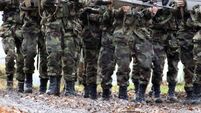
Pumas poised to get Euro presence
It’s been a long-held dream for the Pumas, famous for their giant-killing exploits, to get a full crack at regular international competition.
Today at Croke Park they’re seeking another victory over Ireland, but this European trip involves business off the field too; it started, and will possibly finish, with a series of meetings geared to having an Argentinean/Spanish presence in one of the two top European club rugby tournaments.
Ricardo Garcia Fernandez is chairman of the newly formed professional arm of the Union Argentina De Rugby. He speaks positively about the future of Argentinean rugby and that includes participation in the Magners League, with a base in Spain from where the UAR can also recruit. The Spanish rugby federation support such a move.
He has been involved in serious negotiations with the Magners League representatives during the last couple of days.
The UAR is looking seriously at the possibility of being included in an expanded Tri Nations, after the 2011 World Cup in New Zealand, and possibly at participation in a re-vamped Super 14, a tournament that would involve an expansion to 20 teams, broken into two groups of 10.
But Argentina has not ignored the huge number of its top internationals based in the northern hemisphere with French, British and Irish clubs. It would be a contractual nightmare and financially unsustainable to extricate those players from such lucrative contracts at a time when the UAR is only just becoming involved in the professional game.
Fernandez accepts it probably would never work to participate in professional rugby at any level below international in the southern hemisphere. “Not when most of our top players are in Europe,” he said.
He is delighted, though, that discussions are ongoing since Argentina’s spectacular showing in the last World Cup.
“We have made a lot of progress; we concentrated on making all the efforts needed to get into the major tournaments around the world. We came together with the IRB and SANZAR to make steps to be ready for inclusion, for instance, in the Tri Nations at some time in the future.
“Discussions have progressed; we had to prove that we have taken steps to get changes in the structure of government (of the union) before they could take place. We have been involved in feasibility studies related to entry into the Tri-Nations and perhaps for every other tournament; we’re thankful that the IRB are taking this case seriously because we need to progress the game in Argentina.
There are High Performance centres in Argentina, and a professional rugby board has been established. Those immersed in the amateur game, who were slow to accept a new world order have been re-educated, not by dictat, but by example.
“The World Cup probably changed everything,” said Fernandez. “There has been a huge surge in interest, player numbers have increased to maybe 100,000, up by 20%. We had to make sure that this new interest from young people would be protected.
“The game as it is will be protected; the amateur state is important because our players come through the clubs and the finance to make it professional isn’t there. We have many, many thousands of people, who give time and effort unselfishly to develop the game at home. We must keep those good things.”
Isolation (in rugby terms) brings its own problems, but it can be used to advantage. Fernandez doesn’t even have to point to results to prove a point.
“At club level, the clubs and volunteers have a great sense of value. That is passed onto the players even when they move outside the country. We cannot sustain a professional game at home, so we must take advantage of doing best for the country and doing best for the players that are based abroad.
“This is what we are trying to do right now. Argentina is a big factory of good players, an efficient system; that’s up to the age of 18 but then there is a problem.
“We encounter physical problems (such as) during the junior World Cup, our players could not compete physically either there or in the Churchill Cup against the likes of Ireland, because they did not have the benefit of professional training.”
Proud Argentinean that he is, he might well sacrifice victory in today’s Croke Park battle if his beloved Pumas win the war — full and total IRB recognition to allow this nation develop as he believes it should.
CONNECT WITH US TODAY



Be the first to know the latest news and updates