Muddy marvels sitting pretty
Leinster stuttered to their anticipated win over Edinburgh on Friday night but once again will have reason to feel disappointed with their inability to secure the four-try bonus point. It could well prove their undoing when this pool is decided next month. Connacht also recorded a remarkable win over a star-studded Newcastle side in the Challenge Cup.
The performance of the weekend, however, from an Irish perspective was undoubtedly Munster’s outstanding win at Stradey Park, their first at that venue for five years. No sooner had Munster’s plane touched down in Cardiff on Friday afternoon than word filtered through that Stephen Jones had been forced to cry off with a neck injury. Given how much of the Scarlets game-plan is channelled through the Lions out-half, the odds immediately shifted to Ronan O’Gara’s men.
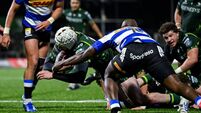
For the second week in-a-row, Munster faced monsoon-like conditions which forced referee Wayne Barnes to contemplate abandoning the contest at one stage. With only 55 minutes on the clock that would have been a disaster for Munster as, under the rules of the competition, 60 minutes must be played for the result to stand.
In adversity, Munster rose to the challenge especially in that last quarter and adapted far better to the conditions than Llanelli as their experience and intelligence came to the fore.
Munster’s quality in the second half was exemplified by a sequence of superlative drives in the closing 10 minutes, producing an astonishing 32 phase cycle. It was rugby’s equivalent of possession football with no Llanelli player touching the ball for a full five minutes. This was forward play at its very best, a treat for purists of the game.
The orchestrator-in-chief was the returning Anthony Foley who produced another exceptional performance on the European stage. His leadership and direction contributed to as good a display from this Munster pack as we have seen in a long time. Foley’s presence was the catalyst for vintage displays from his back row colleagues, Denis Leamy and David Wallace. On a day when solid foundations were essential, Munster’s line-out was again extremely functional — apart from a few loose taps early on — and was used on numerous occasions to set in motion an effective maul that showed a major improvement from the Leinster game. Given the farcical conditions, the throwing of both Jerry Flannery and Frankie Sheahan, who made a huge impact on his introduction, was a credit to both players, as was the aerial skills of Donncha O’Callaghan and Mick O’Driscoll.
Playing with the aid of the elements in the opening half, Munster set about their task in a controlled fashion, with O’Gara orchestrating everything and contributing 17 points with an unblemished return of six from six kicks at goal before half-time.
Munster’s try in the opening half was the product of experience and a little good fortune. Coming when it did, three minutes before the break, it struck a huge psychological blow.
After a massive kick from the highly impressive Shaun Payne, rookie out-half Rhys Priestland cleared to touch yards from his own line. Despite the fact that the ball struck a Munster supporter, Peter Stringer, sharp as ever, took a quick throw to Wallace who waltzed in unopposed. Given the ball hit a third party, the throw should not have been allowed. Stringer was also a yard infield taking the throw but got away with it.
To finish the half with a 12 point lead was a huge fillip as Llanelli’s high tempo off-loading game had caused Munster severe problems at times. Munster also recovered from the sin-binning of Lifeimi Mafi, who showed remarkable pace in hunting down Dwayne Peel, no slouch himself, to save a certain try.
Referee Barnes, under pressure from the highly vocal home support, binned Mafi for preventing Peel from releasing the ball. It was a tight call. Llanelli proceeded to score 10 points in Mafi’s absence, an advantage which Wallace’s try helped negate.
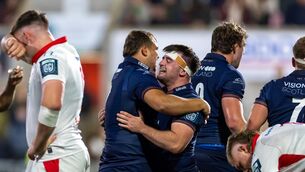
Playing against a gale and torrential rain in the second half, Munster showed remarkable guile and adapted their game plan accordingly. The maul was back in business producing 20 metre drives at times that left Llanelli powerless to respond, none better than the one that produced the match clinching try for Marcus Horan with seven minutes left.
Munster’s patience in the build-up was striking and bore the hallmark of a team brimming with confidence. Having survived a mini revival from the Scarlets which reduced the gap to 22-16, lesser teams would have panicked.
Munster simply rolled up the sleeved and produced an exhibition of forward play not seen in the valleys of west Wales since the Pontypool front row were in their prime. As ever, Munster were clinical, scoring seven points when Deacon Manu was in the bin, matching the 10 points they registered while Mark Jones was similarly indisposed.
No praise is high enough for each and every member of this Munster side from John Hayes and Horan up front to the back three of Payne, Ian Dowling and Brian Carney. This victory was up there with some of the very best in recent years.
As a result Llanelli are now out of the competition with Thomond Park looming next Sunday. The other major plus was Clermont Auvergne’s defeat of Wasps and the fact that neither side achieved a bonus point, an amazing stroke of good fortune in itself given that Wasps had three tries on board with 30 minutes remaining.
Munster now sit pretty on top of the most challenging pool in the tournaments history with ten points at the halfway mark. Under the circumstances, one really couldn’t ask for much more.