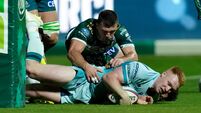
Clubs battling to lift ailing League
The All-Ireland League has been ailing ever since the advent of professionalism just over a decade ago with the provincial teams, and subsequently their academies, relegating the clubs to the third and then fourth rung of the game’s ladder.
Two years ago the IRFU’s suggestion that the clubs revert to a provincial structure was shot down and the same fate awaited a plan to streamline the top division from 16 to as little as eight or 10 clubs last May.
Therefore, while everyone agrees that the discredited system of three 16-team divisions isn’t the answer, that is exactly the structure in place for the forthcoming season.
Other oddities remain, such as the fact that teams can win the Division Two and Three titles without actually being promoted if they finish the league phase inside the top four but outside the top two.
“I don’t know what the answer is to the club set-up,” said Paul Neville, captain of last year’s Division One champions Garryowen. “Maybe if it was broken into two (groups) and then the top two go through to two semi-finals. It doesn’t make sense as it is. If you finish the league top you are deserving winners.”
Whatever the answer, Neville agrees that clubs are playing far too many games and that the quantity is stifling the quality.
“We have the AIB Cup now, which has a lot of teams in it, as well as the Munster Senior Cup and AIB League. You can count on one hand how many free weekends you will have during the year.
“That’s a huge burden. You are trying to run a first, second and third team in Garryowen, an U-20 side as well. It’s hard to fill a 15 every week. Adopting a two (group) system would make it that bit easier.”
Neil Megannety will line out with Greystones in Division One this year after experiencing life in the lower two divisions in recent years and he sees plusses and minuses in the argument to downsize the top tier.
“If you create that 10-team system, it would be a good stepping stone for players looking to move up to that professional level but it would also create an elite division which would make it harder for other teams to get up to that level.”
With crowds deserting the club venues in favour of Thomond Park, the RDS, Ravenhill and the Sportsground, finance is a daily worry for the AIL sides, especially those at the lower end of the spectrum.
Cathal O’Regan is captain of a Bruff side that won the Division Three final last May but still finds itself playing in the third tier this season having finished the league stage in third.
They start their season away to City of Derry on Saturday, a game that will require a seven-hour coach journey and an overnight stay before returning home in the small hours of Sunday morning.
“Finance is definitely a problem. We’re travelling to Derry on Friday for Saturday’s game and that is costly,” said the Cork-based Garda. “There is no doubt but that the structures will have to be looked at.
“The club scene has definitely suffered. The standard isn’t up to what it should be. There was a suggestion of dividing the country in half and that would cut out a lot of the travelling and the costs associated with that.”
The same could be said for every division. With the top players effectively ring-fenced by their provincial and national contracts, the league no longer has use of marquee names.
“The standard in the first division is generally good,” said Neville. “You have development and Academy players coming back to play with their club sides. But we don’t have the full-time guys.”
Ireland’s failure at the Rugby World Cup has prompted a root and branch re-examination of a system that had been applauded for producing Heineken Cups, Celtic League titles and Triple Crowns.
One suggestion has been to switch the rugby calendar to a summer setting with the argument being that it would improve the players’ skills base.
“It would make sense,” says Neville, “It would be nicer to watch as well. If you had younger guys coming in playing in drier conditions they’d go on to play better rugby.”


CONNECT WITH US TODAY



Be the first to know the latest news and updates