Controversy taints crowning
The connotations associated with these words seem to be following Ireland around.
Having been labelled chokers by BBC analyst Brian Moore after the last minute defeat to France, coach Eddie O’Sullivan followed up on Saturday by claiming that an unnamed and apparently unidentifiable Scot had attempted to choke Ronan O’Gara at the end of Saturday’s game at Murrayfield.
O’Sullivan put his neck on the block and ensured front page news for himself with his allegation, especially as he had to acknowledge there was no video evidence to support his claim.
While O’Sullivan would now prefer to draw a line under the entire affair, he didn’t withdraw or dilute his remarks in any way yesterday.
He repeated that “a Scottish player had Ronan by the throat at the bottom of a ruck and he lost consciousness.”
It is all a little bizarre given that the main talking point since the 19-18 victory has been O’Sullivan’s sensational allegations rather than the fact that Ireland have captured the Triple Crown for the third time in four years.
It was far from an authoritative performance but in reality the team’s ambitions of replicating their Croke Park form against England a fortnight earlier were never going to be realised.
That was a once-off situation and all the more memorable and exciting for that.
This time, Ireland were fortunate to depart with a win which now gives them every chance of landing the Championship in Rome after yesterday’s dramatic 26-18 victory for England over France.
There was little sign of exultation at the end of the game. Brian O’Driscoll barely showed the silver salver to the Irish support.
There were reasons for this, not least because the inevitable reaction to a single point victory and a stuttering performance is essentially one more of relief more than anything else.
Furthermore, Dave Pearson’s final whistle sounded with O’Gara prostrate on the ground, and several team-mates — especially John Hayes who had the presence of mind to turn him into the recovery position — seriously concerned for his welfare.
In making his comments, O’Sullivan was cool and deliberate, as he claimed “it couldn’t have happened by accident.”
His words elicited a furious response from the opposing management, refuting “any allegations of foul play at the end of the game.”
What happens next? The Scots are in indignant denial and the other Irish players claim to have seen nothing. What is an undisputed fact, though, is that O’Gara was blue in the face and losing consciousness for a short period so he was obviously the victim of an assault, whether by design or otherwise.
Thankfully, he was feeling fine after changing and showering. His place against Italy on Saturday next shouldn’t be in doubt.
In time to come, this team will be recalled for what it has done in the last four years but for now there’s the sober reality that Croke Park and England are history and that every win in this championship has to be worked for, especially against tenacious opponents like Scotland at Murrayfield and with a point to make after the defeat against Italy.
The Azzurri may have had luck on their side on Saturday but the power of their forwards was once again apparent. There’s another serious battle looming on the horizon.
“The most disappointing thing,” sighed Scottish coach Frank Hadden, “is that the second best team in the world were there for the taking and we didn’t play well enough to beat them.”
“Had we finished in front at the end, we would have accepted it but would still have been disappointed with the performance.”
Hadden was being a little harsh on his team, most especially when he spoke of how disappointed he was with their defence.
The facts are, of course, that Ireland managed only one try and that came directly from a mistake by out-half Dan Parks whose line kicking was otherwise superb.
With players like Brian O’Driscoll, Gordon D’Arcy and Shane Horgan in world-class form, they might well have been overrun. Instead, they stacked up big time and while O’Driscoll did make two magnificent line breaks and D’Arcy was constantly a thorn in their side, they still did enough to keep both Irishmen at bay.
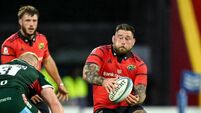
Not for the first time, Ronan O’Gara was Ireland’s saviour, demonstrating his footballing nous when creating and finishing off the game’s only try. He scored all of Ireland’s nineteen points to bring his international points tally to 705 and his try count to twelve.
With due respect to Denis Hickie, who did pull off one magnificent, try saving tackle on Chris Paterson, O’Gara would have been my man of the match followed by O’Driscoll and D’Arcy among the backs and Paul O’Connell and Denis Leamy up front.
It is great to see O’Connell back to his awesome best. His colossal strength and work rate have rarely been seen to better effect on the kind of day when honest effort was an imperative. One of the highlights was a crucial turnover tackle at a time when Ireland were hanging on for dear life.
These were the positives. There were negatives too, like how they were outscored 3-0 when the Scots had Nathan Hines in the sin bin. And O’Sullivan also admitted to something like dismay at his side conceding six penalty chances in their own half to a place kicker of Paterson’s calibre. He put them all over which means that he now has a 100 per cent record from his last 20 goal kicks in international rugby.
“This was far from the emotion of Twickenham last year” O’Driscoll acknowledged. “It’s a very different dressing room from that day and the day in Croke Park.”
Perfectly understandable, too, as was D’Arcy’s reaction that “we got out of jail. It was a game more of character than performance but remember, good teams win when they play badly.”
Maybe so, but considering the momentum Italy have built up over the past few matches, it will take more than was apparent in the Irish performance at Murrayfield to clinch that fourth win of the championship.