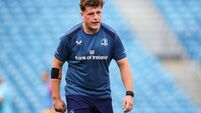
The Wallabies’ sterling perfomer
If there’s one player aside from Matt Giteau that Ireland coach Eddie O’Sullivan would like on his team, it’s Mortlock, one of the top three outside centres in world rugby.
“A lot of good things happen around him,” said O’Sullivan this week.
“He’s a very good footballer and a strong man. I’ve always admired him.”
People seem to forget what Mortlock has achieved in 51 tests for Australia: he’s scored 24 tries and, unlike Ireland’s star centre Brian O’Driscoll, Mortlock can kick well, as his 332 test points to date testify.
Tomorrow Mortlock captains the Wallabies and starts for the first time at inside centre, partnering Lote Tuqiri in what the Australian press term “a monster midfield” — both are over six foot and weigh more than 100 kilos.
Off the field Mortlock is quiet and unassuming, almost whispering into the tape recorder, but on the paddock he makes his mark. One of his more famous scores came against the All Blacks in the 2003 World Cup semi-final, where his 80-metre intercept try was a lasting memory of the tournament. Three years earlier, in his debut season, he converted a last-second touchline penalty to clinch the 2000 Tri Nations title for Australia against South Africa in Durban.
Although Mortlock had minor knee surgery in September, against Italy last weekend he still scampered over for the match winning try. Is he annoyed at not getting due recognition as being on a par with the likes of Brian O’Driscoll and Tana Umaga?
“No, not really. The players you name are world class, though Tana is now retired from international rugby. I don’t really think about those things to be honest. That’s for the press to write about.
“But so far I have to admit I’ve had a good innings. But I’m surrounded by some fine Wallaby talent.”
His move to inside centre will be viewed as a risk by John Connolly, but the man behind the move is Australia backs coach Scott Johnson, thought to be unhappy with Matt Rogers’ removal from out-half.
Outside Stephen Larkham tomorrow, Mortlock’s kicking and game-breaking ability will see him assume the role of auxiliary out half.
“The way the game is gone in the modern era, the number on your back does not matter,” says Mortlock.
“The significance is less off phase. You could find yourself anywhere in the ruck now, while our forwards get out there in the backline and play similar to centres these days.
“My move is just a subtle change, but I’m trying to make sure this week that I’m really confident with the defensive change at 12. There are just little variations. I’m at first receiver where we need things to happen.
“That’s something we as a backline try to focus on anyway. The main thing is making sure defensively as a unit 10, 12 and 13 work well together, because we haven’t started as a combination before. I think that, and making sure we’re a cohesive unit in attack as well, is important.”
Australia have a backline as talented as the All Blacks’ and Ireland’s, but the cold northern hemisphere climate isn’t always conducive to their game plan.
“I think as a team we’ve really addressed how we want to play early on in the week, and thus far our progression has been pretty solid, so I’m very hopeful that we’re fully aware of the conditions how we want to play,” he said.
“When I played here in 2002 it was a very wet, windy battle and the match could have gone either way, but in the end Ireland’s ability to play consistent rugby in the wet was the difference. We’ve really taken that on board. In the northern hemisphere, when you’re used to playing teams in these conditions, we’ve got to find answers to their kicking game, their option taking and also take advantage of opportunities that may arise.”
Mortlock is 29 now, club captain at ACT Brumbies since 2004 and the international captaincy sits easily with him. After minor knee surgery in late September, to be lining out against Ireland is a brave call, but he missed last year’s tour to Europe after a season riddled with injuries.
Now he looks close to his best after the summer tests against England (two), Ireland and the Tri-Nations.
“I guess having experienced captaining the Brumbies at Super 12 and Super 14 certainly comes easier and sits on my shoulders a lot easier. When you are captain you can be concerned and tied up with a lot of things and making sure others bear a bit of the responsibility. Hopefully that doesn’t weigh me down and I can concentrate on my game first and foremost.”
His respect for Ireland went up a few notches after watching them demolish South Africa. Now he rates Ireland as a top three side but feels the All Blacks, who beat Australia three times this summer, are well ahead of the pack.
“There’s no doubt they’re number one and I think their emphatic result over France last week proved that. But what’s a really a positive thing for New Zealand rugby is their vast amount of depth, they’ve got two teams at least who could compete and beat the best teams in the world at the moment.
“But Ireland are quality. They’re very good at playing to the conditions and that’s something we as a southern hemisphere team have struggled with of late. As a team we’ve really addressed that and hopefully that won’t be the difference between the teams.
“That being said, Ireland have strike power across the paddock, they’ve got a very solid forward pack, their lineout is fantastic. We’ve got our work cut out for us — there’s no doubt about that.”