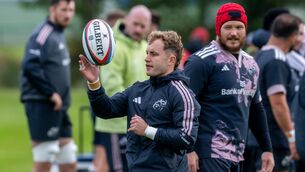
Give the boys in red credit where due
I don’t just mean the fact that they both wear red, that both are champions, or that both have their own loyal and good-humoured red army (Cork fans outnumbered Clare by at least four to one in Thurles on Sunday, a fact which should not be excused by the explanation that Cork’s population is four times that of Clare’s. In the good times, Clare would have filled Thurles all by themselves).
No, there’s more to it than that. For some years now Munster have been damned with faint praise. Half a great team, went the chorus, world-class from 1 to 10, but thereafter, well, watery. Even this year, when they finally won the cup, it was the same song — great pack, pity about the backs.

Look at Cork. What have the scribes been writing for the last three years (and yes, this clown included)? Why, half a great team, outstanding from 1 to 10, but thereafter, well, whatever you’re having yourself. For Munster 1 to 8, read the Cork keeper and his six backs; for the Munster half-back pairing of Stringer and Rog, read the Cork midfield duo of Tom Kenny and Jerry O’Connor, Ben O’Connor getting the one honourable mention in the forward line, at 10.
The rest, Munster and Cork?
Solid, that was all, but under par. Does such an assessment stand up to scrutiny? Let’s look at the evidence.
In rugby, there is a tendency to judge the backs on the number of tries they score, on their attacking abilities, their pace, handling, ability to break the gain line, ability to break down the opposing defence.
In hurling, it’s scores — how many points does each of the forwards score, how many goals? How dangerous are they in possession? Perhaps, however, we need to re-evaluate those terms, or at least, we need to add to them.
There is no doubt that, ball in hand, the current Munster backline doesn’t look as threatening as those of the best club sides in Europe, most lethal of which is Leinster. But you know something? As an attack force they’re not bad. In tries scored, Munster stand comparison with anyone in the group stages in Europe this season when all teams played the same number of matches. They scored 22 tries, matched or bettered only by Toulouse (22), Biarritz (24) and Leinster (28); 186 total points, bettered only by Toulouse (188) and Leinster (214).
Against that, you look at their tries conceded; six, that’s it. Only Perpignan, with five, were meaner in defence. Yet Munster got very little credit for their quarter-final win over the French side.
I realise that many of those tries were scored by the forwards, but rugby is a team game and when you add those two stats together, then it becomes apparent this is a wrongly maligned back division.
The same applies to Cork. I took careful note of the contribution of the forwards last Sunday. Joe Deane we all know about, nine points, man-of-the-match display; Brian Corcoran scored two, was fouled for two more, Timmy McCarthy didn’t figure on the scoreboard, but he worked hard and kept Gerry Quinn fully occupied.
Niall McCarthy scored just one point but he had a hand in at least three others and was very effective.
Two of the Cork sextet came in for a lot of criticism afterwards, even from the Cork supporters, and there can be no arguing that Cian O’Connor and Kieran Murphy never offered a scoring threat at any stage. But they too worked their socks off and never gave up.
Question: in the modern game, which is more important in your forwards (in hurling and gaelic football), and in your backs (in rugby), that they be lethal with ball in hand, or that they defend like demons when the opposition has the ball? We all know the ideal, that they be lethal and demonic, both sides of the ball, but if you don’t have six scoring forwards in hurling, if you don’t have five Brian O’Driscolls in rugby, which is the more important attribute?
How much of the Munster success is down to the fact that, defensively, their backline is well-nigh impregnable?
How much of Cork’s success is down to the fact that their defence starts in the full-forward line?
I would still argue that Cork are not starting their best six up front (Neil Ronan and Kieran Murphy of Erin’s Own surely deserve a real chance at this stage). No-one can argue with the effort of those who are there, however. Like their rugby brethren in red, it’s about honesty, commitment, effort; it’s about the team. Maybe it’s time we gave credit where it’s due.