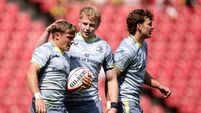
O’Sullivan’s men meet great expectations
Ireland travelled to Murrayfield with the year 1985 ringing in their ears. We knew Scotland would come out with all guns blazing but to almost score from the kick-off was too much. The video referee was right and a possible try was disallowed for a knock-on.
Ireland recovered well. The key to Murrayfield is the first 20 minutes. Ireland won that period 30 and, given the history of the fixture, that was important. More significantly, they also controlled the set pieces and were content to play for field position.
Having successfully negotiated the opening quarter, Ireland began to attack with ball in hand. It was a period when Brian O'Driscoll came into his own. He is a phenomenal talent and was responsible for setting up Ireland's first try, scored by Denis Hickie. The threat posed by the Ireland backs began to worry Scotland. In an effort to counter this, they elected to push up quickly, which resulted in the concession of a number of penalties, which hardly helped their cause.
When Scotland upped the pace they looked dangerous but the difference in the quality of backs was illustrated by the inability of Laney to take advantage of a four-to-two overlap in first-half injury time.
Peter Stringer had earlier saved the day with a trademark tap tackle on Glenn Metcalfe. The portents were good. For once in Murrayfield, the Gods were smiling on us.
The second half saw Scotland competing more aggressively in the lineout and beginning to take the initiative. In any game, regardless of the opposition, there are times when you have to absorb the pressure. The most significant improvement in Ireland's play since last season's Six Nations has come in their defensive organisation. After decisive away defeats to France and England, Ireland's defensive system came under severe criticism. However, yesterday we saw the impact of defence coach Mike Ford's work. The Irish defence held solid for a six-minute period of constant attacking. It is easy to panic when forced to defend seven yards from your line. It is a measure of the increasing maturity in this side that when called on, all held their heads.
They were assisted by the lack of pace and handling skills of the Scottish backs. Their best ball handlers were two forwards, Tom Smith and Simon Taylor. Having absorbed a period of pressure, the game was put to bed when Geordan Murphy forced a turnover and showed his pace in scoring a 70-yard breakaway try. Ireland's winning margin of 30 points could yet be decisive when the championship placing is sorted out.
While there are plenty areas for Ireland to work on, this performance was very positive. The scrum was a revelation and constantly put Scotland on the back foot. Reggie Corrigan had his most productive international. After losing out to Scott Murray on the last few occasions, Malcolm O'Kelly reigned supreme in the lineout. Keith Gleeson continues to make a big impact on international rugby and his work at the breakdown caused Scotland untold damage.
From Scotland's point of view, debutants Gordon Ross and Bruce Douglas failed to step up the intensity of Six Nations rugby. That will come as a major disappointment to Ian McGeechan. While their forwards are reasonably competitive, their backs are too one-paced and even Gregor Townsend failed to make any impact when introduced.
Meanwhile, at Twickenham, England maintained an unbeaten record that has stretched to 19 games. Their defeat of champions France has set them up for the title and another serious tilt at the Grand Slam. While the game wasn't a classic, there was no question England were the better side.
They were more patient and their greater experience was crucial. At half-time France were well in the game. In terms of territory and possession they had the edge in the first-half but found themselves five points adrift. England's defence was magnificent. Their discipline in this area is phenomenal and frustrating to play against.
They are the only side in international rugby that can influence the game without the ball.
The key moment was Jason Robinson's try 10 minutes into the second half. In truth, with 30 minutes to play, France were naive. With a 10-point gap, they forced the game from deep in their own half, which suited England perfectly. I was surprised Galthie, a catalyst for the French at scrum half and captain, had so little influence. This was mainly down to England's ability to get hands on the ball and slow the game at rucks. In this respect, Neil Back was at his best. He was responsible for a huge number of turnovers. The French back three of Rougerie, Clerc and Poitrenard are superb individual athletes but lack collective experience at this level. The 20-year-old full-back could find Lansdowne Road to be a lonely place.
After experiencing first hand the 'doom and gloom' that exists in Wales when visiting Cardiff for the Celtic League final, my prediction of an Italian victory proved correct. The quality of the rugby left a lot to be desired but one must congratulate the Italians. The installation of John Kirwan as coach has led to a more expansive game. They were rewarded with three tries. However, to threaten any other side in the championship, they will have to sort out their defence, which was poor at times. Having recorded only their second ever win in the Six Nations, they will look forward to a home game against Ireland in a positive frame of mind.
For Wales, if those in authority were looking for any further evidence a radical overhaul of their structures is required, this was it. They were pathetic. Their set piece was a shambles and their pack is lightweight. On Saturday they face England. God help them.