The Prix De L’Arc de Triomphe: A race that has consistently exceeded the ambitions of its creators
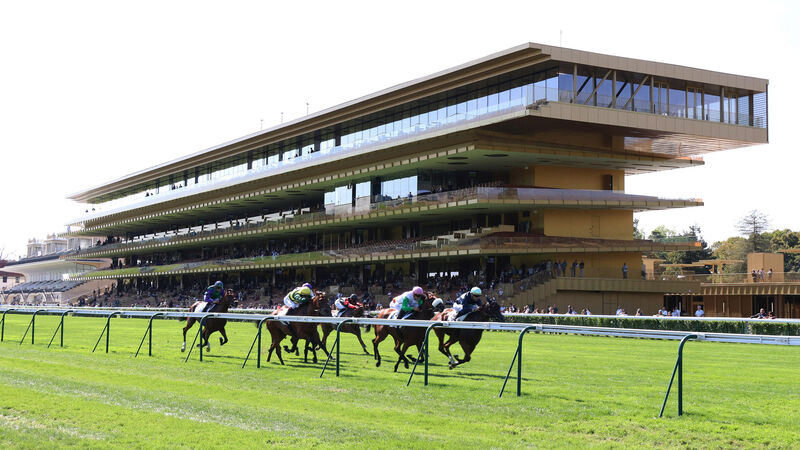
ParisLongchamp — the home of the Prix De L’Arc de Triomphe for all of its 100 year history. The original vision for the race was a level weights, lucrative middle-distance end of season championship that would attract the best horses from every major racing nation. Picture: Healy Racing
It’s another notable week in this decade of historical centenaries. One hundred years ago Michael Collins was on his way to London for the start of negotiations on what would become the Anglo-Irish Treaty and, after some initial unpleasantness, the foundation of a new Free State.
In Paris at about the same time the second running of Europe’s greatest flat race, the Prix De L’Arc de Triomphe took place at Longchamp. Due to the outbreak of another war, the 1939-40 editions were skipped, so tomorrow is the belated 100th running of the race.
Fifteen horses go to post and although there have been larger fields and greater champions, seldom in its noble century has the contest looked quite as deep, as diverse or as distinguished.
The race originated from the rubble of World War One when the French Turf Club (Société d’Encouragement) wanted to revitalise their ravaged thoroughbred industry. Their vision was a level weights, lucrative middle-distance end of season championship framed in a way that might attract the best horses from every major racing nation.
The next problem was to choose a name which would elegantly brand their new race. When victorious allied armies marched splendidly past the Arc De Triomphe in commemoration of Bastille Day in 1919 the light bulb switched on. It would be named in honour of France’s most iconic and recognisable war memorial.
Given the objective of its creators and the provenance of its title, it was appropriate that the first running was won by a horse with a militaristic name who came from outside France.
Comrade, a three-year-old colt trained in Newmarket by Peter Gilpen, had looked so utterly talentless as a yearling that he was sold on for a paltry 25 guineas. Appearances though, as is often the case with horses, proved to deceive. His Arc victory two years later pushed his total career earnings to over £25,000 — about a million in today’s money. A nice return on a small investment by his owner Count de Saint-Alary, a man so passionate about his horses that he had once challenged a journalist to a duel for writing critically of one of them.
History was again made in years two and three of the race with the first double winner who also bore a name linked with the recent war. Ksar also holds the honour of being the only Arc winner eulogised in class literature when he turned up later in an Ernest Hemingway short story.
“This Ksar,” wrote Hemingway, “is a great big yellow horse that looks like just nothing but run. I never saw such a horse. He was being led around the paddocks with his head down and when he went by me, I felt all hollow inside he was so beautiful.”
There have been seven more dual champions since Ksar, a piece of history that won’t change tomorrow as last year’s winner, Sotsass, was retired to stud immediately after the race.
The Arc has consistently exceeded the ambition of its creators, particularly in its ability to attract the best horses from all over the world. There have been winners trained in France, Ireland and England and even Germany has chipped in a couple of times. Their first victory with Star Appeal in 1975 still holds the record as the longest priced winner ever on the Paris-mutual (tote) at 118/1.
Italy too has twice won the race and arguably the greatest Arc winner of them all was trained near Milan — Ribot is still rated today as one of the best Flat horses ever to munch an oat.
He retired unbeaten in 16 starts in three different countries, at distances ranging from five furlongs to two miles and on all ground conditions between heavy and firm.
The versatile colt was one of the seven ‘repeaters,’ winning in 1955 and 56. His stud career proved to be equally stellar from an Arc perspective as two of his sons, Molevdo and Prince Royal, followed in their old man’s footsteps by winning the Longchamp classic in the early sixties.
Some more history: The trainer with more victories than any other in the race is Andre Fabre who has won eight times but unusually has no runner this year so that record won’t change. The jockey with most wins is Bellewstown’s new favourite son Frankie Dettori who partners Love, one of three Ballydoyle runners and has an outside chance of adding to his half-dozen victories.
The ownership with the most successes is the Aga Khan whose ancestors trace back 49 generations directly to the Prophet Muhammed. The famous green colours with red epaulettes have been carried to victory seven times to date and the present incumbent of the title has triumphed with Akiyda (1982), Sinndar (2000) Dalakhani (2003) and with the brilliant filly Zarkava in 2008.
So, who will write their name in the history books tomorrow afternoon? Only one thing is certain, the quality of the field ensures it will be a compelling spectacle. Fifteen runners go to post, four each from England, Ireland and France, two from Japan and one from Germany. Few are completely without chances and there are abundant opportunities to create more great memories.
Adayar, along with Snowfall, was added into the race on Wednesday for an eye-watering fee of €120,000, which could be a wise move as Danedream (2011), Treve (2013), Golden Horn (2015) and Enable (2017) all won it following late supplementary entries.
Adayar would be the first three-year-old colt since Lamtarra, in 1995, to win the Epsom Derby, the King George and the Arc in the same season. His stablemate, Hurricane Lane, who was an unlucky third in the Derby, also has the hand of history on his shoulder. If he prevails, he will be the first horse to win both the St Leger and the Arc in the same year — a feat that even greats such as Nijinski and Shergar could not achieve.
Then there is the Japanese angle. Despite many optimistic attempts and a few near misses, Japan has yet to see their rising sun flag raised in victory on October’s first Sunday. Their most memorable year was 2006 when 15,000 obsessive fans travelled to France to support their revered champion, Deep Impact. They brought a colour and passion to the meeting that reminded of the Irish fans at Italia ‘90.
Regrettably, he could manage only third behind Andre Fabre’s Rail Link but they have a decent chance to right that wrong tomorrow with Deep Bond or Chrono Genesis. Trained by Takashi Saito, Chrono Genesis, a five-year-old grey mare was unlucky when finishing second to the high-class Mishriff in Dubai last March.
Her wide draw is problematic but Saito is convinced she can handle that and the probable soft ground. “She adapts herself to all different ground,” he said earlier this week.
“She’s very brave and courageous so I’m not worried about the ground.”
But if it is to be a female winner of the great race tomorrow it is more likely that she will come from Ireland. If you discount Snowfall’s defeat in her trial race last month, she’d probably start favourite, especially given the change in the ground. But Tarnawa looks more likely. A narrow and unlucky runner-up to the brilliant St Marks’ Basilica in the Irish Champion Stakes looks poised to add her name to the illustrious Aga Khan roll of honour.
The family have been breeding horses for over three centuries, relying generally on their own stoutly bred mares to enhance the bloodlines. It is unusual that a five-year-old Group One-winning mare has been kept in training and Dermot Weld needed all his skills of persuasion to convince the Aga Khan to postpone the breeding shed for a year and target this race. She’ll benefit from a lovely draw in trap three, goes on the ground, excels at the distance and is reportedly in the best condition of her life. Whatever the outcome this is a truly intriguing bookend to the European flat racing season. A race that will be remembered 100 years from now.
Prediction: 1. Tarnawa 2: Hurricane Lane 3: Snowfall