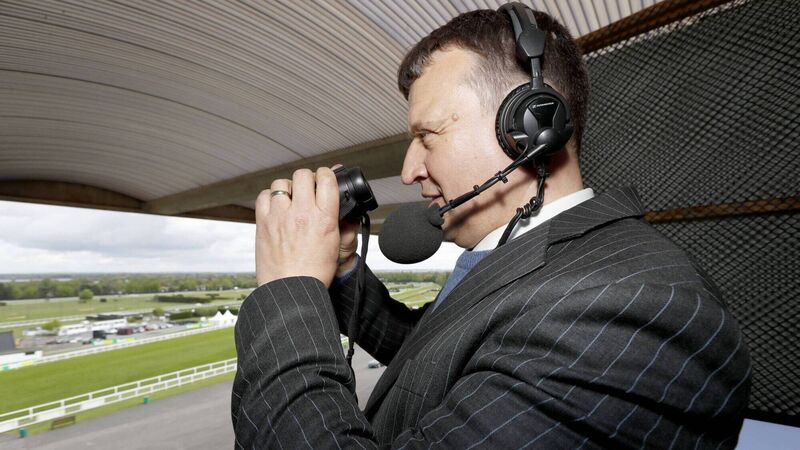
Your road to the microphone this week?
I originally qualified as an accountant. Then in the early 90s I was a young aggressive financial planning analyst in the retail sector, and it dawned on me that, because of the recession, I was going to be made redundant. Racing was my sport, and I started writing to people in racing to see if they thought I had any transferrable skills, and eventually applied for a job I saw in the Sporting Life at SIS (racecourse commentary). I was lucky enough to get the job, which still seems bizarre to this day.
One day I was working at Musselburgh, and Channel 4 decided to show one of the races — The Scottish Sprint — at short notice. It was absolute chaos. About five of them were together with about 15 yards to go, but I managed to get them in the right order, and it sort of started from there.
Are you really as calm as you sound?
It’s like the old analogy of the swan calm on top of the water and legs going crazy underneath. You don’t want to make your audience feel nervous for you, and as a result you can get away with a lot more if you appear to be measured and in control. If you put yourself under pressure, that’s when things go pear-shaped. It’s like an exam — the more you stress, the worse you do.

Cheltenham Festival
The latest news, views, analysis and opinions on Cheltenham from the Irish Examiner sports desk and our team of award-winning horse racing writers, tipsters and fans
The funniest thing for me is this belief that we spend the night before, you know, writing copious notes on what to say. I don’t even know who the horses are until they are going down to the start. It would be no fun at all if you’re scripted.
I don’t like commentaries where it sounds contrived, that it’s just going for the soundbite. The odd time I’ve tried to come up with something funny, which might even sound really funny the first time — but use it in good races, and it’s cringeworthy.
Any tricks of the trade?
Many. I’ve trained myself, for example, not to say the “last three are”, which basically means I’ve got to get them all right. If I say, the “last three include”, I’ve wriggle room. The other thing is just learning to concentrate at the right time. I operate on open feedback in my headphones, so I’ve got sets of eyes all around the course, all of whom can yell in my ear if I’ve missed something.
Concentration is crucial, but at the right time. I once asked [ex-England cricket captain] Mike Atherton how he had managed to concentrate for the whole of a nine-and-a-half-hour innings.
He said: “I don’t. I concentrate from when the bowler is halfway through his run-up until the time I play the ball. And then as soon as it’s done, I’m thinking about anything but cricket. All I’m doing is concentrating in bursts of 15 seconds, not nine and a half hours.”
I’m involved in training budding presenters (Chamberlainsports) and this is one of the main messages.
Worst tongue-twisters?
French names are problematic. My French isn’t bad, but every horse seems to have three words in the name. The key thing is to work out where they are when they jump out, and then you’ve got the map in your mind.
And we’d have letters from people from Ireland saying: “You’ve just absolutely crucified this name, and if you ever want to know how to pronounce a name, call me up!” The problem is you could phone five people in Ireland and they’d all pronounce it a little differently! Now I just watch a video and see how an Irish commentator said it.
Your first Cheltenham Festival?
I didn’t get to call there until well into the 2000s because obviously people were already in situ, and you have to wait your time. Quite often, as a younger commentator, it made a lot more sense to go and work for days somewhere else when everyone was working at Cheltenham and Aintree, which meant there was plenty of work elsewhere.
I reckon it was about 2004. I remember being indebted to Barry Geraghty for coming out after Moscow Flyer had unseated.
I was doing the interview thinking this bloke would never come out. I think I tried to treat it very much the same, but the level of intensity is very different.
Biggest changes through the years?
The biggest change in my commentating career has been the development of in-running betting.
Up until that point, you’d bet, they’d jump away, and as long as I put a horse in the right position, everybody was relatively happy. Now you’d have 20 of them coming down the hill, and one person is thinking that the one in yellow is going well and would want you to reinforce that. The second you say something is going well and then it comes under pressure, the blame thing starts.
Every loser gets blamed on somebody else — and it’s often the pundit or the commentator.
In fairness, if you make a mistake and somebody has genuinely relied on that, then you do feel bad. It’s drawn more attention to commentators, and accuracy has definitely improved.
In-running betting is a poisoned chalice, but it does keep you on your toes every single time.
Finest hour?
Denman’s Gold Cup. Both as a racing fan and as a commentator has always seemed the perfect race to me.
We’d an addition to the family that year. I wasn’t getting much sleep and I hadn’t got invested in all that tribal Kauto Star Vs Denman stuff. I had stood back a little more than usual. I was a little more analytical and had no personal view invested. I remember them going out on the second circuit and saying something I thought was fairly innocuous like ‘Denman begins to up the stakes’ and the whole place just went wild. I remember thinking: ‘Blimey, steady on here, don’t peak before the come down the hill, just keep dropping little bits in.’
The reaction of the crowd to every word was great, so you time it, wind it up. It was like landing a fish. It was like an out-of-body experience. I kept thinking: “This is so much fun.” I always think my job as a commentator is to provide the soundtrack to great memories. Your job is to describe it accurately and be fortunate enough that it embeds in people’s minds as a memory, and that’s a real privilege.
The perfect Festival, 2021?
Well, a perfect Festival is all about the atmosphere and that won’t be there this year, which will just be bizarre.
At some meetings you wouldn’t even notice the crowd, but not at Cheltenham.
The absence of a crowd will be very noticeable. Of course, you hope everybody comes back safe and sound and that as a team, and we are a team at ITV, we have done the sport justice. That might sound a bit cringey, but as a team we feel a wider obligation and this year even more so. Recent controversies have shown how racing can be a bit panicky at times.
Sometimes we have to be like a boxer on the ropes, absorb a bit of punishment. And then you capture some stable staff reaction on ITV and that’s the real sport of racing. At the moment we have to suck it up a little, step back and then reassert.