Fergal O'Brien: 'Racing is part of the entertainment industry. We've got to make it fun'
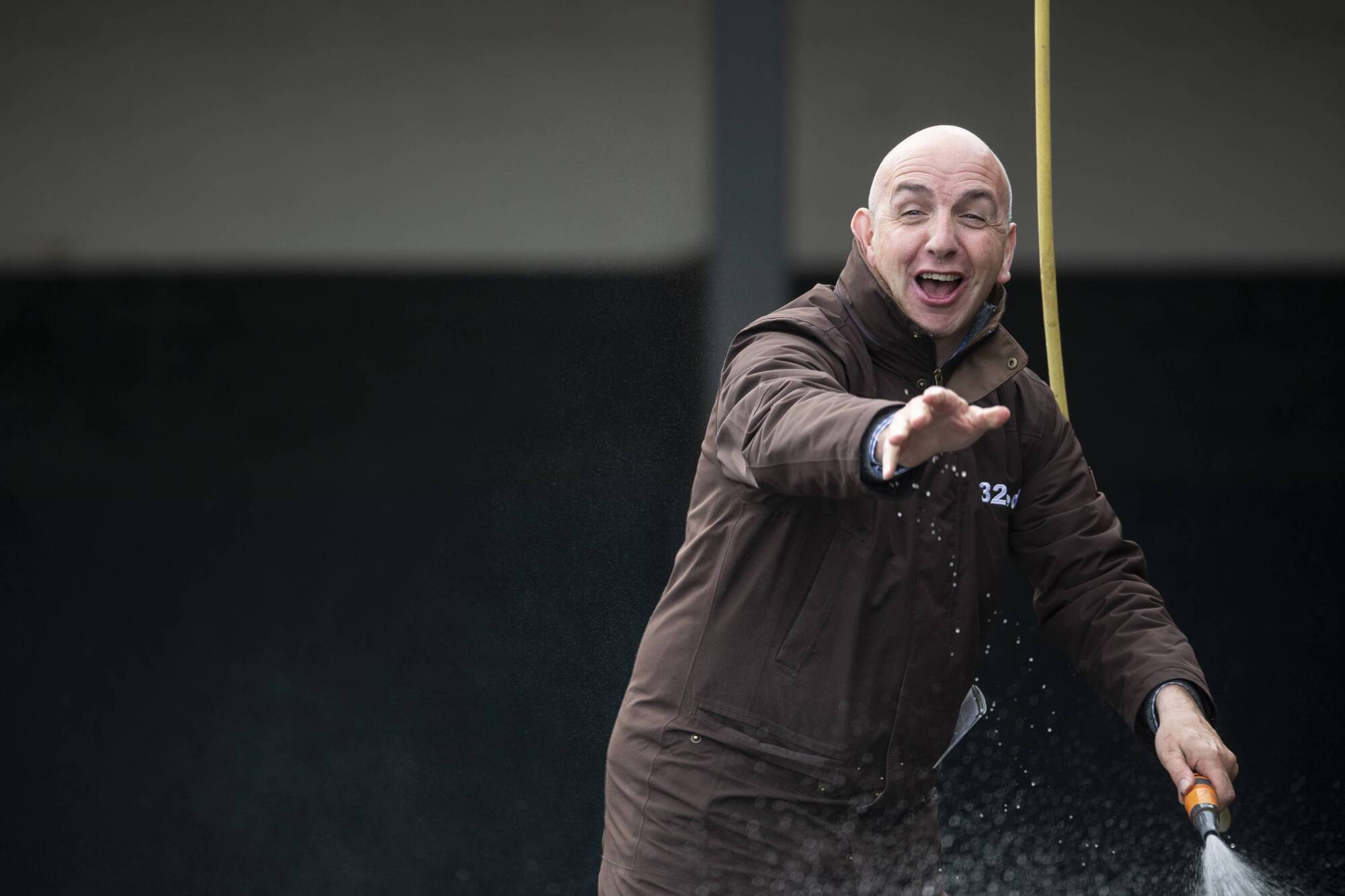
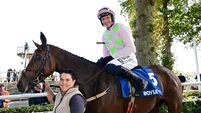
Fergal O'Brien in a playful mood at Warwick. Picture: Edward Whitaker
Fergal O’Brien has gone uncharacteristically quiet considering that it’s a simple question. Does the tagline on his now legendary Twitter account accurately represent who he is and how he lives his life? He’s laughing, pausing to frame an answer. “Ah Jaysus,” he replies eventually, “I didn’t write that.”
The motto he didn’t write advises his 35,000 followers that he is: “Reliably witty, perennially genial. Making racehorse ownership fun.”
Making racehorse ownership fun.
The last part at least is undeniably true these days. O’Brien’s many owners are having great fun watching their horses propel him into the top half-dozen of the British National Hunt trainer’s prizemoney table - second overall on the number of races won.
“We actually led the table for a while in September,” he enthuses, “I even got a text from Paul Nicholls telling me not to get too comfortable, that he was coming to get me. But honestly, I’m not too sure I’ll be ahead of them at the end of the season!”
Fergal O’Brien was born in Limerick 47 years ago. The youngest of six siblings, he was only four when the family moved to the three-county, two-village geographic mish-mash that is Ballina-Killaloe, where a short bridge separates counties Clare and Tipperary as Limerick looks on jealously from across the hedge.
His Munster accent still undiluted by three decades of English living, he moves hastily to dispel any questions of allegiance.
“I’m from Ballina, a Tipp man through and through,” he clarifies, before immediately clouding things over again. “But my brother Tony and Dad are both Clare men, Tony was raised by my grandparents in Killaloe so that was a normal thing to do. Ballina and Killaloe were always great rivals, like Tipp and Clare.
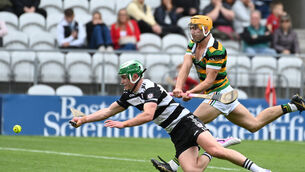
"It’s the one thing I miss to be honest, the GAA. I won three hurling finals at underage level. I played in goal, probably the safest place for me.”
Between the sticks in hurling is normally a position reserved for the fully brave or the half-mad so should he add the word ‘courage’ into that stable motto? “Courage? You must be joking. It was probably because I was so bad that I’d be less of a danger to those around me then I would have been outfield.”
He still misses the hurling although less than he did before Tipp grew its football legs. “The longer you are over here it’s harder, you lose track of players, old faces are gone. I used to go back every year for a final or semi-final but then you miss a few years and I wouldn’t be able to tell you one player!”
O’Brien credits much of his growing success as a trainer to the family values and work habits he picked up during his idyllic lakeside childhood. “I was very fortunate to grow up in a lovely part of the world, on the edge of Lough Derg,” he recalls.
“Dad worked for CIE for thirty years, driving a bus, while Mam was the breakfast cook at the hotel in the village. My father was a hard worker. He headed into Limerick on his motorbike every day come hail, rain or shine to drive his bus. They gave us a great work ethic.”
Unusually for a man destined to be a trainer, none of that work ever involved horses, which still seems to puzzle O’Brien.
“Two of my older brothers, David and Brian, went into racing but I’m still not really sure how. We come from a non-horsey village and family, but David went to England in the eighties and Brian followed him. Then I followed Brian and ended up with him in Doug Francis’ place in Cheshire.
"My other brother Ger very kindly bought me a flight over to England, which cost a lot of money at that time, and I was supposed to see Brian for a week but ended up staying two and a half months. I just found that I loved the horses.”
He was ‘encouraged’ back home by his parents to sit his Intermediate Certificate exams but he’d been badly infected by the racing virus and back then the world was slower to release new vaccines.
“I had come home to do my Inter in which I surprisingly passed everything - except Irish that is - but by then my heart was in becoming a jockey. Brian arranged for me to go to the racing school in Newmarket. I remember the date still, February 6, 1989 - the day I started my nine-week course.”
His time at the school proved to be life changing. He met and mixed with a variety of students from all areas of the sport and sponged up information on his newly found passion.
From there the genial kid from Tipperary went to work at the laconic Lambourn stable of the Old Etonian ex-army officer, Captain Tim Forster. Never one to be mistaken for a ray of sunshine, Forster had greeting cards pinned to his office wall whose slogans reminded him that: 'The situation is hopeless and getting worse' or 'yesterday was a dead loss, today is even worse, tomorrow is cancelled.’
O’Brien still values all he learned at Forster’s. The stable had already won three Aintree Nationals by the time he got there with Well To Do, Ben Nevis and Last Suspect.
“The Captain was a brilliant trainer, had lovely horses, but he was a very dour and pessimistic sort of character. Different times though,” O’Brien reflects.
“We’d never see a three-year-old, we’d get the odd one at four, but they wouldn’t run till they were five or six. Everything was slow, everything took its time and the owners wouldn’t be expecting them to run until they were six anyway. All the horses were big seventeen- hand chasing types.”
He stayed with Forster for three and half years, long enough to realise he wasn’t going to make it as a jockey, and then travelled on a bendy road for a year before he arrived at the door of the then-emerging stable of Nigel Twiston-Davies at Naunton in Gloucestershire.
He stayed for 19 years.
O’Brien describes the difference between Forster and Twiston-Davies as chalk to cheese.
“Nigel was a complete optimist,” he says. “He’d be saddling some 200/1 shot and he’d be telling the jockey that ‘this one has a real chance today.’ But he was often right, his horses were always punching above their weight. We soon went up to 100 horses – it became pretty intense.”
Following some staff musical chairs at the stable the assistant trainer Peter Scudamore was left standing when the music stopped and before long O’Brien found himself promoted into the vacant role of assistant trainer/head lad/general dogsbody No. 2 role.
“I was lucky to be in the right place at the right time after Scu left I suppose. Maybe it was because nobody else wanted the job!” That ‘right place’ later included the stable in the winner’s enclosure at Aintree where he helped prepare two Grand National champions, Earth Summit [1998] and Bindaree [2002] and later in a Cheltenham Gold Cup win when Imperial Commander turned over the two superstars Denman and Kauto Star in 2010. Was that his greatest day with Twiston-Davies?
“I suppose it was,” he remembers. “Earth Summit kind of passed me by and Bindaree was a funny one. That was the year that Nigel was going to give it all up. We had a terrible Cheltenham, it was three days back then, and on the Friday he put his bags in the car and said he was going skiing for a week.
"Then on Sunday his wife, Kathy called me and said he was packing it in. He was going through a hard time with some things and he probably thought it would be easier to start again later, maybe downscale a bit. Bindaree revived him, changed his perspective.”
The year after Imperial Commander won the Gold Cup, O’Brien decided to scratch an itch he’d had for a while and set up as a full trainer in his own right. Backed by his long-term friend, business partner and principal owner, Chris Coley, he initially rented a small yard locally before moving back in to share space with Twiston-Davies.
Independence Day came last winter with a long lease at Ravenswell Farm, a modern eighty-box yard not too far from the Cheltenham winning post.
Coley had made money in hospitality, the tented village at the festival being one of his more enduring initiatives. He was more than happy to back his belief in his friend’s future who he says “knows his stuff and I’d be disappointed if he doesn’t get to the very top. The dream is to become Champion trainer."
Fittingly, O’Brien trained his first Grade One winner for Coley when he took the Challow Hurdle at Newbury with Poetic Rhythm in 2017.
Coley’s high hopes for his friend and protégé are becoming less fanciful. In last year’s truncated season, O’Brien had his best-ever total of 63 winners and barring calamity he will smash through this total long before the turn of the year. While the trainer protests that his friend’s confidence is exaggerated, he still opened another thirty boxes last week which is a significant statement of intent.
His next big challenge at Ravenswell is to fill those boxes with better quality animals. Although winning lots of races, they are only yielding about seven grand a pop and he hopes to gradually change the mix of in the hope of finding higher rated horses.
“I paid sixty grand for one recently when previously forty or so would be my limit,” he says. “The balance is definitely changing. Sally (Randall, his partner) is sourcing good point-to-point horses in Ireland.“
If stables were football clubs, Ravenswell Farm would be Leicester City. Limited resources sensibly deployed in search of excellence and a happy staff ensuring a welcoming and vibrant home ground.
Like Brendan Rogers, Fergal O’Brien too is a modernist, although happier to leave the corporate speak to others. He is uniquely focused on the importance of his customers' experience, especially with his syndicate heavy, diverse ownership profile.
“I’ve always believed that we are part of an entertainment industry, no different to a theatre,” he says. “It’s an expensive hobby and we’ve got to try make it enjoyable. If owners are spending that much money and not having a good time then they aren’t going to hang about.”
Unlike many of his inscrutable peers he is adamant that regular communication is crucially important and that social media is the best way to reach an audience way beyond the confines of his stable.
The tweet count (@FOBRacing) has passed 30,000 and although often addressing serious topics such as horse welfare and mental health, the real joy is when the account goes ‘off-piste.’ An obsession with the perfect Victoria sponge cake. The remarkable price of racing pigeons. The owner’s pub-crawl.

The prospects for his greyhound syndicate that night in a seventy-five quid race at Swindon. Reliably witty insights flow on all manner of random subjects, all helping keep open a frictionless border between trainer, owner and punter.
When praised for their brilliance he modestly credits another friend, local GP and racing fanatic Simon ‘Doc’ Gilson for the success of the Ravenswell Farm social media department.
“Jaysus,” he laughs, no pause this time. “I don’t write most of those either!”