Russell hoping Joe can give him edge in National
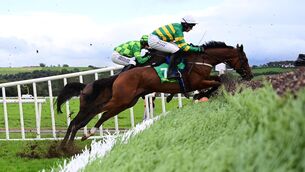
WHEN Davy Russell was a child mowing the lawn at his home just outside Youghal, the cuttings only ever became one thing - a Grand National fence.
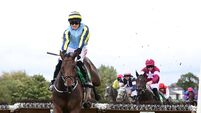
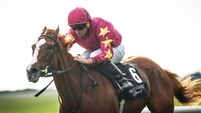
He jumped them himself, he jumped them on ponies and he dreamed of winning the National. Today he’ll line up on the Ferdy Murphy-trained Joe’s Edge with a live chance of making those childhood dreams a reality.
Like all good stories, however, Russell’s career has not been plain sailing and even after a stellar career as an amateur, the reality of life’s rough waters quickly taught him that success was not a given and that his dreams weren’t necessarily going to fall into his lap. The essential ingredients of hard work and patience, he has learned, are key to the whole deal.
At 23 years of age, just three short years ago, the racing world appeared to be at his feet. He was the champion amateur here in Ireland when the offer of a lifetime came up to go to Yorkshire as stable jockey to Ferdy Murphy - yet another of those Irish ex-pats who’d made good in the training ranks in England with a string of top horses like Paddy’s Return and French Holly, both of whom he trained to win festival races at Cheltenham.
Russell says he was happy enough doing what he was doing before the offer from Murphy came, and his big worry was that if he were to turn professional, then his weight could become an issue. Even so the deal was brokered by local Youghal bloodstock agent Tom Mahony and, worries aside, Russell was on his way to West Witton in north Yorkshire as a professional jockey.
“I always wanted to be a pro,” he recalls, “And Noel Meade, who I’d ridden a good few winners for as an amateur, had said to me that I should do it, but in Ireland then - even in 2002 - there weren’t too many good jobs around, so I wasn’t so sure as I felt my weight would be an issue if I wanted to freelance. But then the offer came in from Ferdy and I was only too glad to take it.”
Unfortunately for both parties, this partnership was not going to work out and within two years the Irishman was back at home, despite having made a decent impact on the British scene.
“I wanted to make the most of my time as a professional jockey because we don’t have too long at it and I wanted to come home to Ireland every weekend to ride here, and Ferdy didn’t really think it was such a good idea. Eventually he said to me that I should pick one or the other.
“In the end I was only too happy to come home, because I’d build up good contacts and felt I could make a go of it.”
Unusually in the ways of these things in the racing game, the pair did not fall out; rather, they simply agreed to go their own way.
“We’d had a good start and Truckers Tavern finished second to Best Mate in the Gold Cup in 2003 and we had a couple of nice winners along the way, but then the horses weren’t sparking all of a sudden and I wanted to come home at the weekends and Ferdy wanted me to stay in England. It just didn’t work out, but we never fell out and we shook hands on it.”
Back in Ireland he was not in the limbo in which some jockeys find themselves in such circumstances. His policy of coming back and forward from the UK to Ireland had meant that he’d ridden 15 or so winners here in the period and there were only too many people willing to have him ride their horse.
“I wasn’t left in the lurch,” he reflects. “My time in England was very good and I learned a lot, but I probably rushed into the whole thing a little too much. I thought it would be a little easier and that I wouldn’t have to step up too much. But it was very hard work and very intense, particularly as I had to look after my weight so much. I was probably not mature enough to hold on to a good job, but the experience stood to me in time.
“The weight thing was a problem that I hadn’t had riding as an amateur and I rode at about ten stone seven, but when I got to England I found I had to wake up every morning at ten stone four. Three pounds might not seem like a lot, but those three pounds can be the hardest when you’re trying to get rid of them. I actually got down to ten stone at one point, but I found that I was probably riding too light. I just wasn’t mature enough to realise it.
It is all about learning in this business and I’m still learning.”
Having made the decision to come home, the Corkman based himself in Cashel to be at the centre of things and he says several trainers were very good to him straight away, with good rides to offer.
Even so, it is a measure of Russell’s new-found maturity that while he has been pleased with his rate of progress since returning home - over 51 winners in his first year and 68 so far this year with accumulated prizemoney of over e1m - that he still thinks there is room to “step up” and find improvement. The thing is that he has been able to find that progress on a consistent basis.
Of his stellar season last term, Russell attributes much of his success to having been able to ride “a better class of horse” and a growing maturity within himself.
“I’ve been able to do the job that bit better and things come easier now. I have learned a lot and I’ve realised it took time for me to settle into the job. In the beginning I was probably trying too hard and things weren’t happening for me.
“But I have a good agent now - Andrew ‘Frosty’ Kelly - and we work very well together. He rode on the flat for Aidan O’Brien and he’s been through the mill, so he knows what it takes, and in many ways he’s much more than an agent.”
The fact that Davy scored his first winner at Cheltenham this year on board Philip Rothwell’s Arctic Jack in the Sporting Index Chase is indicative of the fact that the jockey’s profile is consistently on the rise and today he is hopeful that Joe’s Edge might fulfil another ambition.
“The thing is that when any fellow takes out a jockey’s licence, all they want to do is ride winners. I’m no different. I’ve had a licence since I was sixteen and I wanted to ride a winner at Cheltenham since I was about eight, so it was a long time coming.
“But Aintree has been good to me so far and I won a bumper there with Quadco in 2000 and last year I rode Cregg House to win the Topham Chase over the National fences and that builds up your confidence. It also means that there are no psychological barriers there.”
Of those fences - the ones he created miniature copies of as a child - Russell maintains that they are every bit as daunting now as they were years ago, because the horses actually go much quicker over the four-mile course nowadays than ever before.
“We are going much faster now and we don’t have the big, sturdy old-fashioned National Hunt horses in the race anymore. The horses are trained differently now and they are much leaner. Red Rum mightn’t have been overly big, but by God he was a barrel of a horse. Compare him with Hedgehunter, say, and there is a big difference.”
Of his mount today, the Corkman thinks that last year’s Scottish Grand National winner is well entitled to his chance on the basis that he jumps well, he stays and he likes good ground. Nevertheless, the irony of the fact that he rides the horse for his former mentor is not lost on him.
“I was only blackguarding Ferdy one day asking him what he had for me in the National and he said he wanted me to ride Joe’s Edge. I was surprised and delighted because the horse has a good chance and Ferdy is a good man to have them right on the day. He’s always dangerous with staying chasers - you should always have him on your side.”
His plan today, he says, is to take Joe’s Edge down the inside of the Aintree track, despite the fact that the fences are probably slightly bigger on the inner. The advantage, he says, is that you can make up a lot of ground going this route and he thinks it is probably safer than in the invariable crush in the middle.
Of the opposition among the Irish horses he picks out Ted Walsh’s Jack High, who has been specially laid out for this race, along with other Irish contenders Garvivonian, Numbersixvalverde (Irish National winner) and last year’s winner Hedgehunter. Of the home-based challengers, he fears Jonjo’s Clan Royal and Tom George’s Lord Of Illusion most of all.
Whatever the outcome though, Davy Russell is just glad he’s fulfilling his childhood fantasy - winging those huge fences on the horse that wins the National. Who says dreams don’t come through?