How Andrew Coscoran put the pieces together to end Ireland's 48-year wait
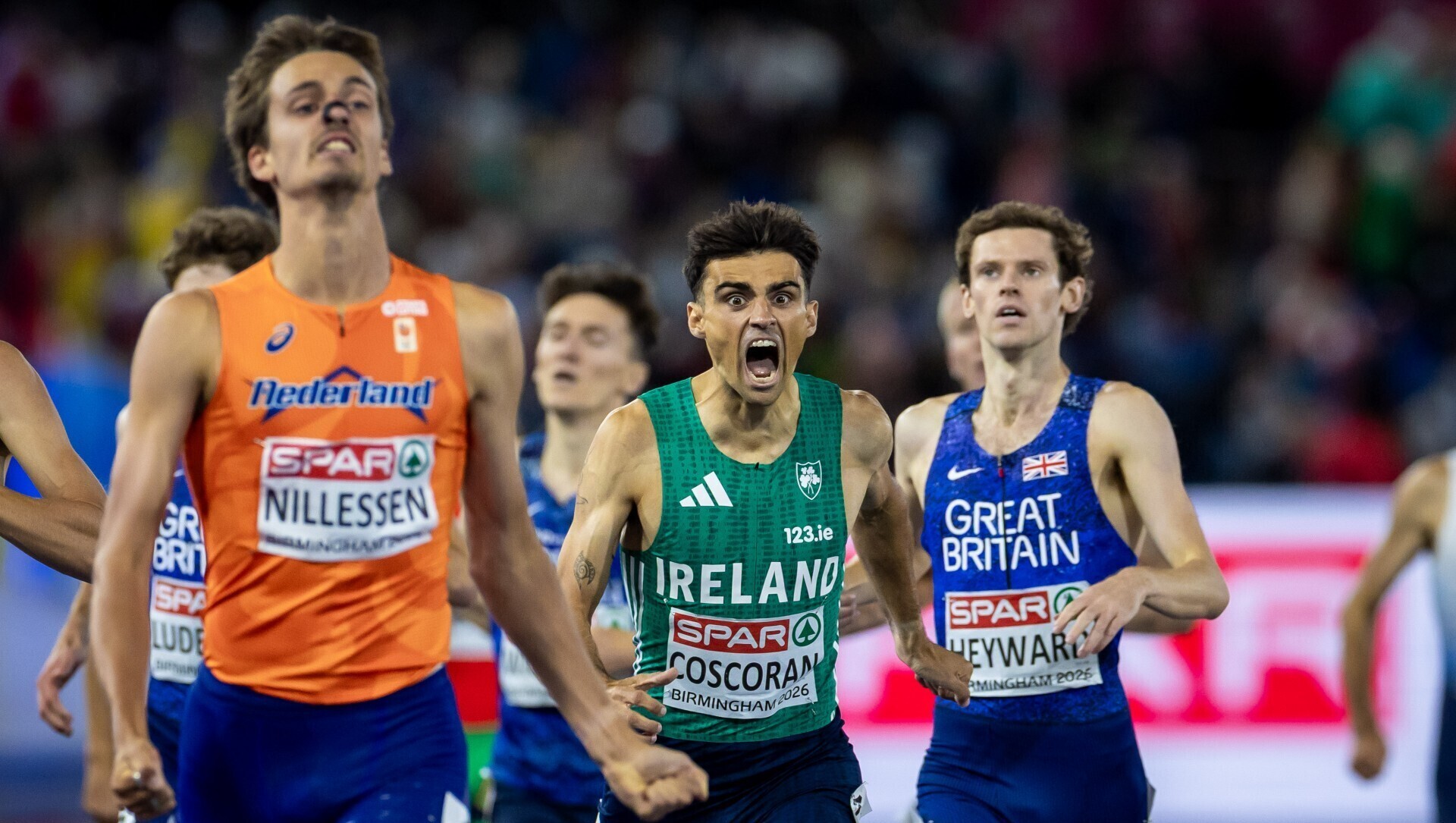
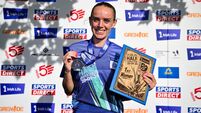
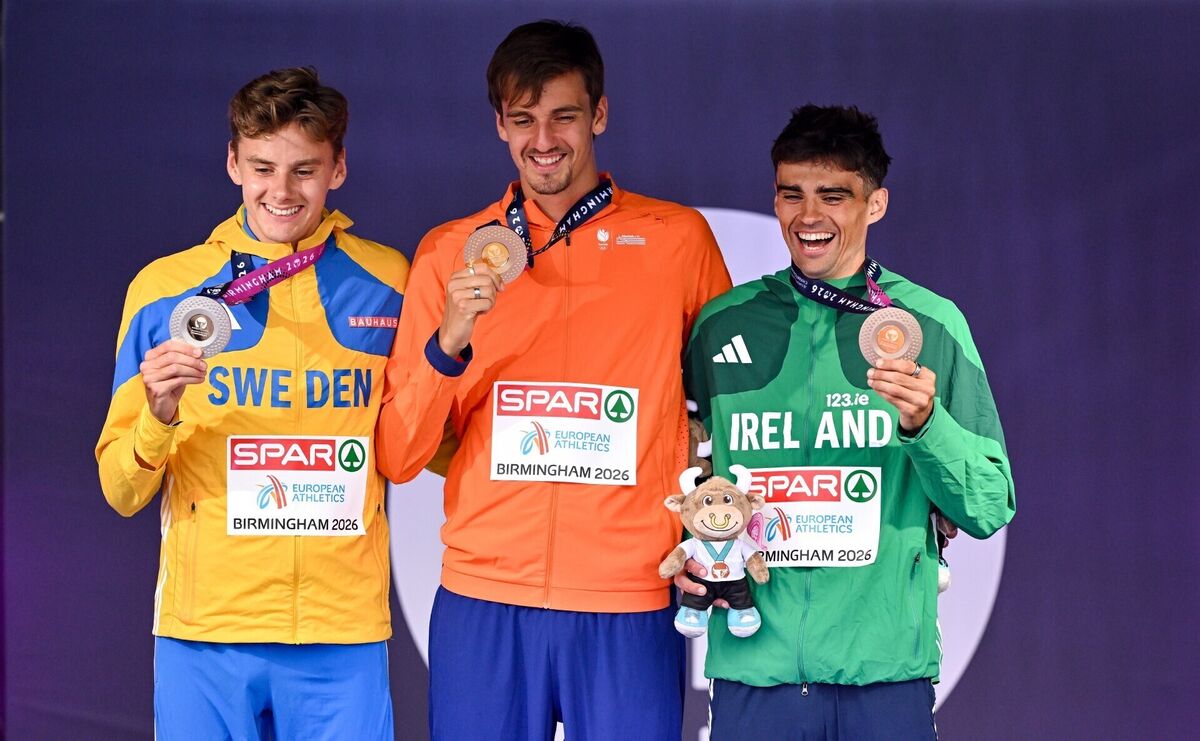
Andrew Coscoran moved from seventh to third in the final 100m of the European 1500m final to claim a place on the podium. Pic: ©INPHO/Morgan Treacy
It takes significant investment. That’s the biggest thing to know about where Andrew Coscoran came from and where he’s now got to – a European 1500m podium.
And we’re not just talking financially, though that’s a given when it comes to the long and winding road to a European medal. It’s time, effort, energy and expertise – from so many people who have helped him along the way, all of which culminated in what we saw in Birmingham on Saturday: Coscoran moving from seventh to third over the final 100m, his mouth agape as the moment he’d long dreamed of finally arrived.
It was the first European Championships medal for Ireland in the men’s 1500m since Eamonn Coghlan’s silver in 1978, and just the fourth in the event’s 92-year history.
Go back 11 years. Coscoran was 19, a gifted junior, and had just finished eighth in the European U-20 1500m final. That kind of run is a signal: you’ve got the talent to go very far. But so do many others. The key for Coscoran in converting that potential into senior success?
Read More
“I think it’s just time, energy and not giving up, continually trying to get better every year,” he says. “Every time something goes wrong, you learn from it, improve on it, and make sure it doesn’t happen again.”
Earlier this year, Coscoran left his training group, Team New Balance Manchester, and returned to Dublin. He now shares a house with Irish 800m star Cian McPhillips and while he’s primarily been steering his own ship since leaving previous coach Helen Clitheroe, he is being advised by Paul Robinson, who finished an agonising fourth in the European 1500m final in 2014.
The two spent much time training together over the years with Feidhlim Kelly’s Dublin Track Club and Nic Bideau’s Melbourne Track Club.
It was only this year, aged 30, that Coscoran felt he had accrued enough knowledge to take the reins of his career, understanding what works best for him.
“Every coach that I’ve gone to, I’ve learned something from,” he says. “I’ve learned from brilliant people. You pick things you like and then you put all those pieces together to create that puzzle.”
His first coach, at Star of the Sea athletics club, was Brendan Meade. After an impressive underage career, Coscoran went stateside in 2015, following the lead of the late Ciarán Ó Lionáird to Florida State University, working under coach Bob Braman for a year. It wasn’t a good fit, so he returned home and enrolled at Dublin City University, working with Meade for a stretch before switching to Feidhlim Kelly in 2018, who coached him until 2024.
To get where he needed to be, Coscoran had to be a dreamer – spending several years living and training like an elite without really having the income to sustain it. Richard Donovan, an ultramarathoner who organises adventure races, was pivotal in that period, backing Coscoran financially at a time when he had nothing coming in.
“Without him, I wouldn’t be in the sport today,” says Coscoran. “Building the foundation that senior athletes need, you need money coming in to work with the best physios, the best strength and conditioning coaches, surrounding yourself with the best people.
“To build that strong foundation, you need support at a grassroots level and from a young age. He allowed me to go all in on running.”
Under Kelly’s guidance, he made the shift towards the ascetic, disciplined lifestyle of an elite athlete, training alongside many of Ireland’s best like Brian Fay, Seán Tobin and Mark English, and his 1500m times came down steadily, from 3:40 in 2019 to 3:35 in 2021 to his Irish record of 3:30.42 in 2023.
Coscoran spent a chunk of 2024 being coached by Nic Bideau in Australia before relocating to Manchester after the Paris Olympics to work with Helen Clitheroe, who coached Ciara Mageean to a European 1500m title in 2024.
But this year, he began to feel the pull of home once again.
“What I was looking for was people to train with, guys who could really help out with training. Being back in Dublin, there’s a lot of people there who have been really helpful over the years and I just wanted to go back to that, people who I think elevate me.
“I’ve been really lucky in my career to be surrounded by really, really brilliant people who know what they’re talking about and have their head in elite athletics. I think I’ve just learned from the best and that’s why I’ve put the pieces together.”
Coscoran has excavated all areas trying to find improvements, including his own mind, taking trips to see British psychiatrist Steve Peters. “Ticking every box is important and the psychology is one thing that you shouldn’t miss,” he says. “It definitely makes a difference.”
He also worked with Irish sprints coach Gerard O’Donnell to improve his explosiveness and refine his sprint mechanics. The gains were clear when Coscoran unleashed a blazing 11.89-second final 100m to win over 3000m at the Grand Slam Track meeting in Miami last year, and again when he kicked his way into a world 1500m final in Tokyo last September.
In the European 1500m final last weekend, Coscoran threaded a risky path up the inside on the final bend but with 100m to go, he finally saw daylight, shifting gears impressively to cross the line third.
He’ll race again in Berlin on August 30 and is on track to qualify for the inaugural World Ultimate Championships in Budapest (September 11-13). While he may have a future over 5000m, he plans to stick with the 1500m until he maxes out his potential there.
With the European Indoors and World Championships ahead in 2027, and a third Olympics on the horizon in 2028, the future is laden with possibility. But for now Coscoran is still basking in the glow of his first major medal – an arrival of sorts after a long and difficult journey.
As he said while still in that euphoric, post-race daze: “This is the dream. I’ve been working so hard for this for so long.”
CONNECT WITH US TODAY



Be the first to know the latest news and updates