A blow for sportswriting in Super Bowl week should remind us who really wins
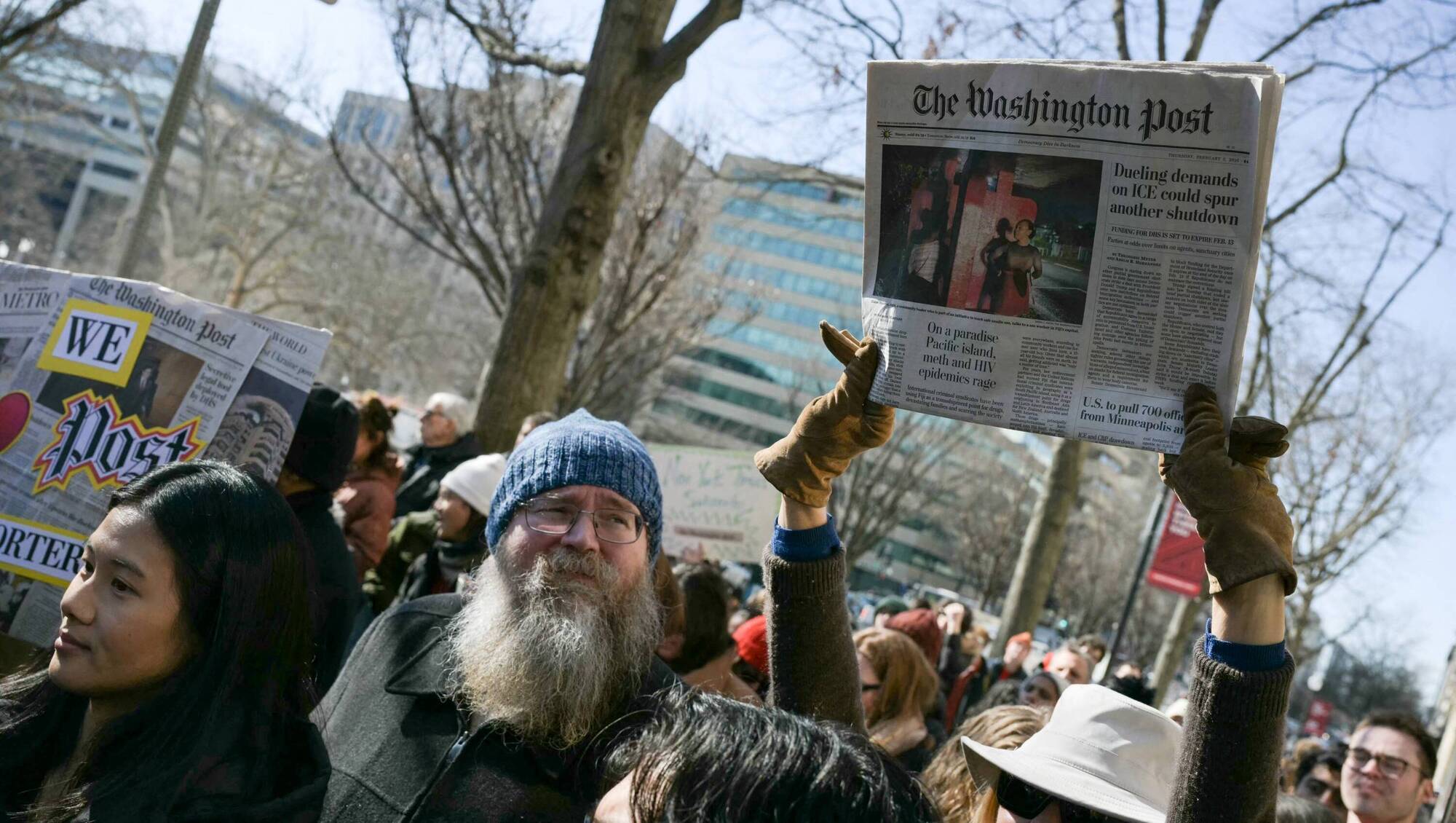
WORDS ON THE STREET: Washington Post employees and supporters rally outside the newspaper’s offices this week after its billionaire owner, Amazon founder Jeff Bezos, announced major job cuts, saying ‘painful’ restructuring was needed. Pic Oliver Contreras/AFP/Getty
Before mourning yet another blow to sportswriting and the general unease that accompanies the sense that everything is getting worse, it is worth answering a more fundamental question: What is a sports section for? To miss a sports section you must first appreciate the sports section. To appreciate the sports section you must, on some instinctive level, understand what the sports section is for.
It is many things to many people. One person’s insight is another’s entertainment. It can be for clarity rather than catharsis: to understand Ireland’s deflating loss to France on Thursday or to further fuel the rage against it. It can also be purely for distraction, or even a mistake as your thumb accidentally hits the link during another mindless doomscroll. (If that is you, fair play for sticking with it until the second paragraph.)
The Washington Post sports section existed with a seriousness of purpose. This week, the newspaper eliminated it in its entirety, while also laying off a third of its staff.
Such grim news was announced days before the start of the Winter Olympics and the Super Bowl, America’s greatest annual sporting spectacle, as if irony itself no longer merited notice.
They had sway. Names like Feinstein and Boswell established their authority because they valued their work as much as Woodward and Bernstein. It wasn’t just boys and their toys; they understood power and consequence and the need for trust.
Yes, we know. These are the big words journalists like to attach to journalism. Even still, at the heart of it, we’re all participants in the same quiet contract. You want to feel informed and occasionally challenged. You look for people who care about the thing you care about, at least as much as you do.
The Post had a one-two combination that made it feel necessary. Their dogged investigative work helped hasten the end of the Daniel Snyder era, the once-disastrous owner of Washington’s NFL team. His awful reign reflected wider problems: how a billionaire’s ego can send what was once a remarkably valuable franchise into a spiral.
After the reporting came the reckoning. Along came the late, great John Feinstein with his searing column calling for Snyder “to kick him to the curb, which is where he belongs.”
Jeff Bezos, the billionaire owner of the newspaper, appears to hold the same attitude toward his colleagues.
The Amazon founder first purchased the paper in 2013 with grand promises to invest in journalism. With the onset of a second Trump term, something shifted. Ambition curdled into appeasement. A tidal wave of subscriber cancellations followed the decision to block an endorsement of Kamala Harris for president.
After reporting nearly $100 million in losses in 2024, the response was that of the Flanders parenting philosophy: “We’ve tried nothing and are all out of ideas.”
Bezos has been recently busy promoting the Melania documentary, an Amazon-MGM Studios film that has received scathing reviews on these shores.
Will Lewis, the publisher appointed by Bezos, was too busy to attend the virtual meeting announcing the cuts. He was, however, able to walk the red carpet at the NFL Honours awards in San Francisco ahead of the Super Bowl. Rest assured: for that cohort, this week would not be spoiled.
All this comes during a period of great flux for the industry and as another battle in the endless culture wars. Predictably, the news was like blood in the water. Sharks constantly circle.
This is how it goes. The back-and-forth wails into the void and nothing comes of it. There are those glad to see another limb severed from the lamestream media. Others retreat into hazardous nostalgia for great work from better days. “Flood the zone” is no longer even a strategy; the churn happens naturally now.
Watching the game week media before Sunday’s decider between the Seattle Seahawks and New England Patriots is another reminder.
There is a need to learn about how Patriots quarterback Drake Maye went from attending a Super Bowl with his dad ten years ago to being on the verge of becoming the youngest starting QB to ever win football’s biggest game.
There is also a need to question NFL commissioner Roger Goodell about New York Giants co-owner Steve Tisch and his association with Jeffrey Epstein after his name showed up more than 400 times in files released by the U.S. Justice Department.
There is, of course, a legitimate conversation about reinvention: about how journalism must find new ways to survive in the current climate. There is also the blindingly obvious truth that giving up entirely will never achieve that.
Deputy sports editor Matt Rennie spelled this out in a note to colleagues, later carried in The Atlantic.
“The people making these decisions have failed in their responsibility to our readers, whom they never took the time to know, and have undermined—likely irreparably—the ideals of an institution they never bothered to try to understand.”
The industry will continue to fracture and splinter. New outlets will emerge. The ground is shifting beneath our feet. What risks being lost in that movement should not be mistaken for acceptable collateral. Powerful people are invariably better off without the sort of work the Post once did.
There was power in that work. It will not be redistributed now. It simply pools at the top. The class that made this decision is insulated from its consequences. An institution is weakened, readers lose out, sport certainly doesn’t benefit.
None of them win. And that, in the end, is the point.

CONNECT WITH US TODAY



Be the first to know the latest news and updates