Larry Ryan: Finding the Phyx to stretch out a five-a-side career
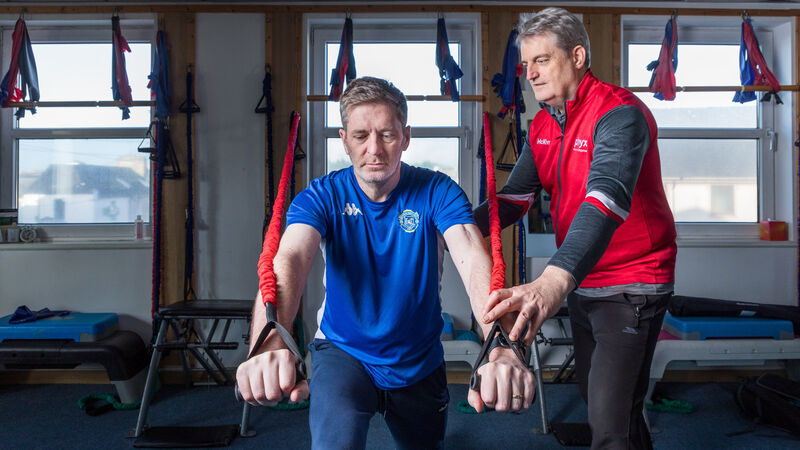
BIT OF A STRETCH: John Dillon overseeing Larry Ryan perform exercises at his gym Phyx in Douglas, Cork. Picture: David Creedon
THE odd reader may recall an emotional column in these quarters around four years ago when my retirement from the five-a-side arena was confirmed. Despite adamant protests, the physio and surgeon were unanimous this was the appropriate course of action, should there be any ambition, down the line, to climb or even descend a stairs. The knee groaned agreement, so a final sorrowful farewell to the astros and cages and halls was bade.
Except, and you can mark this down, if you wish, to another slice of mainstream media fake news, a few months later I made a comeback. No miracle improvement in ability, granted. But a comeback nonetheless. And it was all down to John Dillon.
Who is John Dillon? An interesting case, in a number of ways. Not least because, while not too many know about him, everybody seems to find him.
“I'm normally the last call,” he says. “I get that a lot. A last throw of the dice. People come in and say, ‘you’re not going to be able to do anything with me, but I’ve heard you can help people’.”
He nearly always helps.
My vested interest declared, a quick bio of the man.
Yorkshire man. County-level cricketer, athlete, rower, basketball player, whatever you fancy. Might have been a celebrity chef, if he was that way inclined. Instead just a top, top chef. Fancy London places, Savoy, Hyatt Carlton. Took over from Anthony Worrall Thompson as executive chef at 23 restaurants. Then his own places in Dingle. Then his own serious injury, and plenty throws of the dice before he helped himself.
“It was a bad foot injury in a martial arts session. It went wrong, there were clots. There was a long time in hospital unable to work. And no prospect of standing up in a kitchen all day, working at the old pace.”
He’d trained all his life, knew gyms inside out, studied rehab methods. So he pieced together a training system, using resistance bands, that got him back on his feet. A recipe, if you like. And it worked so well he got out of the kitchen altogether to give others a taste of it.
That’s the shortcut to Phyx, a workout and rehabilitation gym based in Douglas village in Cork. An open secret for the bones of 18 years. The crocked use it to recover, the elite to fine tune or prevent injury. Plenty who are in good nick just want to get more flexible and mobile and stay that way into later life. Local doctors and physios send patients down, knowing they’ll be in safe hands.
The setting is as low-key as its owner. Above a financial broker. Offering a different kind of life assurance. An unpretentious room, low on mirrors, full of bands and balls and pilates benches. A few signed jerseys on the walls signpost grateful customers. Amy O’Connor, Donncha O’Callaghan. A photo of John surrounded by Munster rugby players. Though his middling grasp of marketing and PR is betrayed by an admission he asked Peter O’Mahony to take it.
On one of my first visits, big Damien Delaney, the former soccer international, is on his way out, suitably stretched. “I heard of John by chance,” Damien says, a weekly disciple. “I became conscious since I stopped playing that I wasn't doing a lot. I carried no injuries, thankfully. But I noticed the change in my body, my range of movement, fatigue levels. I just want to keep playing golf and I’ve noticed a huge difference in my range of movement, my mobility, my energy levels. It’ll help with daily life as I get older, just functioning and playing with the kids.”

Like most clients, I took the long way here, via the physio, the surgeon, the keyhole surgery and anti-inflammatories and cortisone jabs. The aim was not to kick a ball again but to kick a knee replacement down the track. And John offered one major sweetener. One hour a week is enough, you don’t need any more. In fact you need the recovery before next week.
“Exercise for its own sake doesn’t do you any good,” John says. “Exercise is a stimulus, a catalyst for the recovery that does you good. That’s why you can’t exercise one day after the next, after the next, you’ll just break the body down.”
He gets no argument there. Still, that first hour was cruel. John’s exercises look straightforward. Hold those bands attached to the wall and sit down on that bench slowly. Except, keep your back straight. “And if you think you’re doing it slow, go slower.” And very soon, your muscles are burning and shaking and you’ve discovered new muscles that want to get in on the burning and shaking too.
“The main difference with what we do is we’re working the muscle in both directions,” John says. “There is more dynamic going on. Like all good high intensity training, it works your cardiovascular, works your respiratory, does all that good stuff. Works your balance, your coordination massively.
“And the key really is that it’s not complicated. The beauty is in the simplicity. We’re working and activating every muscle in the body. For some people it’s maybe too simple. We’re not looking at how many reps you do or what weight you can lift, we’re looking at a system that activates the muscles as much as possible. This is our advantage.
“We’re not necessarily about growing the muscle. But about activating the muscle so the strength has more integrity. There is less opportunity for injury if the muscle is more proactive.”
John isn’t sold on the modern pre-occupation with growing muscle and can’t help draw a line between some practices and the epidemic of hamstring and soft tissue injuries among serious athletes.
“There’s nothing wrong with weights. Rugby players come into us and use this as a primer. They use it to get the body and the muscle more prepared for heavy duty sessions. This time of year, we work with a lot of hurling and football teams ahead of pre-season, to get them ready for what’s coming.
“But when you’re using weights, heavy weights, and doing it two or three times a week and hitting the body in a certain way that it grows muscle, it can create imbalances.
“The muscle swells alright, partially. The way to swell a muscle is to break it down. On a cellular level you're trying to get the cells to react in such a way that it needs repair. And it’s the repair that grows the muscle.
“We’re not asking the muscle to do that. We’re asking it to get more activated so there is more balance going on within the muscle. And that’s systemic around the whole body.
“We don’t use the term strength and conditioning, it’s conditioned strength.
“So if I’m working with someone in a traditional gym, the first thing I do is take the weights off and slow it all down. And they can’t do an eighth of what they were doing. Their muscles aren’t conditioned to it. We’re focusing on the push and the pull. We’re controlling it coming down.”
His approach can make even the strong feel vulnerable.
“We have had elite athletes coming in. Effing and blinding. Feeling sick. Because of a squat that we’re doing. And they look over and see a 70-year-old doing the same exercise. ‘They can’t be doing the same exercise as me.’ ‘Watch them, what is different?’
“But they find it too difficult, because their muscles are big and swollen but they are not proactive. So some of those elite guys don’t like the system.
“It’s magazines too, it’s Instagram, influencers. I used to play sport and my fitness was a by-product of the sport. People are now training to look a certain way.
“And it’s what some S&C people have been taught. I had an inter-county player, who could bench press 80kg, say to me that his trainer had told him to go away and not be wasting his time until he could do 120kg.
“Why does he need to lift 120kg? What function does that serve, apart from it being a stress through his pectorals, which ultimately will affect his shoulder blades, which will affect his mobility?”
******

“That was hormonal. You were releasing a growth hormone. We were getting into your body in such a way that you were getting a huge spike in hormones. It’s a horrible feeling in the tummy. Bodybuilders are looking for that all the time. But you didn’t really experience that after a few weeks, did you? Your body adapts. You are conditioning yourself.”
First exercise John does every time is a simple lunge, repeated over and over, with bands. It isn’t just an exercise. It’s for diagnostics. “It’s me sussing out where you are at. Then we can tailor the session to that.” A slight tweak multiplies the difficulty. Stop the front knee drifting past your toes and crank up the burn.
“As soon as you neutralise the knee or the wrist, the muscles have to take the strain, not the joint. Our methods are specific to getting the muscle involved rather than the joint.”
So when a 28-year-old hurler comes in and does that exercise, John can identify his issues immediately.
“Straight away. You see his balance, you see whether his core is involved. You see how the muscles are working. It gives you massive feedback. It tells you where people are at. And you can immediately see the difference six weeks later in how they can do that exercise.
“The core is spoken about a lot but there is not an appreciation of what a true connection of your core can do. It’s how you engage with resistance. Having your pelvic floor naturally aligned, we get massive results from that. That’s the holy grail really, if anything. Having people in their natural form, and more relaxed.”
This is the hymn sheet Tom Brady sings from. Ever since he hooked up with famed ‘body coach’ Alex Guerrero, Brady stopped lifting weights and used bands to focus on the pliability of his muscles. It kept him in the NFL 'til he was 45. Asked once if he was disappointed the methods hadn’t caught on everywhere, Brady said no, “it’s great, nobody will ever be as good as me”.
John Dillon isn’t that keen to preach to anybody else either. “I’m not trying to change a culture, I’m just doing what I’m doing. I might be a singular voice in the wilderness, but the beauty is I've got 17 or 18 years behind me of testimonials. A lot of top-flight physiotherapists, chiropractors, osteopaths, high level international athletes.”
Physio Neasa Long calls him “an exceptional exercise and rehabilitation therapist”. “I know he works a lot with neuro rehab patients. I have had some patients with spinal injuries he has treated and they've done very well. His system is just very adaptable and most importantly it’s very very safe.”
GP Dr Nuala O’Connor shouts the benefits of resistance and flexibility training and balance. “They are important at all ages of life, but particularly as you get older. because of the risk of falls, especially females who are more vulnerable to osteoporosis.
“And John is also very familiar with working with people who have injuries or who are post-op and can gradually get them back to their full strength.”
Ger Cunningham has sent over the Barrs hurlers for prehab work, the Douglas footballers have been in. Ex-Cork manager Kieran Kingston is a huge fan. “When you're hitting to 60, I wasn't looking to do anything too strenuous, nothing too focused on heavy weights or anything. Just something safe and effective, where the focus really was on mobility. It ticked all the boxes for me and I couldn't recommend it highly enough. There's no week the same and I have seen a huge difference since I started going in my flexibility and strength and mobility and balance.”
After three months with John, I got back to sleeping soundly, the knee no longer making its presence felt. After four, I was back in the cage, albeit goal-hanging even more than before. Scaling things down to a couple of outings a month, maybe. But still a comeback.
I’ve met plenty of fellow soldiers. In the 50s, too many knees and hips announce themselves. Eddie Nicholson played rugby for Cork Con and Shannon but had to pack up in his 20s due to cartilage tears. He’d had two knee replacements before finding John three years ago. “He's phenomenal. His knowledge, his encouragement, his ability to get you to do what you should do. I have full use of my knees now.”
Eddie is back on the grass, playing full-contact mixed-ability rugby with the West Cork Jesters, a noble organisation that celebrates sport for all.

Then there’s Liam Cotter, who puts myself and Eddie to shame. Liam, now 60, ran the Tokyo, Berlin and Boston marathons this year. And run them in 2:50.
“I’ve been going to John since 2011. I had a really bad knee injury. Went to everyone. I was one week away from having major surgery, recommended by a top Irish sports surgeon, that probably would have affected me for the rest of my life. John stopped that, said I didn’t need it.
“The key to John’s process is he doesn't focus on the injury, he focuses on all-round body strength to take the pressure off the source of pain which allows the body’s strength to recover.”
This month Liam ran Valencia in 2:49:47. London, Cork, Chicago and New York are on his map for next year.
Sarah’s difficulties began nearly two decades ago, with a condition affecting the pelvis during pregnancy. A teacher, her mobility was so shot that her school was on the point of moving all her classes downstairs.
“I went so far downhill. I was always in pain. I've had so many consultants and physios. But slowly and steadily John got me moving. It didn't happen overnight. I wasn't expecting it to. I'd been on such a long road. I wasn't expecting a quick fix. But gradually you noticed little things, like I was able to reach up and grab the sauce from the press.” As a marker of how far Sarah has come, for her 50th this year, her friends chipped in for hiking gear.
Little Domhnall was nine when his nightmare began. Inexplicable debilitation. Barely able to move. Awful pain. Out of school. Sport impossible. Three years of occupational therapists, neurologists, psychologists. Test after test. John was the final piece of a complex treatment jigsaw that eventually got him moving.
“He looked forward so much to those Tuesday morning sessions with John,” his mam recalls. “It was like he wasn’t sick anymore and they were just training. John would talk to him about soccer and one day Damien Delaney came in and they did keepie-uppies and it was just a great boost.” Domhnall is back in school now, in first year. And when he finally made his comeback on the soccer pitch, his teammates clapped him onto the field.
John Dillon is not a miracle worker. I’ve retired again. Or a mini-retirement, hopefully, in Gary Neville parlance. The other knee. Cartilage tear. Another keyhole. Another jab of cortisone. But we’ll go again. Going into surgery, the muscle was there this time. The knee is already improving. The surgeon has stopped talking about replacements.
Somewhere along the way though, perhaps this stopped being about the chase for another goal or two. Maybe a penny finally dropped that we do have some responsibility to give a little bit back to bodies that have brought us on a good spin without too much complaint.
Without ever consciously working on it, the back spasms have gone, the posture is a bit better. After intrepid exploration, I’ve found my core. At 6’4, I never had any issue reaching up for the sauce, but these days I can comfortably pull on my socks. Energy levels are respectable. And despite resisting, so far, the nutrition plans John, drawing on his other life, also offers, and instead remaining a devout apostle of Mr Kipling, I’ve lost a few pounds.
The wife, Suzanne, will admit to being a studious avoider of exercise regimes beyond the fundamentals of a good walk. She is certainly not after one more goal. But perhaps addiction to John’s methods kicked in sometime around week three or four, when she detected muscle in places that hadn't previously been colonised by muscle. Now she could not miss it. She likes ‘the vibe’. It’s not like any other gym she ever set foot in and reversed out of. Buoyed by this surge of well-being, she ran this year’s mini-marathon.
Another insurance policy, just in case the next comeback does end in tears. If I can just hang onto her for the rest of this innings, at least I might have somebody to help me up and down the stairs.

Three exercises each day, six days per week.
Squat down to seated form, bum level to the knees, knees directly above ankles so the legs form the shape of a chair. 30 seconds down, 10 seconds holding the shape, 20 seconds back up. (Keep breathing the whole time!)
Left then right leg, eyes open. In case of losing balance, support with your hand. Do 10 to 20 seconds on each leg.
Get out there for your body and mind.