Paris Olympics were great, so why not hold summer Games every two years?
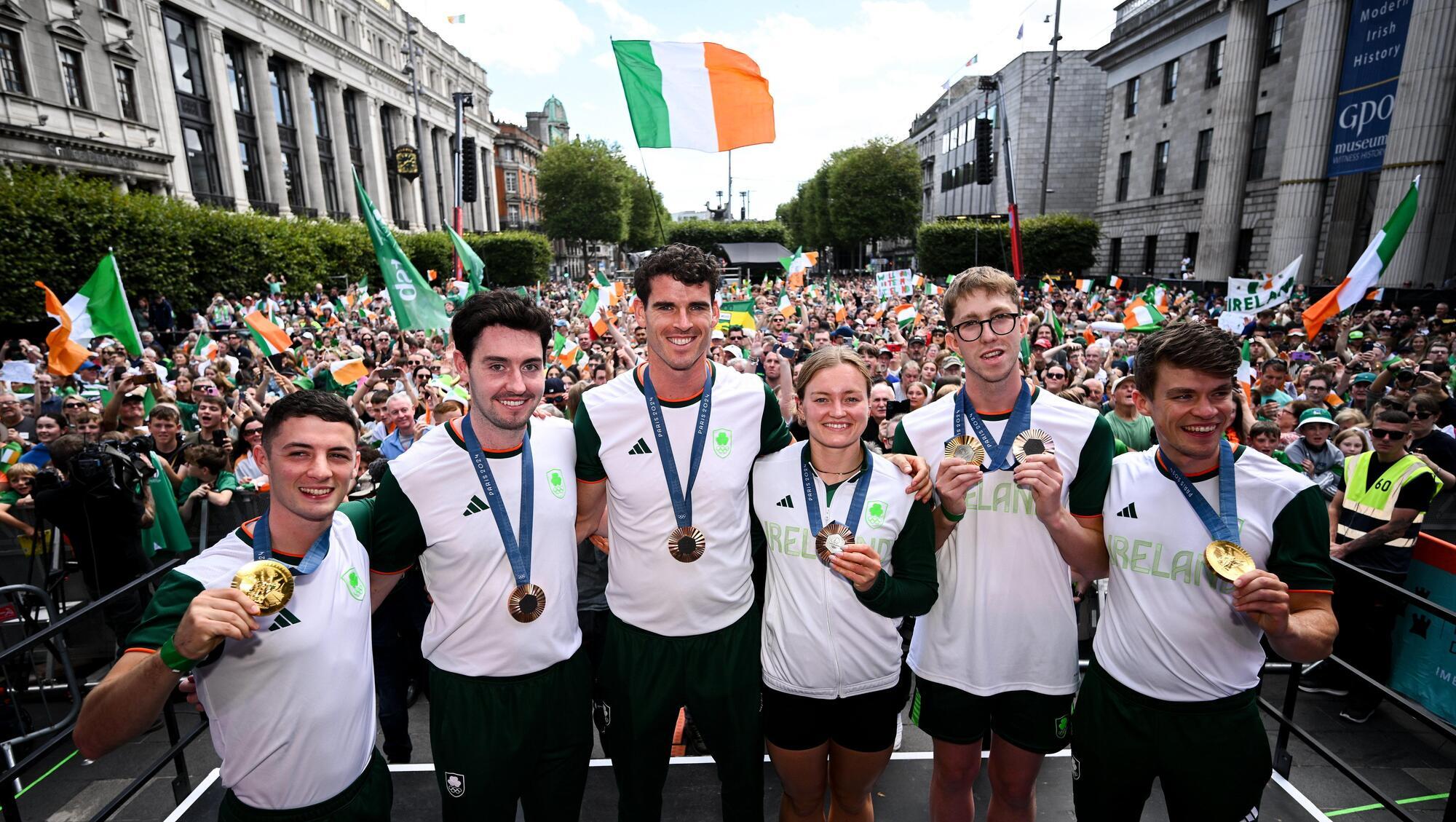
Team Ireland members, from left, Rhys McClenaghan, Daire Lynch, Philip Doyle Mona McSharry, Daniel Wiffen and Fintan McCarthy are welcomed by supporters on O'Connell Street in Dublin, celebrating their remarkable achievements at the Paris 2024 Olympic Games. Photo by Ramsey Cardy/Sportsfile
We are knee-deep in Twixmas: that twilight zone between Christmas and new year, excess and reflection, lists and yet more lists.
Over the past week there have been many saluting the best sporting moments of 2024. Yet across the globe there is one constant: these lists are dominated by a Paris Olympics seared into the memory. Nothing else came close.
Pick your day, relive the moment. Keely Hodgkinson, Alex Yee, Simone Biles, Léon Marchand, Mondo Duplantis, Sydney McLaughlin-Levrone and a men’s 1500m final for the ages; I was fortunate to see them all up close.
But even that list still barely scratches the surface. As Christophe Dubi, the executive director of the Olympics, put it to me recently, Paris 2024 was like the Dude in the Big Lebowski: the right Games at the right time and place.
In fact it was so good, it even provided the most thrilling moments of the year in tennis and basketball – two sports where the Olympics are usually an afterthought not the pinnacle. Novak Djokovic’s victory over Carlos Alcaraz was one of the great men’s matches, while Steph Curry’s “golden dagger” provided one of the great moments, and memes, in the dying embers of Team USA’s triumph against France.
Read More
The TV figures were also strong, with the BBC’s live coverage winning the ratings battle every day. So during this period of excess and reflection, a provocative question comes to mind. Would it be that wrong to stage the summer Games, this wondrous celebration of sport, more frequently? Perhaps, even, every two years?
In the past you could have brusquely dismissed the idea with two words: too expensive. But Paris – while not exactly cheap – showed how to stage a Games without a city becoming a building site or being crippled with debt.
The iconic tourist attractions provided the perfect backdrop. And only two new venues, the Olympic village and the diving centre, were built from scratch. It’s not as if there’s a shortage of potential hosts either. India and Hungary openly want an Olympics. Qatar and Saudi Arabia would be in like a shot as well. And so would London if it had a realistic chance to stage it again.
Naturally, there are counterarguments, with the most compelling being that the Olympics would lose the rarity value that makes them so unique. And, as Michael Payne, a former senior marketing executive at the International Olympic Committee, explains, you can have too much of a good thing.
“When Fifa was considering staging the World Cup every two years, they came out with various research studies saying that the fans wanted it,” he says. “But if you asked six-year-olds if they would like Christmas every day, what would the answer be? And how quickly would you end up destroying what makes it special?”
Payne believes that Paris was arguably the greatest Olympics yet and provided a much‑needed reboot for the Olympic brand after Tokyo and Rio. But he warns that you can’t expect an organising committee to hit the heights of Paris – or London in 2012 – every time.
He also wonders whether there is enough sponsor and TV money to support having a Games every two years. “The Olympic product is in robust health,” he insists. “But at the same time the business model, which has supported the Olympic world for 40 years, is undergoing significant change.”
Not only is there growing uncertainty over the long‑term viability of the Olympic Partner sponsorship model, which brings hundreds of millions of pounds to the IOC every cycle, but many major TV contracts are due to run out in 2032. “I don’t think there’s anybody on the planet who can tell you what the landscape will look like in 2036,” Payne says. “Will it be the traditional players? Will it be new players? Might it even be people that we haven’t heard of today?”
All that is true. But there is a final argument in favour of a more frequent Olympics. If the Games don’t push on, they may fall back. We live in an era where the average sports fan in the UK is increasingly a big-eventer. Sure, they will follow every cough and spit of the football season. But in an average calendar year, their focus is on the big events in the biggest sports.
For tennis and golf that means the grand slams and majors. For rugby it is the Six Nations and World Cup. Cricket? Probably Test series against Australia and India, the World Cups and not much else. And for the classic Olympic sports and athletes?
Let’s be honest. Outside of perhaps track and field, how many will enter the public’s consciousness even once before Los Angeles in 2028? The danger is that in a world of shortening attention spans, out of sight may lead to being permanently out of mind.
Sure, there are logistical challenges in staging an Olympics every two or perhaps three years. But they are not insurmountable. To avoid the football World Cup, for instance, the Olympics could be staged in odd years.
One last point. We often hear from the IOC that the athletes are at the heart of the Olympics. But how can it be right that many of the greatest athletes of this or any era – from Biles to Duplantis to McLaughlin-Levrone – will have to wait four years to have the world’s attention fully focused on them again?
CONNECT WITH US TODAY



Be the first to know the latest news and updates