Gravity no barrier in speed climbing - the Olympics' quickest sport
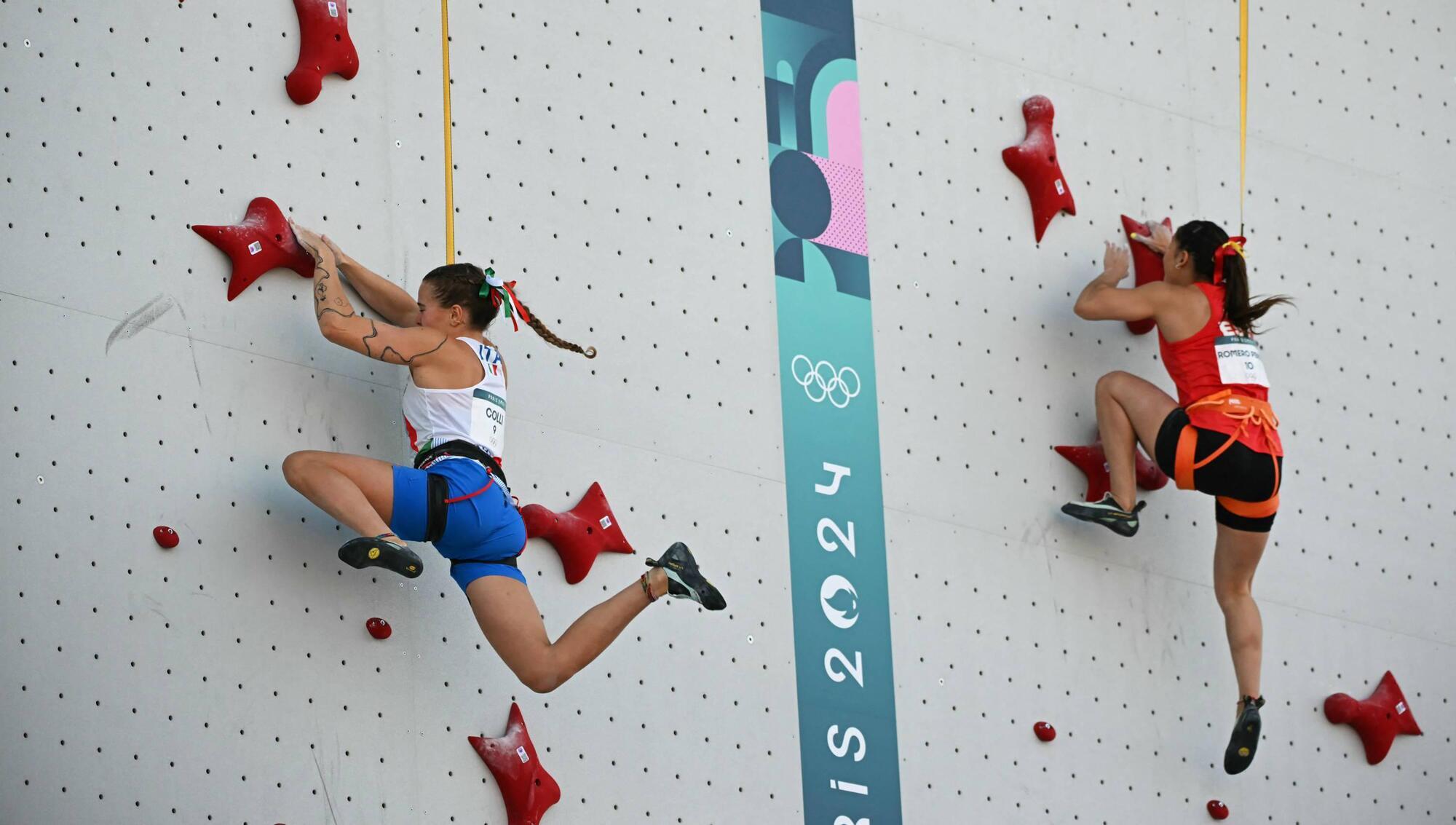
Italy's Beatrice Colli, left, competes against Spain's Leslie Adriana Romero Perez in the women's sport climbing speed preliminary round heats
It would be a surprise if even a handful of the Irish hordes that helped fill the Velodrome in Marseille for the opening game of the Six Nations last February stumbled across the Arkose Prado hidden away down an innocuous laneway and no more than the kick of a ball from the stadium.
The Arkose Prado is a restaurant (and it sells cracking burgers and fries with a beer for a very reasonable price) but it’s also a rock-climbing centre. This might seem like a strange hybrid of a business, but it is very French and it speaks for how embedded a sport virtually unknown in Ireland can be elsewhere.
Families and friends hang out over coffee, groups of kids clasp fingers to precarious toeholds, and the world outside keeps turning. It’s class. Estimates are that there are more than a million recreational climbers in France, and the sport is only going to up those sort of numbers again now that it is part of the Olympic programme.
It was in 1985, when an Italian climber by the name of Andrea Mellano and a journalist, Emmanuele Cassara, got a group of climbing acquaintances together to organize a climbing competition they called ‘Sportroccia’ at a natural crag in Valle Stretta near the town of Bardonecchia.
A new sport was born.
On Thursday afternoon, in the Parisian commune of Le Bourget, thousands of people spilled into the Site d’Escalade to witness the world’s best go for gold in the speed version of the sport. This is basically a series of races between two men or women up a pair of identical 15-metre high walls rigged with protrusions. And they do it at breakneck speed.
The speed wall is one part of a vast stage that also plays host to the lead and boulder competitions. The three of them are bolted onto a massive wall that looks like someone started to build an aircraft hangar but got bored less than halfway through. Add in a temporary amphitheatre of stands fitted around it and you are in business.
We’ll extend the rugby theme a bit further here and point out that it seems to be a sport for all shapes and sizes: from the 5’ 1” and 18-year old New Zealander Julian David, to the 39-year old, six-footer Bassa Mawem from France. It’s straight elimination, one man or woman racing another on adjacent walls until two make the final and one wins.
They start in complete silence – the crowd respecting the kicker – launching themselves vertically at a speed that hardly seems possible. Gravity, normally a no-nonsense dictator, has its powers severely curtailed for the briefest of scenes as these lightning pockets of muscle and bone finish their ascents either side of a five-second mark.
The margins are ridiculously thin.
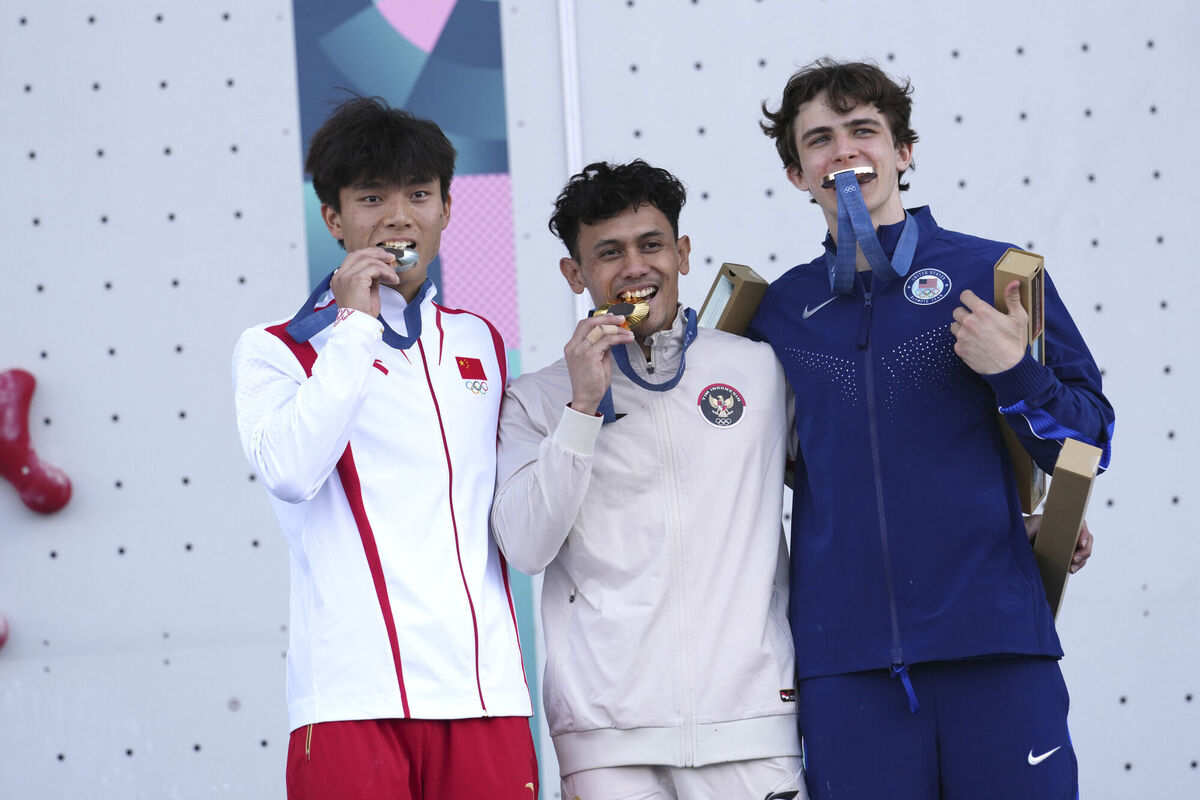
Wu Peng of China squeezed through a quarter-final by touching the buzzer at the top just two one-thousandths of a second before Italy’s Matteo Zurlani. To be clear, that’s 0.002 seconds of a difference. Wu would be on the wrong end of a 0.02 margin in the final when losing gold to Indonesia’s Vedriq Leonardo.
Favourite Sam Watson of the US had to be content with the bronze, and the satisfaction of a new world record time of 4.74 seconds that would better Wu’s effort in the final by 0.01 seconds. The Olympic record up to now, incidentally, was Mawem’s 5.45. That’s a 13% decrease in time in a shortened three-year cycle.
It’s the quickest of all the Olympic sports.
As concepts go it’s brilliantly simple, a no-brainer for the Games given a first-past-the-post and blink-and-you’ll-miss-it nature that is deemed to be perfect for a younger, screen-obsessed generation.
Still, there are endless layers to it, milliseconds to be found and shaved in the pursuit of excellence.
David compares it to the seemingly repetitive nature of running 100m sprints on an athletic track in that no two runs are ever identical. It’s also, for him, a repository of pure adrenaline. Mawem embraces the moment where he stands at the foot of the wall and sets aside the world that spins furiously on its axis.
“Climbing brings me balance, a moment in which I detach from work, family,” he explained. “A moment in which I don't think either about the future or all those things that I still have to do. In simple words, it is my moment." Even in Tokyo when he suffered a total rupture of the lower biceps tendon and spent six months in recovery.
It’s a punishing ask. On fingers and on fingernails that can be ripped clean off. On knees and on toes. And one slip, one brief sliver of hesitation as you figure your way up that vertical puzzle, and you’re done. Defying gravity is never easy.

CONNECT WITH US TODAY



Be the first to know the latest news and updates