The race of the century? Unpacking the tactics that helped Hocker to 1,500m Olympic gold
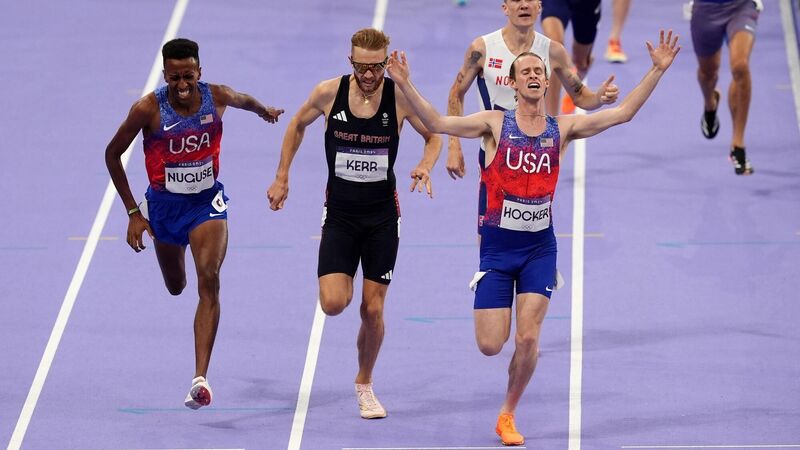
USA's Cole Hocker celebrates winning the Men's 1500m Final as Great Britain's Josh Kerr and Norway's Jakob Ingebrigtsen look on dejected at the Stade de France on the eleventh day of the 2024 Paris Olympic Games in France. Picture date: Tuesday August 6, 2024.
It was one of the greatest Olympic 1500m finals in history. Perhaps even the greatest. And while Cole Hocker was a deserved champion for the United States, what really made it an all-time classic was that Britain’s Josh Kerr, the US’s Yared Neguse and Norway’s Jakob Ingebrigtsen could have all won if their tactics had been slightly different.
Ingebrigtsen went too fast early on. Neguse let Hocker slip past him on the back straight, while Kerr was also a bit too wide when he struck for glory. In a race of such fine margins, pacing strategies and even the Stade de France track made all the difference in a race for the ages.
Most races on the Diamond League circuit will have pacemakers and Wavelight technology (a pace-setting system using LED lights on the inside of the track) to enable athletes to run fast at an even pace. But when it comes to the Olympics, athletes are on their own.
“Usually it’s very robotic,” says former British Olympic 1500m runner and elite track coach Matt Yates. “Running efficiency has changed because of the super spikes and lights. Many athletes are now so metronomic in how they run because they are looking for energy off the shoes because of the stride pattern. But at the Olympics it is different. Athletes don’t have pacemakers or lights. So they are on their own.”
Many raised their eyebrows at the Norwegian blasting through the first lap of the 1500m final in 54.82 seconds, before passing 800m in 1:51. For Yates, it wasn’t that the time at this stage was too quick – it was that he didn’t run the two laps evenly. “Ingebrigtsen is a very energy efficient runner. But in the final that efficiency went out the window,” Yates says. “The 54.82 killed him and his physiology started changing. But he would have gotten away with it if he had run a couple of 55.something second laps.”
Because while the Norweigan was the quickest man in the field, he knew that Kerr was far faster over the final 200m – as he showed at last year’s world championships. “Ingebrigtsen doesn’t really have much of a pickup,” says Yates. “You’re not going to find him dramatically changing pace and running a 50-second lap. He bolted on the first lap, because he let the occasion get to him. Kerr was in his head.”

Yates isn’t convinced – and makes a point about the Stade de France track that no one else has picked up on. “While the track is fast, it’s also not the easiest to run on, because the bends are very tight,” he says. “You cannot go on someone’s shoulder on the bend. And that’s what Josh found out. These bends are very tight. And also the straights are quite long.”
Not necessarily. “I don’t like that position,” says Yates. “I call it ‘the schoolkid’s position’. If you run on the shoulder of the leader, then you can be forced onto the white line onto lane two. So you’re already running a bit further.
Yates suggests that the way Ingebrigtsen and Hocker stuck to the inside lane was the best approach – at least until the Norwegian pulled out in an attempt to block Kerr during the last 100m.
“Position on this track is really key,” Yates says. “No one is coming off the shoulder of the leader on the last bend. They’re coming off just behind. So you’ve got to drop in. And attack later than you normally would on the straight. That’s what Hocker did on Tuesday night – and he timed it to perfection in the final 20 metres.”
Guardian


CONNECT WITH US TODAY



Be the first to know the latest news and updates