Croke Park dream, an Olympic reality – talent transfer in Ireland and the complications that come with it
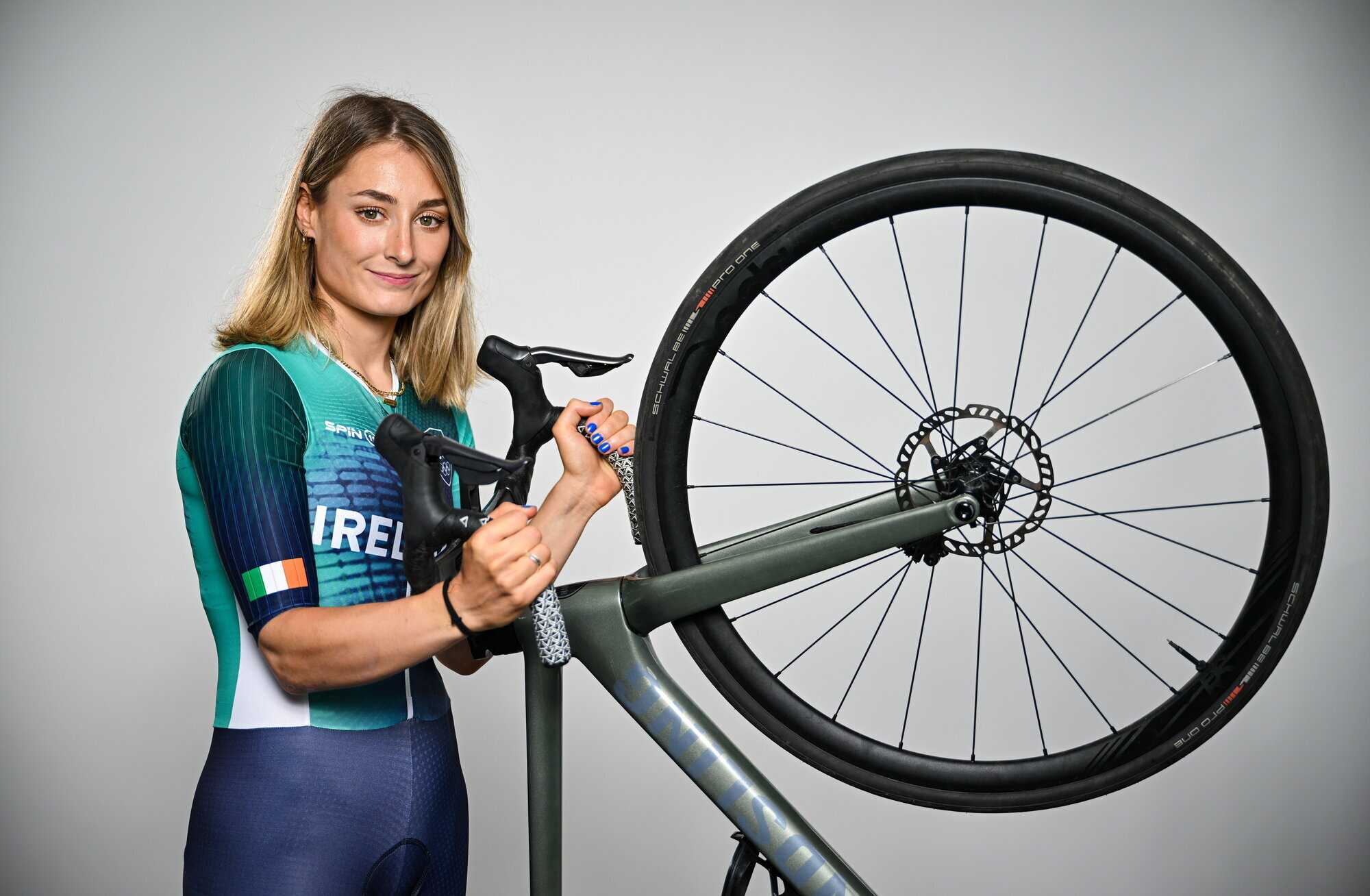
Mia Griffin during the Team Ireland Paris 2024 team announcement for Cycling Pic: David Fitzgerald/Sportsfile
When Mia Griffin was growing up, her sporting career was headed in one clear direction. The creed in Kilkenny meant she was destined for the small ball. She was reared around camogie. She was born to be an Olympian.
“An All-Ireland in Croke Park would have been on my priority list,” she says of her childhood.

“I never really thought about the Olympics, but I always would have thought that going to the Olympics is pretty spectacular, and if an athlete goes to the Olympics, it is a pretty big deal.”
Every athlete in Paris has their own story. They all have talent. How it was discovered and nurtured is another matter entirely. For Griffin, at the start there was no grand ambition or essential dream. Her burning passion for the pursuit is evident but she didn’t find cycling. Cycling came calling.
“Being a Kilkenny native, it obviously means from a young age that hurling and camogie is the biggest sport. It is like a religion. I played camogie since I was five years old. That was my sport. I played county minor. I was playing intermediate when I stopped. I was 18 when I started cycling.”
Griffin transferred to cycling in 2017 through a talent identification drive. She won a bronze medal at the U23 Track European Championships in 2020 and thrived on the road too, winning two Rás na mBan stages in 2023. Now she is a trailblazer, part of the first ever Irish women’s pursuit team to qualify for the 2024 Olympics.
These kinds of talent identification programmes have been common in parts of Europe and beyond for decades. Yet successful Irish transfers are typically by accident rather than design. Bruce Wardrop is a lecturer in the Department of Sport & Exercise Science at the SETU Waterford and the presenter of the Irish Sport and Exercise Science Association Podcast.
Griffin’s mother, Maria, works on the same campus. Cycling Ireland’s notice was advertised there and it was Wardrop who suggested it.
“Over the years I have said to one or two students, would you ever have a go at this particular sport? But often coaches don’t want to tell athletes to leave their sport,” he explains.
“It takes an open-mindedness. You also need to see some potential. It could even be a family member. Support staff and coaches can keep an eye out and make suggestions. Not every sport is set up to accept a high-performance athlete from another sport.
“You need a long-term plan. You won’t do it six months before the Games.”
What does it take? Griffin immediately demonstrated a particular skillset. She was put through a three-minute test on the Wattbike and a six-second peak power assessment. Her strength now in cycling is high peak numbers. That stems from camogie as well as a cross-country running background.
There are other successful crossovers. Fellow cyclist Megan Armitage went from hockey and casual running to marathon training. The 28-year-old took up cycling during lockdown. A sensational rise saw her become the first Irishwoman to win a UCI-ranked staged race at the Vuelta Extremaduras Feminas. In Paris, she competed in Sunday's women’s road race, finishing an impressive 35th.

A long-awaited arrival. Almost 20 years ago, Cycling Ireland set up a track cycling camp in Mallorca. In recent years Griffin and the team built an Olympic-worthy unit piece by piece. Their underlying creed was 100% commitment. It had to be that way. Having no home base meant the small margins were stacked against them. Alice Sharpe recently said there have been times when someone suffered an injury and they were without the required medical support. The sport requires an iron will. For their dreams, the demand was greater.
This is the crucial component for Wardrop. Ability alone doesn’t matter. Pay heed to the case of phenom Oskar Svendsen.
In 2012, an 18-year-old Norwegian visited a lab for physiological testing. Svendsen’s game growing up was soccer and skiing. In high school, he took up cycling. His school had been testing teenagers as part of their selection process. It was made up of all the usual stuff, lactate threshold, VO2 max. Svendsen smashed it. Literally.
A quick primer, VO2 max refers to the maximum amount of oxygen that an individual can utilize during intense exercise. At 15, Svendsen clocked a remarkable VO2max of 74.6 mL/(min·kg). In 2012 he recorded a staggering 96.7. Scientists dissembled the testing equipment and sent it back to the manufacturer to check its calibration. They confirmed it was functioning correctly.
“A normal person might be at 40,” explains Wardrop. “A really fit person might be 60. A really well-trained endurance athlete might be in the 70s. World class might be in the high 70s or 80s. He was basically the fittest human ever. He went on and became the U18 world champion in cycling.”
Two years after that famous test, Svendsen left the sport behind.
“He didn’t like it. He didn’t like the lifestyle. The competitive nature. He had all the physical attributes, but he didn’t have the head for it. This is the thing. Take Mia. She is so driven. Determined. Now she has the physical attributes as well. But being a high-performance athlete is tough physically and mentally. It is really important to remember that.
“You only learn it by experience. You take ten athletes, eight might have the physical capacity. Five might have the physical and be coachable. Three have that physical ability, are coachable and have the mental fortitude to see it through.”
Griffin is part of a four-member team. They are the only group to qualify without having a national velodrome.
“We had a comparably small budget compared to other nations,” she says. “We were a small number of people, but we were able to put a lot of time and energy into a small group and from there create a high performance environment that was small but functioned quite well.”

Sharpe came from a triathlon background. Kelly Murphy only took up cycling at 28. So, can Ireland expand programmes like this or those that have succeeded elsewhere? Well sure, reckons Wardrop, but it is tricky.
“There are different ways. You can be really targeted for example. Diving in Ireland is not a sport we typically develop. So, we might look at Gymnastics. Or you can do it more generally. Athletes who’ve done well but maybe hit their ceiling. You want people around them who can provide the right support and nudge them along. It is something that we could do more, but it’s not easy. There are loads of structures that have to come with it.”
In reality, the problem with talent transfer programmes is a testament to every athlete on the ground right now. There is a reason the depth of human feeling will be on full display over the next two weeks. Just getting to this stage is hard-won. It is a challenge for the head, the body, the heart. It’s taxing and volatile and uncertain and hard. It is an awesome Irish sporting story to even make it to Paris in the first place. The necessary concoction can’t simply be manufactured or unearthed in a lab.
In 2018, Deadspin tracked down Svendsen for a reflective interview. He was happy with his decision to walk away. He was content with his new life. Later he studied Information and Communication Technology as well as Civil Engineering. That wasn’t the initial choice. Before that, the fittest human ever, the sensation with all the physical attributes required to thrive decided to delve deeper into why sport didn’t work out. First, he studied psychology.