In at the deep end: Team Ireland ready to dive into Paris Olympics
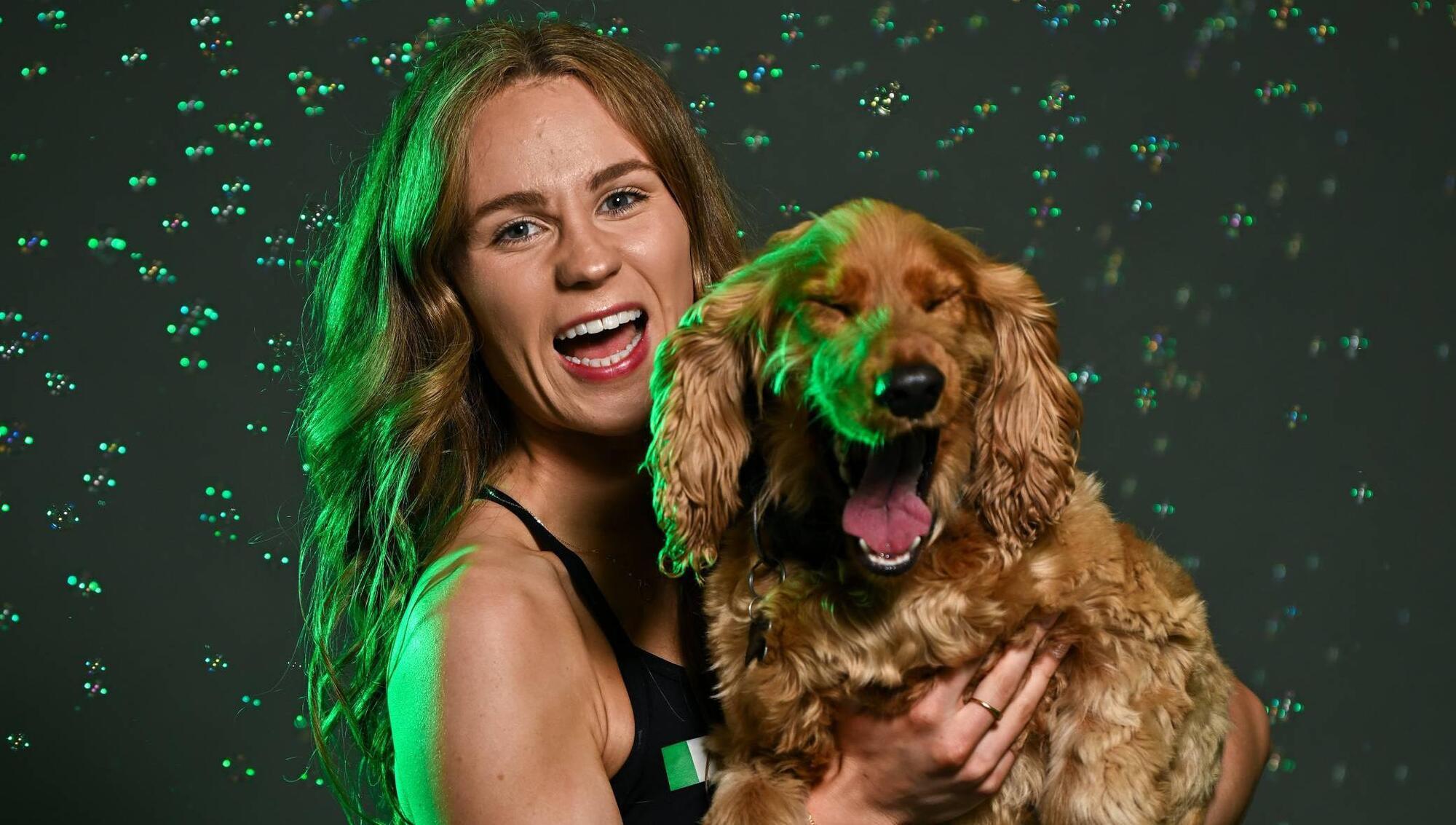
IN AT THE DEEP END:; Swimmer Ellen Walshe with her Cocker Spaniel Barley. Photo by Sam Barnes/Sportsfile
For some, it was that time we craned our necks back and tried to gawp all the way to the top of our first New York skyscraper.
For others it was the endless shifting landscapes of a coast-to-coast. Or maybe the sensory overload that is Las Vegas.
America has always had this. Always been this. It has always had that capacity to confound with its sheer size and its energy and its possibilities.
For our athletes and swimmers who earn scholarships to their universities those eye-opening moments can come on the track, on the field or in the pool.
Ellen Walshe was no shrinking violet when she left Dublin for the University of Tennessee three years ago.
A self-confessed “diva” as a teenager, she had matured by 2021 without losing any of the drive that had made her such a seriously talented swimmer. She was a one-to-watch among the select elites pooled in Templeogue and nationwide.
Knoxville was another world.
“Over there it was 80 [people in the training group], 40 men and 40 women, and everyone shows up to every session.
"You lived and breathed the same sport with these people. You never step outside of it because your friends were doing the same thing.
“That’s one college I was at, there are many swimming colleges in the States, and when we went to compete against different countries, at NCAAs or SECs, they have 20 women going the exact same time. We have one person doing it every 50 years.
“That’s a big exaggeration, but it takes a while for us to get one or two down to that level. US trials was on recently and they have four or five people hitting the FINA ‘A’ [Olympic] time every single time. We have one person in every three or four races. It’s nearly impossible.”
This is the context. This is what athletes and coaches and pundits are getting at when they try to explain just how significant it is when Irish swimmers or shooters or sailors even make a Games. This is the bigger picture to the images we’ll see in Paris but it still doesn’t fully explain why we have made so little stir in Olympic pools.
Put the charred memory that was Michelle de Bruin’s experiences in Atlanta in 1996 aside and the well was dry in terms of Olympic finalists for this country until Mona McSharry made it to the last eight in the 200m breaststroke in Tokyo three years ago.
In the five Games separating ’96 and 2021, only two Irish swimmers had even made it out of their heats and into a semi-final. Andrew Bree managed it in 2008 and Shane Ryan in 2016. Both did it on the back of new national bests.
That was what it took just to make the mezzanine.
Some Irish swimmers went to Games and posted PBs and other Irish records and never made it out of their lanes. Sometimes nerves and form, or illness and injury collaborated against them when it came time to bear ultimate testament to their talents. Others passed through the circus and just found their natural ceiling was at the lower end of the big top.
John Rudd, the current performance director for Swim Ireland, is astute enough to avoid a deep dive into the past and its whys and why nots. The Englishman has made the point that Irish swimming has been a thing for 131 years whereas he has only been on board for the last seven.
“There has been talent in the past, prior to me and this team working here. That talent, for whatever reason, didn’t quite come to fruition. There was a frustration in Irish swimming that they didn’t get to see some of those really good swimmers of the last 10-20 years make it into the next rounds and challenge for medals.
“Where we’re at now is we have a population of athletes who believe and who feel comfortable in a world arena and don’t go in there with a level of timidity. They have their shoulders back, their leads high and they will take on the world.”
Rudd explained this to the in the wake of January’s World Championships in Doha where Daniel Wiffen won two gold medals in the 800m and 1500m freestyles, Mona McSharry swam in three finals and left “gutted” by the absence of a medal, and more teammates again posted seriously impressive and improved times.
Danielle Hill has since won a gold and a silver medal in the Europeans in June. There will be expectations that Wiffen makes at least one podium in Paris while McSharry is an outside bet for similar but a good shot at another final. This sort of progress is a swell that has been visible to the naked eye for some time.
Ireland has won almost five dozen youth or university medals at major championships in the last five Olympic cycles and almost half as many at senior levels too. You could throw in some World Cup successes there too.
This is new and the graph is only going one way. Eleven senior and 17 underage podiums have been recorded in this last cycle. That’s a record in itself but it’s more than just quantity with various national records tumbling too and the breadth of their impact expanding.
Shane Ryan winning bronze in a World Short Course Championship in China in 2018 felt significant as It stretched the string of successes beyond Europe and this last three years have delivered across World, European and Commonwealth levels.
But why now? Why not before. What has changed?
Not the finishing schools. McSharry, like Walshe, has had her education in Tennessee, Wiffen has profited enormously from his time at Loughborough University in the UK while others have plied their trade from home shores. None of that is different to before.
Go back through the last few decades of our swimming Olympians and you’ll find that Bree and Barry Murphy passed through Tennessee long before the current generation. Emma Robinson and Melanie Nocher swam in the same Loughborough pool as Wiffen. The home base remains another route.
So, there’s no one, simple answer. Is there ever?
Before the Wiffens and the McSharrys there was Grainne Murphy.
Born in Wexford, Murphy moved to the then centre of excellence, the NCTC in Limerick, as a kid. She won European medals at junior, a silver medal at the 1500m freestyle at the 2010 European seniors and two bronze at the continental Short Course that same year.
This was a year dot. She was Irish swimming’s future.
Her Olympics in London in 2012 experience was a disaster, a bout of glandular fever forcing her to withdraw from the entire meet after swimming the heats in the 400m freestyle, and she had retired just three years later due to further illness.
If health and luck was against her then so was the timing. Her zenith coincided with the high-performance unit’s relocation from Limerick to Dublin, and all the headaches that brought. The governing body’s decision not to renew a contract with her coach Ronald Claes after London caused another big stink.
That was then. Murphy looks at the system and pathways in place now and she can see clear and obvious improvements. Not least among them is how teenagers are able to tap into programmes dotted around Dublin, Limerick and the north so that they don’t have to uproot, as she once did.
“So they are getting a taste of that full-time athlete life. Nationwide there is that bit more structure whereas at the time I was competing Limerick was the first high-performance centre and then Dublin came in shortly after.
“It is expanding in different ways. We have full-time head coaches with assistant coaches underneath so that if they are gone to a Europeans and someone hasn’t made it there is still someone there to look after them and it’s not just someone trying to help out.
“There’s obviously a lot more investment there too and, I always say it, the coach-athlete relationship is at the centre of everything. If that’s not there the success is not going to come. Performance comes from a happy athlete.”
The wider Team Ireland will go to these Games with nine medals predicted for them. They may have twice as many shots at a top-three place in all, some more hopeful than likely, but what all the anecdotal evidence of recent years tells us is that this is a virtuous cycle.
The coalescing of talent around facilities like the Institute of Irish Sport and the National Indoor Arena in Dublin has opened avenues of communication and allowed people from different codes to learn and take inspiration from each other but this theory applies within each sport too.
If people see they can be.
Grace Davison, a member of the women’s medley relay team that will compete in Paris, won’t turn 17 until after the Games. She won gold and silver at the Youth Commonwealth Games last year and spoke afterwards about how she had been inspired by Wiffen, Barry McClements and Bethany Firth claiming medals at the senior version the year before.
That same spirit is infecting Team Ireland’s swimmers,” she believes.
“Ireland is obviously a small country and after the meets are over you don’t really see Ireland on the [medal tables]. But the last few meets I’ve been to, the European Short Course in Romania and then Doha, we’re starting to get on the medal table.
“It’s exciting because it was almost something that was never in reach but you were seeing teammates, people you know, breaking a world record, in Daniel Wiffen’s case, and you never would have thought that would have happened. It’s something to aspire towards.”
Walshe speaks with the same voice.
Knoxville never intimated her by the way, it motivated her. She has explained in the past how she looks around call rooms now without fear or favour and sees women who are of the same flesh and blood. The collective rise in Irish swimming has been another part of that.
This transfers further down the line than the senior programme. The Irish Open in May provided a picture perfect example of that when Walshe nailed the Olympic qualifying time for the 400m individual medley to add to slot already booked in the the 200m.
Her younger sister Eva finished sixth in the same race.
“I remember sitting in the call room recently enough and a young girl came up to me and said ‘it’s great to have you as role models in the sport’,” said Walshe. “So to hear that, if I don’t get a medal then I’ve still inspired people to drive on.”
(National Centre, Dublin), 400m, Freestyle Relay, 400m Medley Relay (*)
(Ards SC), 400m Freestyle Relay, 400m Medley Relay (*)
(NCD), 50m Freestyle
(Loughborough University), 400m Medley Relay
(NCD), 400m Medley Relay
(Larne SC), 100m Backstroke, 50m Freestyle, 400m Freestyle Relay, 400m Medley Relay.
(Millfield School, England), 400m Medley Relay.
(University of Tennessee), 100m Breaststroke, 200m Breaststroke, 400m Medley Relay.
(NCD), 400m Freestyle Relay, 400m Medley Relay (*).
(NCD), 400m Medley Relay.
(Templeogue SC), 100m Butterfly, 200m IM, 400m IM & 400m Medley Relay.
(Loughborough University), 800m Freestyle, 1500m Freestyle & Open Water 10km (*).
400m Freestyle Relay Diving
(Ohio State University) 10m Platform
(City of Leeds) Male 3m Springboard
CONNECT WITH US TODAY



Be the first to know the latest news and updates