RTÉ award choices sunk in a pit of confusion
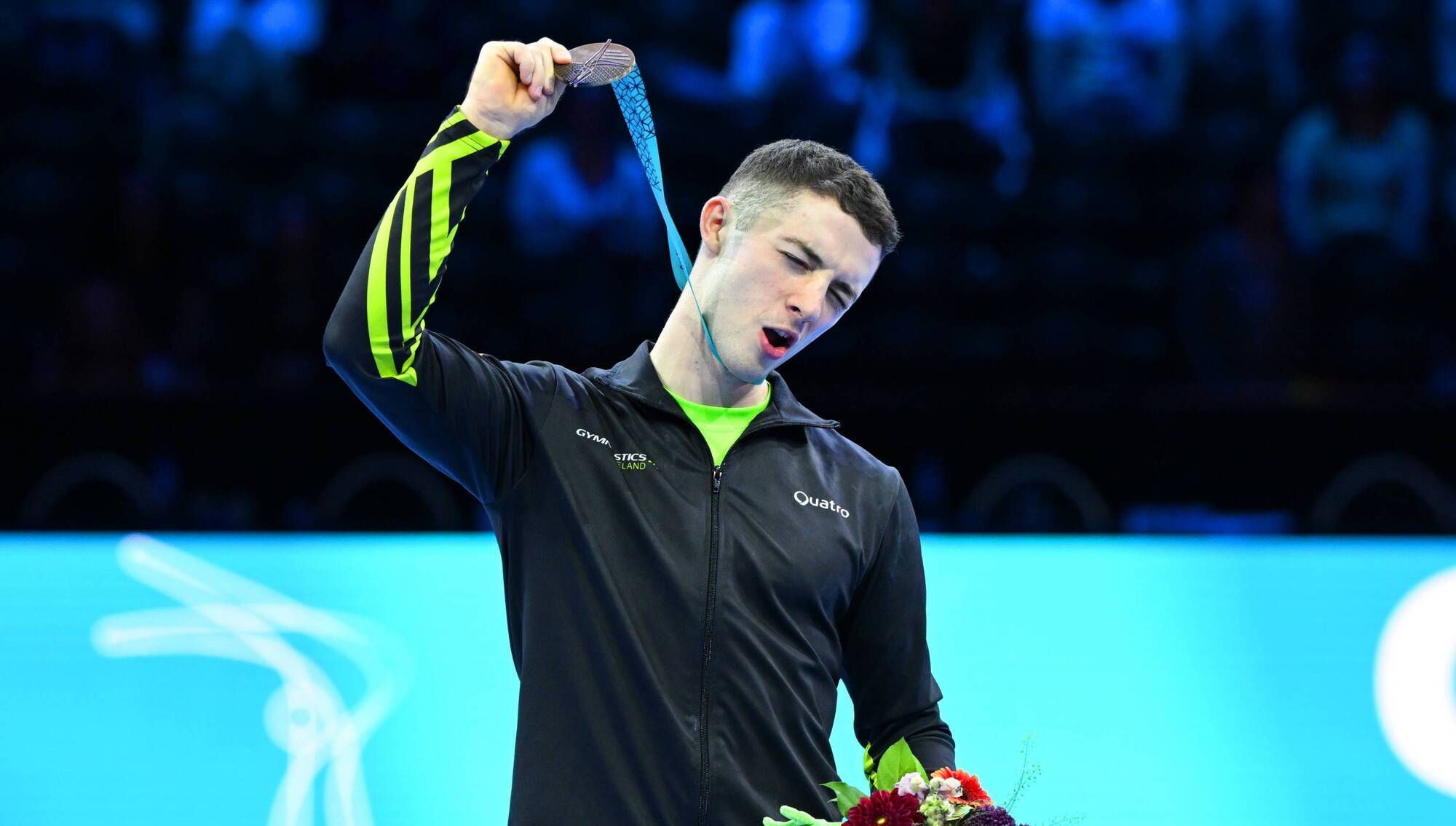
A YEAR TO SAVOUR: Rhys McClenaghan celebrates with his gold medal after winning the Men’s Pommel Horse final at the World Artistic Gymnastics in October. Through his exploits in 2023, McClenaghan blazed a trail where no Irish gymnast has ever been.
The worst lies of all are the ones we tell ourselves, and at this time of year, there’s an empty promise I keep making: thou shalt not get annoyed at the RTÉ Sports Awards.
After all, the athletes don’t really care, their only barometer of success being the cold, hard figures on the scoreboard, stopwatch or judges’ scorecards, and not the subjective opinions of a panel, tasked with an apples-and-oranges comparison.
Still, every December, that feeling draws in like a dark cloud – an outrage on behalf of a sportsperson you might not even know, a sense of injustice that their achievements have been overlooked in favour of the less accomplished.
Maybe this is you, too. Or maybe you have a life.
Last Friday, RTÉ unveiled their nine candidates for Manager of the Year and you know who didn’t make the list? A man who has coached Irish boxers to nine Olympic medals. A man who, this year, coached two European champions, five European medallists. A man who, in his 20 years in this country, has made a bigger contribution to Irish success on the world stage than anyone, in any sport, ever. Zaur Antia.
The Georgian’s former sidekick at the IABA, Billy Walsh, did claim that accolade in 2012, but Antia has been head coach for the past decade, garnering astonishing success, and has been overlooked for reasons I can’t fathom. He was nominated for the honour the last two years, losing out to rowing coach Dominic Casey in 2021 and Irish women’s soccer manager Vera Pauw last year. This year: nothing.
Under his guidance, four Irish boxers brought home medals (three of them gold) from the Strandja Memorial in Bulgaria in February, the most prestigious tournament in the world outside championship boxing. Now, I’m a long, long way from a boxing expert, but I’ve been to watch Katie Taylor, Kellie Harrington, and I was at the European Games in Poland this summer, where five Irish boxers – Harrington, Aoife O’Rourke, Jack Marley, Dean Clancy and Michaela Walsh – won medals against Europe’s best, thereby securing their places at the Paris Olympics.
It's no secret that Antia’s technical genius has been a chief driver of success in Irish amateur boxing over the past two decades, but to stand in the mixed zone and hear boxer after boxer, unprompted, bring up his name and explain how big a role he'd played in both their preparation and in-fight tactical adjustments makes it land like a haymaker.
“He is the man, always has been, always will be,” said Harrington after winning gold. “He is fantastic.” Yet those selecting the top nine managers or coaches in Irish sport this year obviously don’t think so. There are many worthy candidates on the list, but it makes no sense that four are from GAA. Each of those undoubtedly deserves immense plaudits, as no All-Ireland comes easy, but we’re guaranteed four such winning managers every year, no matter the quality of each championship. Does leading a team to a national title imbue a divine right to be on the list? If so, several other sports would like a word.
Antia's omission smacks of two things. One: the painfully chronic inability of so many in Irish sport to differentiate between the difficulty of success in a domestic sport versus one contested by most of the world. Two: a fear of being shouted at, of causing offence to large sectors of Irish sport by omitting one of its leading lights. Best to just shun the so-called minority sports.
The latter seems to be the bigger issue here, and it’s why you’ll always see rugby, soccer, GAA and horse racing well represented at these awards, even in years where one proves mediocre.
The shortlist for Sportsperson of the Year? Johnny Sexton, Katie McCabe, Katie Taylor, Rhys McClenaghan, Paul Townend, Róisín Ní Riain and Aaron Gillane. No room for Rhasidat Adeleke or Ciara Mageean or Daniel Wiffen, all of whom finished fourth at their respective World Championships.
The shortlist had 10 nominees last year. This year it’s down to seven. The nominees were announced last weekend, the same day Wiffen won his third gold medal of the week at the European Short Course Swimming Championships, smashing the 800m freestyle world record held by seven-time Olympic medallist Grant Hackett. The panel might get a pass on Wiffen's omission if the decision was made before he went on his European medal spree, but then he also won European U-23 gold in August, along with finishing fourth in two world finals.
The absence of a medal – no matter how close they came – in the biggest event of the year obviously counted against Wiffen, Adeleke and Mageean, but this metric wasn’t turned against Sexton or McCabe, whose years were rightly judged on the whole, and not on their teams' absence at the business end of respective World Cups.
Which brings us to Adeleke, who seems a glaring omission. At the age of just 20, the Dubliner set seven Irish records this year and became the first Irish sprinter ever to win an NCAA title, clocking an astonishing 49.20 for 400m. Adeleke didn’t just run faster than everyone who showed up at that NCAA Championships in June – which gathered the majority of top college-age talent from the US, the Caribbean and all over the world. She ran faster than anyone who's ever shown up at the event.
Her season was built around that race, as it must be when you’re supported by a university, yet two and a half months later, running on fumes, she came agonisingly close to a World Championship medal in Budapest despite an interrupted preparation with lower-back problems. Yes, she fell short of the true goal, but both the pure performance merit of that NCAA win and the impact of her reaching that final and contending for a medal in Budapest should have seen her nominated.
But the more you dig into this stuff, the deeper you sink into a pit of confusion. Billy Walsh and John Coghlan have coached Olympic champions in boxing and athletics for other countries in recent years but received no recognition, yet Ronan O’Gara is up for Manager of the Year for leading a French team to the Champions Cup. No one doubts O’Gara’s brilliance, of course, but if he’s up for that this year, why was Mark McCall overlooked in 2016, 2017 and 2019, when he led Saracens to Champions Cups glory? Guess who was nominated in each of those years? Four GAA managers.
It's proof, if needed, that these awards are not truly about crediting Ireland’s best based on the difficulty of their achievements, but a tokenistic exercise in people-pleasing.
Who should win this year's top prize?
For me, it’s Rhys McClenaghan, who became back-to-back world champion in the pommel horse and also claimed his second European title, blazing a trail where no Irish gymnast has ever been. But knowing the history of these things, I won’t fall off my chair if I’m wrong. I'll just try to keep my promise and not get annoyed. Try and fail.
CONNECT WITH US TODAY



Be the first to know the latest news and updates