America still in awe of late, great, track rebel Prefontaine
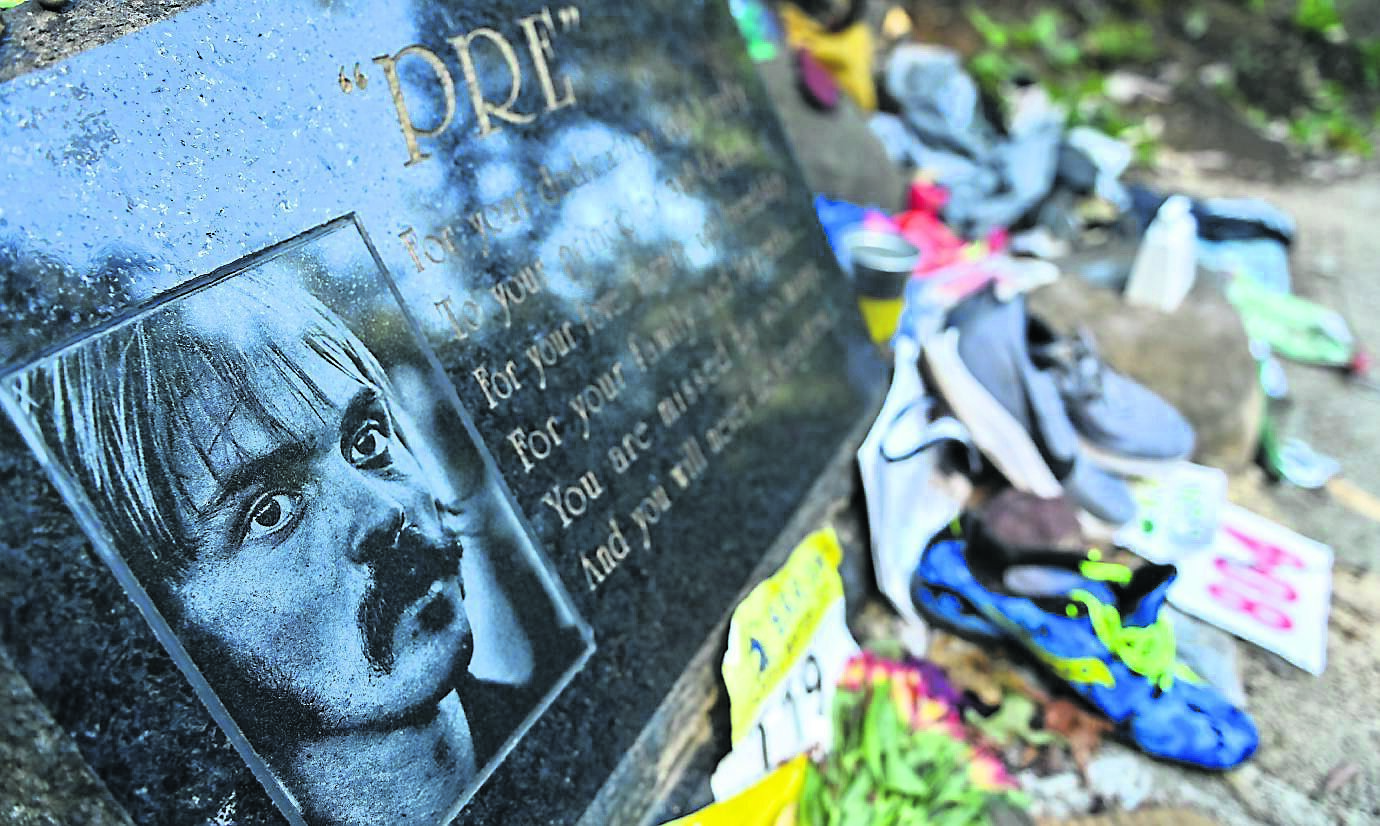
Pre’s Rock during day four of the World Athletics Championships in Eugene, Oregon. Pre’s Rock is a memorial to US distance runner and Oregon native, Steve ‘Pre’ Prefontaine, who died at the location in 1997.
In the tree-covered hills above Eugene, a 20-minute walk from Hayward Field, there’s a stone slab by the side of the road that remembers an athlete whose influence can be found everywhere you turn at these World Athletics Championships.
Pre’s rock, the site where US distance runner Steve Prefontaine crashed his car and lost his life on 30 May, 1975, is more than just a tick-the-box memorial. It’s a shrine to the James Dean of distance-running – a hard-racing, hard-drinking rock star of the sport who died at the age of 24, and whose charisma and courage granted him god-like status in this little corner of the United States.
Ask a random American to name a distance runner and he’s the one most will pluck for – almost half a century on from his death – and Pre’s rock, tucked away amid the trees overlooking the Willamette river, is where they come from far and wide to pay respects.
It’s where runners lay their medals or shoes, their race-t-shirts or spikes – various little tributes to a man whose best lines remain immortalised nuggets of inspiration for young athletes, most famous of all that gem about making the most of your talent: “To give less than your best is to sacrifice the gift.” On the sole of a Nike shoe left at the site, there’s a handwritten line: “Only when you make a place a home are you allowed to leave.” And few made a place their home like Pre, as he was known to a generation of adoring locals in Eugene, his life story captured for contemporary audiences in two movies, Without Limits and Prefontaine – the former being the go-to choice for countless athletes across the world the night before a race.
Some of Pre’s best quotes are dotted around Hayward Field, coming at you in random places such as the bathroom walls. “A lot of people run a race to see who’s the fastest. I run to see who has the most guts.” Or the line that sums up his racing mentality: “The best pace is a suicide pace, and today looks like a good day to die.” The stadium here was given an eye-wateringly expensive facelift in recent years – estimated cost: $270m – ahead of these championships. The creaking wooden seats of the old place were ripped out and replaced by plush, cushioned ones that feel more like armchairs, the rickety stands that used to shake to the chants of “Pre, Pre, Pre” through the ’70s came crashing down, replaced by a stunning new-age structure that seems a fitting flex of wealth by its chief donor, Phil Knight, the Nike founder and University of Oregon graduate whose love for the sport runs as deep as his pockets: he’s got an estimated net worth of $40 billion.
This is Tracktown USA, but it’s also Niketown, and for decades the brand has been inseparable from its roots at the University of Oregon, Prefontaine’s alma mater. Pre never did win an Olympic medal, finishing an agonising fourth in the 5000m at the Munich Games in 1972, but he set American records at every distance from 2000m to 10,000m.
But it was his attitude, more than his times, that truly captivated the crowds.
On my first visit to Pre’s rock, during the 2014 World Junior Championships in Eugene, I ran into Prefontaine’s sister, Neta, and his nephew, Michael, who painted a very different picture of the late, great athlete to the fiery, ultra-confident person the world got to see.
“Underneath he was not quite sure about things,” said Neta. “I always saw him as being very humble. When he knew about something, though, he would be very confident.” Neta helped mentor her younger brother through the insecurity of childhood, recalling how when Pre was eight, she came home from school one day to find her brother hitting his head against the wall, tears rolling down his face.
“I’m stupid and I’m dumb,” he said, “and I’m never going to do anything right.” Neta, nine years his senior, put her arms around her brother and said: “Honey, someday you’re going to find something you can do and when you find it, that’ll be your gift.” Many years later, she went to Hayward Field for the first time to watch one of his college races and sat in stunned silence as the crowd made the grandstands shake with a thunderous, rhythmic chant: Pre, Pre, Pre.
“I started crying,” said Neta. “I realised he’d finally found his gift.” Pre was also a prankster, his sister recalling the time he streaked through the Valley River shopping mall. “He put a bag over his head, stripped down, ran through the mall and out the back door,” said Neta. “When he got out the other side, his college coach [Bill Dellinger] was waiting for him. Steve thought nobody would recognise him with the bag over his head.” She laughed fondly at the memory. “He could be so innocent,” she said. “He just enjoyed life.” A month before his death, she had a dream that Steve was killed in a car wreck. Spooked by the experience, she called him to asked if he was okay. “I’m fine,” said Steve.
But in the early hours of 30 May, 1975, the phone rang in Neta’s house. It was her father, Ray. “Are you sitting down?” he asked.
“No, why?” she said.
“Well, sit down,” he said, before delivering the horrific news.
Prefontaine had been drinking that night – the police report stated his blood alcohol level was above the legal limit – but even today, no one knows what caused his car to hit a rock and flip upside down, with another car present for the incident immediately leaving the scene. Decades later, his family preferred to think about Prefontaine’s life rather than his death.
“The amount of people he’s touched is amazing,” said Neta. “He saved children from drugs, saved convicts from a lonely life in prison by starting their track programs, and I’ve heard so many people say if it wasn’t for him, they wouldn’t have made it in life.
“To this day, I’d give anything to have one more hug from my brother.”

CONNECT WITH US TODAY



Be the first to know the latest news and updates