Ukraine grateful for Ireland's help ahead of clash
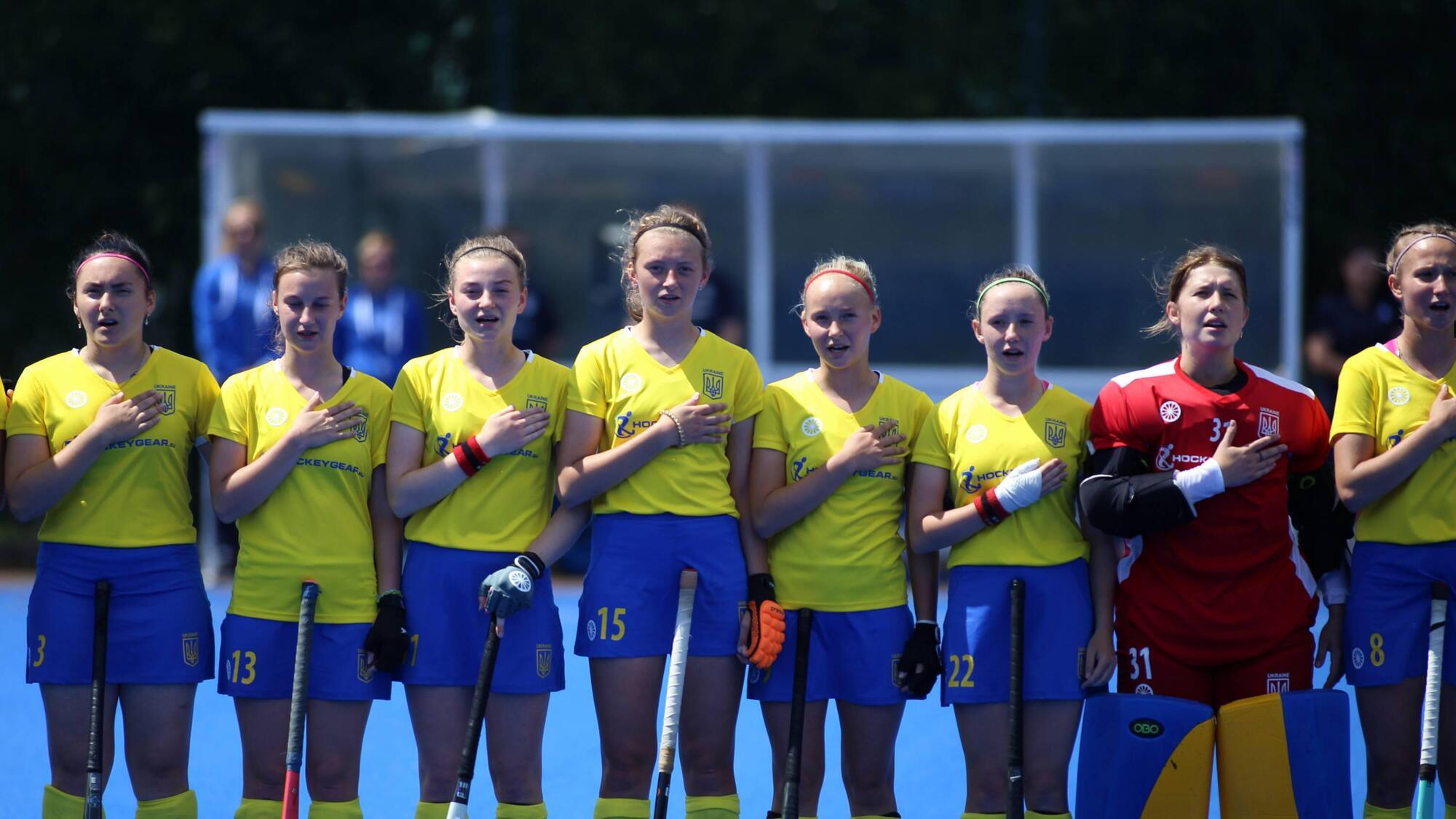
Ukraine national anthem U23 Uniphar 5 Nations, Ukraine v United States of America at the National Hockey Stadium, UCD Belfield on 20/06/2022 Credit: Max Fulham
Two and a half months later than hoped, the Irish women’s development squad are looking forward to taking the field with their Ukraine counterparts on Thursday at Belfield (5pm) as part of the Uniphar Five Nations tournament.
The two nations were due to play each other on the opening day of the Junior World Cup in South Africa in April until the Russian invasion turned Ukrainian lives upside down.
Normality remains light years away but, through the hockey family, Maryna Horokhova says they can play a small part in bringing pride and belief to their people and country.
“The players are people fleeing a war first and then, second, sportspeople who know they can represent their country and have been given the responsibility and a chance to do so,” the Ukrainian Hockey Federation’s vice president said.
“Despite their troubles, fears, homesickness, they are aware they are not just simple hockey players. They are an international team and are growing up quickly, probably faster than they should.”
The Junior World Cup appearance - a first since 1997 - was set to be a breakthrough moment for the side. A camp of 30 to 40 players had assembled between the main clubs in Borispol and Sumy, visa applications were in the pipeline in Kiev.
And then came the war, stopping everything dead in its tracks. Tanks rolled in and surrounded the city of Sumy in the war’s early days; the Borispol hockey stadium closed down with the adjacent area used for munitions supplies.
Singular focus was on evacuating who they could, hoping for what aid their contacts in the hockey community could come up with.
“We just thought, we are taking all our children abroad; please help us!” Horokhova explained as they mobilised as quickly as possible.
“One was sitting in an underground bomb shelter and five doors down, a shell hit and 20 were killed. She could have died - the windows in her house were blown out. Her family sent her the next day.”
Navigating the myriad checkpoints to the Polish border took over four days; their bus initially had 16 hockey players aboard but filled up as it went until they were able to cross with the Polish federation able to transport them on to their Olympic centre in Walcz.
Others linked up with them via their own routes, traversing Germany, the Czech Republic and so on, before the Dutch federation assisted their passage to Rotterdam to set up a base.
In the end, about 20 girls - aged between 12 and 22 - made it that far where Victoria Hockey Club was able to house them in a converted underground changing room.
To get this far was a minor miracle but “it was never a long-term solution”.
“Some still had the feeling they were living in the bomb shelter with no windows. One of the 22-year-olds simply said it was not an option to stay here and I will quit the team - I am an adult and can go my own way.
“The coach understood but also did not want the team to be broken up. They would have no control over them if they went their separate ways but would still be responsible for their well-being.”
The International Hockey Federation did keep their Junior World Cup spot until a couple of days before the event. But requirements for parental signatures on consent forms for visas scuppered that outside hope; with families scattered across the continent, it was an impossible task.
Nonetheless, they were heartened by the show of support from their international colleagues.
“The team manager was in contact with all the managers from the other World Cup nations. The likes of England and Ireland Under-21s were so supportive, asking: ‘what do you need? Sticks? Masks? Whatever you need, name it’.
“The Irish Under-21 team helped us like crazy and Dave Passmore has done a hell of a job to help us.
“In the end, the only thing left was money - it’s more concrete and you need it. Ukranians are proud people and found it difficult to even ask for it. Every person who gives one Euro is a hero.
“We can only be grateful but it still seems never enough and it will stop sometime. The problem is we don’t know when or how it ends.”
It’s in that context, Passmore was so keen to get Ukraine over to Ireland and the Under-21 side’s sponsors and donors have played a key role, covering flights and accommodation.
And it looks like Ukraine will be a competitive feature of this week’s tournament, pushing the USA 2-0 on Monday.
It comes off the back of an unintentional but much extended three-month pseudo-training camp.
Since arriving in Rotterdam, Ukraine were able to train twice a day and pick up regular fixtures against local teams. This, however, is becoming trickier with the Dutch government ending free public transport for Ukrainians a fortnight ago.
They have moved to a Government protective facility, a repurposed office block where their troupe has swelled with the arrival of a couple of the players’ mothers.
“They are better off now being looked after by the Dutch government rather than a willing club who was happy to help but not prepared for the task with this volume of people. We are grateful for their help but it was overwhelming.
“For example, some of the team hadn’t seen as much of the war so initially felt it might be like a regular two-week camp in Belarus or Bulgaria. Only after a month, they started feeling a long way of home.
“We see different girls have different problems. Some are thinking of staying here; some want to go home despite the war; some are thinking about stopping hockey because it has lost the fun; some are thinking about university… not everybody will go back to Ukraine. For some, there is no reason to go back.”
They have also managed to travel to Turkey under the banner of TSOP Kolos Borispol for a European club tournament and they will contest the Under-21 EuroHockey Championship II in July.
Horokhova is keen to stress it was not “the Ukranian team” but “a Ukranian team”, one of circumstance for each individual with many of their more experienced players unable to link up with the side.
“Why is it important they keep playing?” she adds. “Hockey players - and sports people in general - are heroes; every achievement they have abroad is greeted by a lot of respect and memories.
“The Eurovision song contest gave such a proud feeling to the nation; we have a signed Ukranian flag by soldiers which travels everywhere with the team which reminds them what they are doing it for.”
CONNECT WITH US TODAY



Be the first to know the latest news and updates