Potential for handballers to compete for Olympic glory, but building of sport must be from ground up
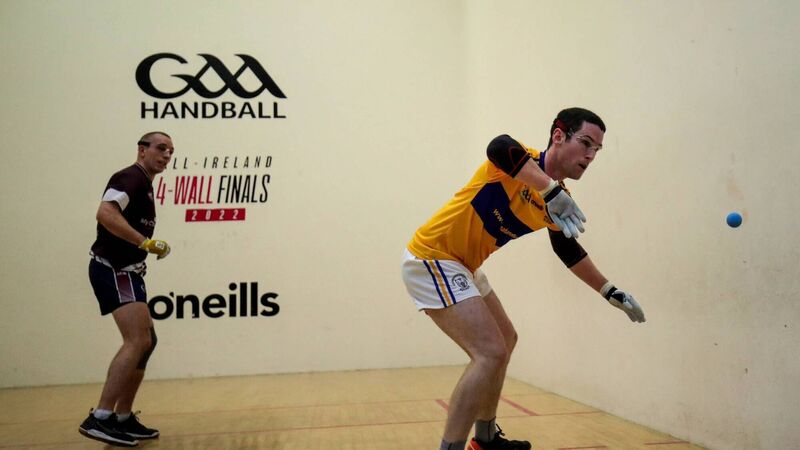
Clare’s Diarmuid Nash in the Men's senior final at Kingscourt against Robbie Mccarthy from Mullingar. Pic: Evan Treacy, Inpho
Irish handballers could some day have the opportunity to challenge for an Olympic medal, believes the GAA’s Director of Coaching and Games, Shane Flanagan.
Handball was hit harder by pandemic restrictions than any other code in the GAA family and off the back of declining membership and based on recommendations in its recently-published Strategic Plan – the sport’s first in a decade – a major overhaul of structures was announced last week.
Chief among these is the sport now coming under the auspices of Coaching and Games in the GAA. Four new full-time regional development officers are to be employed and GAA Handball is seeking to strengthen the links with overseas handball bodies, with One Wall handball seen as a key target area for potential growth at home and abroad.
“There is massive potential internationally,” stated Flanagan.
“If we can get that right and build stronger relationships with the different international bodies out there, we’ve a huge opportunity to make the game really, really attractive to young children. The opportunities to play in America, across Europe and God knows where else, they don’t exist in Gaelic football or hurling unless you’re lucky enough to get on an All-Star tour or something like that.
“Early on in my introduction to handball, 16 or 17 third-level students headed over to the Collegiate games in Missouri. They funded their own trip which takes some commitment but I’m sure they had the time of their lives and I think that’s what we need to be selling.
“I think we should be trying to get handball on the Olympic charter as well, I think that would be a terrific prospect for the GAA as a whole and I think it’s a vision we should have.”
Flanagan believes handball can be introduced widely in primary schools, with the initial focus on regenerating the ailing club network.
“I think the first area we need to focus on is the clubs. We have 189 clubs on paper and of those, there are about 130 active clubs across the country. Our focus should be to support those 130 clubs, identify why those other clubs are not active, look at underage development in those clubs and try to bring it back up that you have a sustainable organisation that has in the region of those 200 clubs across the country.
“There is potential around links with the local schools in terms of growing participation. That is the main focus of the new regional roles we are proposing as part of the new structure, it’s very much to get in and support volunteers within those clubs. Build relationships, build capacity within those clubs and make the game attractive to children.
“That’s the advantage of the relationship with games development at central level, we have the resources and facilities to help promote not just handball but all Gaelic games.
“We are challenged in many areas across the country, particularly in urban areas, to grow the game and I would probably suggest that from a handball perspective, it’s very cheap, it’s not an expensive game to play and if you look at other sports that are not dependent on huge facilities, they tend to develop well within urban areas and I think that’s where handball probably has its greatest potential in the future.”
The sport appointed Offaly native Tom Moloney as interim National Handball Manager last year and he admitted to being shocked by the weakness of the club network.
“The thing has to be smartened up and the club will determine everything,” said Moloney.
“When we broke down the number of clubs, we were actually frightened. A province like Leinster has 40 active clubs, there are 24 active clubs in Ulster. We should be well able to improve that.
“The people that are going to solve it are the people in counties and clubs. The power is with the people in the grassroots.” GAA Handball President Dessie Keegan expressed similar sentiments. Previous efforts to tweak things have been met with resistance at times and Keegan urged the membership to get behind the new structure.
“There is a tsunami of energy coming for our sport but we need to accept that we have to change. I see this as a three-pronged approach – number one is the office structure, number two is the constitution and number three is our Clár. The problem is that if we have all this energy coming, you’re going to hit a wall unless we have the other areas sorted.
“We are getting more staff. The GAA are investing in us. It’s now our decision as to whether we are going to invest in ourselves, in the areas I’ve talked about.
“The GAA can’t do any more than what they’re doing, it’s up to us as handballers now. This is the first time in 100 years that the GAA has seriously, seriously backed us. We have a €12 million handball centre at Croke Park, paid for by the GAA, we will have seven staff, paid for by the GAA.
“It’s time now that we proved to the GAA that we are willing to be a modern organisation.”
The National Handball Centre at Croke Park has been plagued by issues for over 15 years but a snag list is currently being worked through and it will soon be fully functioning, Flanagan confirmed.
“There is a commitment to get the place open, get it active as an administrative hub firstly but equally as a hub for activity at all levels and a staging point for international tournaments and becomes the envy of other international bodies,” he said.
CONNECT WITH US TODAY



Be the first to know the latest news and updates