Phil Healy: 'I could perform unbelievably and not make it through'
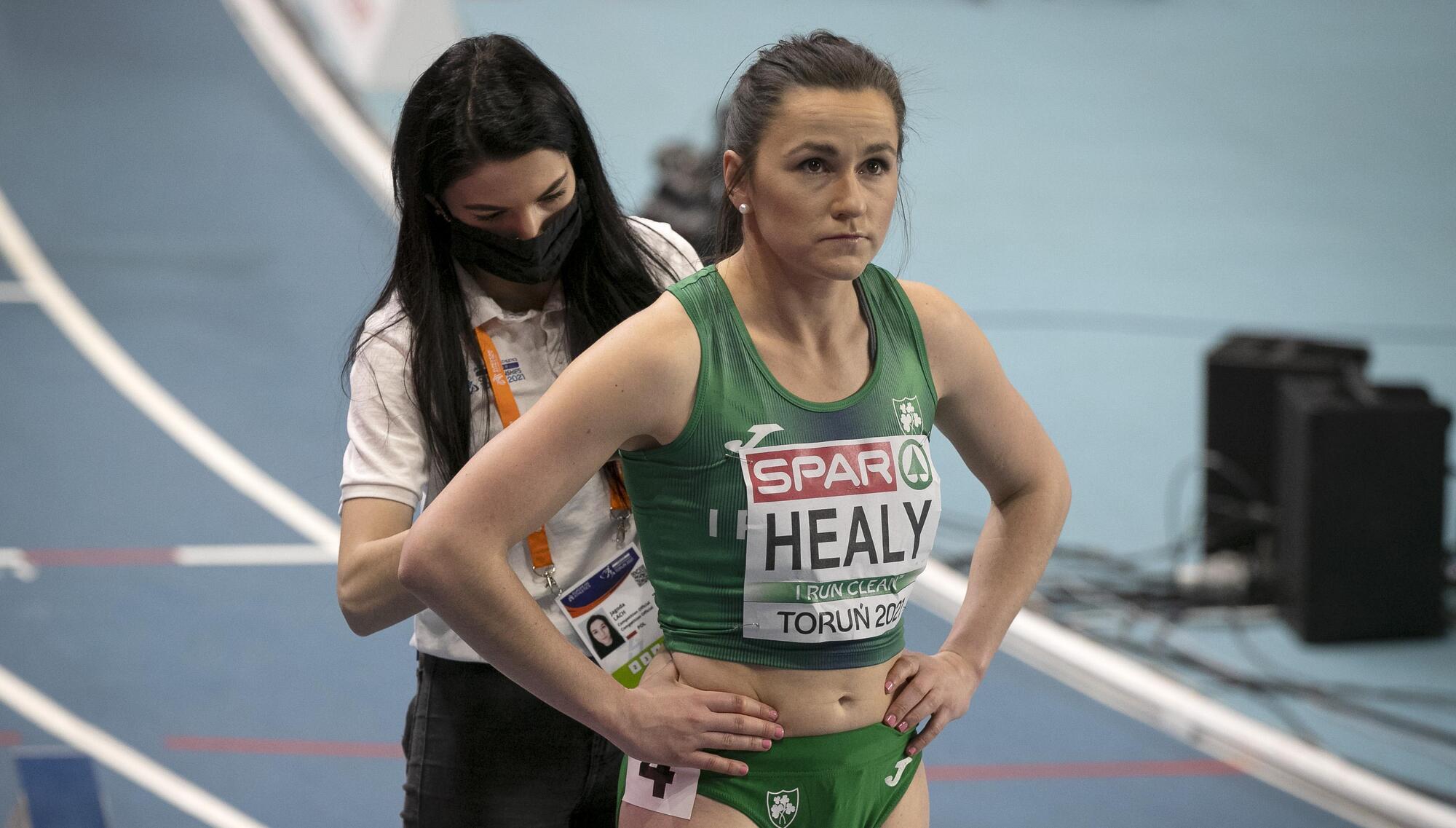
Here's the reality: Phil Healy won’t win a medal at the Olympics. In the three events she’ll contest, she likely won’t make a final and, truth be told, there’s a reasonable chance she won’t make it out of the heats.
But here’s the other reality: That in itself won’t constitute a failure. Far from it.

For those who dip their toe into athletics waters once every four years, the individual spectrum of success can be a difficult thing to grasp, but it’s important to note before the 26-year-old Bandon AC sprinter takes to the track in Tokyo.
It’s not about embracing a happy-to-be-there mentality, nor should it be an invitation to talk to Joe about “all this money” we waste funding Olympians.
If, or when, Healy finishes down the field in the heats of the 200m or 400m, the compare-and-contrast should not be done with Jamaicans or Brits, or Americans, but with her past self. She can only be as fast as she can be, and Healy is already the fastest Irishwoman of all time, an athlete with personal bests of 11.28 for 100m, 22.99 for 200m, and 51.50 for 400m.
In recent weeks, as the Olympic hype kicked into overdrive, Healy could only smile and respond politely when asked by those who simply didn’t know better that innocent question: Will you bring home a medal?
“Getting an Olympic medal is crazy, and it’s so unlikely in the athletics scene,” she says.
“Ireland does have its couch commentators, and if you don’t perform, you’ll be the first to be slated. Making a semi-final is massive, but I could perform unbelievably and not make it through.”
In Tokyo, Healy will become the first Irish athlete ever to contest three events at one Olympics, beginning with the mixed 4x400m relay on July 30, followed by the 200m heats on August 2, and 400m heats on August 3.
“You don’t want to go there and make up numbers,” she says. “But I could do my best in a heat and sometimes that’s not seen as enough.”

At the 2016 Games in Rio, the slowest time to advance from the women’s 200m heats was 22.94, while in the 400m it was 52.02. She has run quicker than both of those, but only on a handful of occasions. If she can do it in Tokyo, where it matters most, then whatever way the cards fall around her becomes almost irrelevant.
She will have done her part — been the best she can be.
During her teenage years, Healy wasn’t the athlete most talent scouts would pick out of a crowd. It’s not that she wasn’t fast — her speed was always a useful weapon she wielded on the camogie, football, or soccer pitch — but she wasn’t track-fast.
She took up athletics at the age of 11, following older sister Joan into Bandon AC — “literally for the craic and keeping her company”, she says.
She enjoyed some success in local sports days, Community Games and the likes, but in those early years the closest she got to an underage championship was watching her sister compete at the European Youth Olympics. Another athlete she watched there was Ciara Mageean, an international star of underage athletics, and recently Healy remarked to Mageean how strange it was that they’d now find themselves on the same Olympic team.
Healy often wound up fourth at Munster Championships in her mid-teens, well behind athletes like Sarah Lavin — another Olympic team-mate — and it was only in her fifth year of secondary school that she first qualified for the All-Ireland Schools Championships in Tullamore.
At Bandon AC, she’d been coached by Liz Coomey, who developed her to win her first national medal when she was U18. That was the year Healy jettisoned other sports to focus on athletics, and though her progress was rapid thereafter, she remains glad she didn’t specialise earlier.
“I’d encourage any child to explore so many things,” she says. “I tried basketball at one stage and even within athletics, I did everything from cross country to heptathlon.”
The big breakthrough came in 2013, Healy lowering her 100m PB to 11.63 and finishing fourth in the European U20 final. After that she moved coaches, joining Wexford native Shane McCormack, who spent the next four years coaching her remotely while Healy studied at UCC.
“She’s a student of the sport,” says McCormack. “She understands the sport, maybe too well, because sometimes it’s easier to coach someone not as clued in. She’s a consummate professional with recovery, she does everything she’s meant to do and doesn’t leave a stone unturned.” The transition to senior level is never easy, though, it is a path littered with enough land mines to detonate many Olympic dreams. Healy did well to keep hers alive in the years that followed.

Studying nursing at UCC — with the long, draining placements involved — was not conducive to high-level training, and her progress stalled. She’d sometimes come home from a 13-hour shift and collapse into bed before rising at 7am to do it all again.
“I absolutely loved the nursing, I had a great group of friends, but you get one shot at the sport, and I knew the career side wasn’t helping,” she says. “That was the time to move.”
She switched courses to something more accommodating, completing her undergraduate in IT, before moving to Waterford in 2017 to do a master’s. There, she trained under the constant eye of McCormack and her form went skyward, Healy smashing the Irish 100m and 200m records in 2018, clocking 11.28 and 22.99.
The chief goal for 2019 was to win a medal at the World University Games, but a freak injury while on a warm-weather training camp in Malta three months before had that in tatters.
While walking down steps, Healy stumbled and fractured her fifth metatarsal, an injury that often requires three months’ rest, but a chink of light emerged when specialist Johnny McKenna told her she had fractured it in a good place, so it could be healed in six weeks. She was back in the gym two days later and made it to the World University Games in Naples that July, finishing sixth in the 200m final in 23.44.
But by the time she got to the 2019 World Championships in September, her lack of training caught up with her, bowing out in the 200m heats in 23.56.
“We gave so much to making it back for World Universities, and after that I had a small crash, my body wasn’t responding the same way,” she says. “It was disappointing to be well below-par, but that season could have been wiped from me. I still rescued it, and that drove me forward.”
Healy can remember the first time the Olympics truly held her attention captive, igniting as they do that spark of inspiration. It was 2008 and she was at home, watching Jamaica’s Shelly-Ann Fraser-Pryce dominate the women’s 100m in Beijing. In the years after the exploits of Derval O’Rourke, David Gillick, and Rob Heffernan fuelled her fire even more, as did Thomas Barr’s fourth-place finish at the 2016 Games in Rio.
“As I got older and the s started lowering, I realised: ‘this is a realistic shot for me too’,” she says.
This year began in promising fashion, with Healy breaking 52 seconds for 400m for the first time in Dublin in February, before finishing fourth over 400m at the European Indoors in Torun, Poland, less than a quarter of a second outside the medals.

She ran a PB of 51.94 — the best performance of her career — and yet it wasn’t enough for a medal.
“Falling short can be that bit disappointing, but I knew I was out there to give it absolutely everything,” she says. “To be in contention with all these girls gave me a massive boost. I fought to the very end.”
The outdoor season saw her ascend to a new level, Healy clocking 51.50 for 400m in Belfast in May to open the door for Olympic qualification in that event. She made sure of that at the National Championships in June, clocking 52.33 to win the Irish title and also secure a spot on the mixed 4x400m relay in Tokyo.
The following day she lined up for the 200m against teenage sensation Rhasidat Adeleke, who had broken her Irish record earlier this year. It was a race that promised much and delivered even more, Adeleke rocketing around the bend and turning for home a metre in front, Healy maintaining her composure and running her down just before the finish. Their times, 22.83 and 22.84, were by far the fastest ever run by Irishwomen, agonisingly ruled ineligible for record purposes due to a marginally illegal +2.1m/s tailwind (2.0 is the limit).
The Olympic experience might not be how she dreamed it, with daily Covid-19 testing and no spectators in the stands — but at her first Games, Healy isn’t too concerned about that.
“I’m just excited to get out there,” she says. “It would be devastating if it was cancelled.”
For the best part of a decade, she’s done everything she can to be as fast as she can. The coming weeks will be her reward, her opportunity. Given where she came from, it seems fair to ask what advice she has for young athletes who’ll watch from afar in the weeks ahead, the same way she watched those Beijing Games when she was 13.
“To stick with it, and just enjoy it,” she says. “You don’t have to be winning everything, but just give yourself every opportunity.”
That’s what she did. That’s why she’s here.