Olympics: Ireland's best medal hopes, global superstars in the making and new sports to look out for
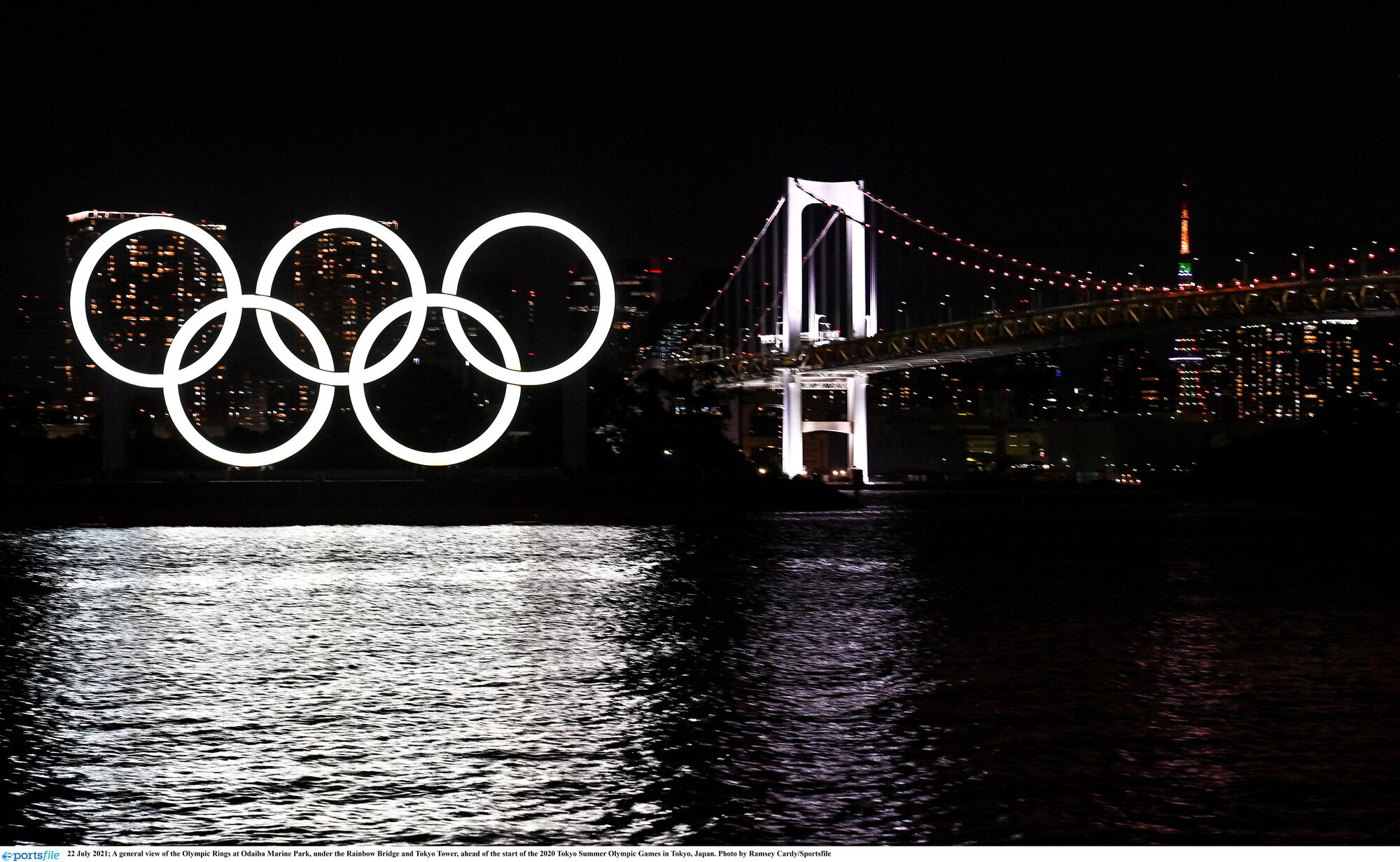
A general view of the Olympic Rings at Odaiba Marine Park, under the Rainbow Bridge and Tokyo Tower, ahead of the start of the Games. Picture: Ramsey Cardy/Sportsfile
Okay, there’s no such thing as a safe bet at this level, but these are four events where it’d be a surprise if Ireland doesn’t win a medal. McCarthy and O’Donovan look as strong a favourite as Ireland as ever had going into an Olympics, the pair currently 2-5 with bookmakers to bring home gold. Puspure will also be hard to keep off the podium, as will Doyle and Byrne. Harrington is ranked number one in boxing could be an underdog in the final if she meets Brazil’s Beatriz Ferreira.
These are four events in which Ireland should, on paper, win at least one medal, perhaps two if things fall their way. McClenaghan looks the one with the biggest shot at gold, while McIlroy is always capable if he finds his best form.
These are events where Ireland looks likely to pick up a rake of top-eight finishes, and where one might just break through to the podium. There are many others who could and probably should fall into this category, but these seem the most capable of springing a surprise.
The Games may seem like a traditional, almost archaic institution, but the reality is that its facade is one that’s ever-changing, with the International Olympic Committee forever tinkering with its format, wondering how it can become even bigger (and make a lot more money).
About three quarters of the IOC’s budget comes from TV contracts linked to the Games, so you can understand why they’re so desperate to ensure ratings remain high in an era when on-demand streaming is posing an existential threat to the popularity of live sport.
Step forward karate, skateboarding, sport climbing and surfing, the latest inductees into the Olympic arena, which now boasts 33 different sports. The new sports will add 18 events and 474 athletes and all four were quite clearly chosen due to their popularity among the younger generation.
Karate, of course, is believed to have originated in Okinawa, Japan, so it’s a fitting stage on which to make its introduction. It will consist of two disciplines: kata, where athletes compete solo and are judged on the form of their movement, and kumite, where opponents battle in an 8x8-metre area in three-minute rounds. However, the sport will only make a brief stay at the Games, the IOC voting in 2019 to ditch it from the Paris Olympics in 2024. Sorry, kids.
There will be two skateboarding events: park, which takes place in a hollowed-out course, and street, which includes stairs, rails and benches. In sport climbing, all competitors must compete in three disciplines: bouldering, lead and speed, so versatility will be key rather than any one individual skill.
The surfing will take place on Tsurgaski Beach, 40 miles east of Tokyo, with the event divided into multiple rounds of timed heats, with four or five competing at once in preliminaries before a head-to-head single elimination format. Scores go from 0.1 to 10, and the surfer’s two highest scores during the period are added together to make their total.
A child prodigy who’s been on the radar of athletics fans since her early teens, this year McLaughlin matured into what many had long believed she would become: the fastest of all time. The 21-year-old competed at the Rio Olympics at 16, experience she will put to good use as she tries to topple current Olympic and world champion Dalilah Muhammad. McLaughlin showed she’s up to the task with a 400m hurdles world record of 51.90 at the US Trials last month.
Swimming fans will already know much about the 20-year-old Australian, nicknamed Terminator (Arnie…get it?), who will go for gold in three individual events in Tokyo. It’s in the shorter races that she excels, and her 400m clash with US star Katie Ledecky could be the race of the Games. Titmus will be the favourite for both the 200m and 400m, having beaten Ledecky in the latter distance at the last World Champs, with Ledecky favoured over 800m.
Want to feel old? One of the biggest stars of skateboarding is...13. What’s more, she has already come back from some serious adversity to launch her tilt at an Olympic medal. Brown survived a harrowing 15-foot fall from a ramp last year that left her with a fractured skull and broken bones in her wrist, but now she’s healthy again and going for gold. She won bronze at the 2019 World Championships and is the first female skater to land a frontside 540 at X Games.
If two dots make a trend, then for superstitious folk three in a row means something more sinister must be at play. Japan had planned to host the summer and winter Olympics in 1940 but the second world war forced both events to be cancelled. Fast forward 40 years to 1980 and the Games went ahead in Moscow, but were overshadowed and heavily diluted in quality by the absence of multiple countries including USA, China and, you guessed it, Japan. They all boycotted due to the Soviet Union’s invasion of Afghanistan. Roll on another 40 years and, well, we all know how 2020 played out.
“It’s a problem that happened every 40 years – it’s the cursed Olympics, and that’s a fact,” said Japan’s deputy prime minister Taro Aso last year. Things are fortunately looking (slightly) more rosy for the hosts in 2021, though you get the feeling they won’t be too keen to bid again for the 2060 Games.
It’s no surprise there’s been considerable opposition to staging the Games this summer, though the tide has turned in recent months with only a minority, albeit a considerable one, still wanting them to be cancelled.
Japan has ploughed about $15bn into hosting the Olympics, and the majority of that is public money. While much of that financial burden of staging the Games is typically offset through the economic benefits of tourism and the feel-good factor for local fans, the decision to ban all spectators has left many locals counting all the costs and none of the benefits.
athletes
percent female competitors
sports
events
venues
spectators
Covid tests per day
medals
million old phones (used to make the medals)
free condoms (given out to athletes to take home, with fornication very much forbidden)
Irish competitors
signatures on the petition to cancel the Games
population of Tokyo
population of Japan


CONNECT WITH US TODAY



Be the first to know the latest news and updates