Jerry Kiernan - the Kerryman who found another big world beyond football
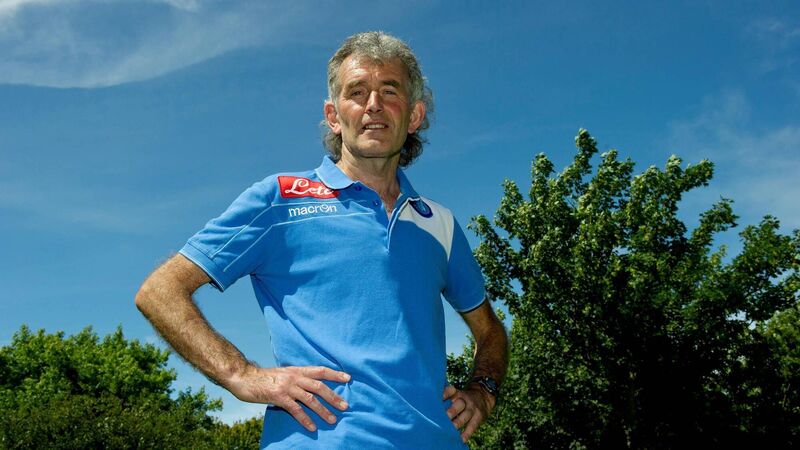
Jerry Kiernan. /Picture: Maura Hickey
No, outside of a couple of our walkers, we haven’t a chance of winning a medal in track or field over the next fortnight, says Jerry Kiernan in that straight, unflinching way of his over an espresso in a small Italian restaurant in Ranelagh.
You can never write off Derval O’Rourke, he adds, because Derval is a championship runner but the facts are scary. Her personal best is the 12.65 she ran winning silver in the Europeans in Barcelona two years ago. The Americans alone had five girls run quicker than that in their recent trials and only three of them can go to London. There’s a Canadian girl who also ran faster in her trials than Derval ever has and she’s not going to the Olympics either.
So, no, while he’d love to be wrong, Derval’s hardly going to be on the podium. Outside of possibly Rob Heffernan and Olive Loughnane, no Irish track or field athlete will. Paul Hession won’t. But just in case you think Kiernan is among the cranks that will be onto Liveline in a few weeks’ time bemoaning “all the money” that’s gone towards our athletes with no medals in return, you couldn’t be more wrong. Kiernan is their greatest champion.
“I remember a couple of years ago coming across Michael Lyster in the RTÉ studios and I said to him that Paul Hession was the greatest Galway sportsperson ever. And Michael did that big guffaw of his, ‘Ha, I bet you there are people in Galway that would disagree with that!’
“Michael of course was probably thinking of some Galway hurlers and footballers and the mindset of 90 percent of Galway people would be similar to Michael’s. But you can’t compare a player from a small amateur sport to someone who has run the 200 metres in 20.30 seconds. For a white man to run that fast? That’s incredible. But Paul Hession doesn’t crave our respect. It’s the respect of his peers. It’s an American sprinter recognising him in a hotel foyer in Brussels and coming over to speak to him.”
He can go round the counties for you. Take Clare, his father’s county. The greatest sportsperson of recent times to come from the Banner? Forget about your Lohans and Daly and Davy and Jamesie and Seanie – Seamus Power literally leaves them in his wake. For nine consecutive years he won the national cross-country championship. Four times he finished in the top 20 in the European cross-country championships. He mightn’t have been as well known as the 20th best hurler in Clare but that says less about Power than everyone else.
It’s the same with Cork. For all the All Irelands and All Stars that are stockpiled by Leeside, no GAA player in the pantheon of great Cork sportspeople, in Kiernan’s view, should be placed ahead of an athlete like Mark Carroll. Carroll could walk down one end of Patrick Street to the other without being recognised, but for a few years he and the American Bob Kennedy were the fastest white men in the world. There are a lot of white people in the world.
“Mark Carroll could run with the Kenyans. He beat Kenyans. His problem was his training was excessive. The shame is that he only has a European bronze medal to show for it all because he is the best all-round male Irish runner from mile to marathon that we’ve ever had.”
It used to be a real bugbear of Kiernan’s, how we downplay international athletes while deifying parochial GAA players. In 2000 he was apoplectic upon learning the Sunday Independent had chosen Seamus Moynihan ahead of Olympic silver medallist Sonia O’Sullivan as their sportsperson of the year on George Hook’s premise that the award shouldn’t go to someone who had “lost”.
These days he doesn’t even bother arguing. All it does is increase his blood pressure rather than change the other person’s mind. Official Ireland seems to think that as long as Croke Park is filled twice in September all is well in Irish sport and the world, and often it’s as if that’s how the public view it too. Four years ago the eve of the Beijing Olympics coincided with the eve of the All Ireland final and a school inspector to Kiernan’s classroom commented that five of the Kerry team would probably have been Olympic athletes if football hadn’t been their chosen game. Kiernan just smiled at the man.
There was a time when Kiernan himself couldn’t see beyond Kerry and Gaelic football. These days he can’t tolerate the sport – “it’s all pulling and dragging” – but growing up in Listowel all he wanted to be was a Kerry footballer. Then the 1964 Tokyo Olympics were beamed into the family living room. Billy Mills, the “red Indian”, beat world record holder Ron Clarke in the 10,000 metres. An 11-year-old Kiernan was captivated. Out there was a whole other big world that suddenly made Kerry football seem so small.
It would take Kiernan 20 years to race in the Olympics himself. He went to LA in ’84 not knowing what to expect, including of himself.
The one thing that gave him confidence was his preparation. One day in school his headmaster handed him a cheque for £6,000, freeing him and his coach to go out to San Diego six weeks before the marathon. Kiernan was the only person who’d finish in the top 20 of that Olympic marathon that was holding down a full-time job but for those six weeks he was full time.
“At home I used to batter myself in training, especially on a Tuesday and be hardly able to put one leg in front of the other on the Wednesday. In California my powers of recovery were remarkable. I would just run in the morning and run again in the afternoon, sit down, read books, nothing else. I didn’t have to be on my feet for six hours. Anyone who thinks teaching is a soft job are wrong because if you want to teach properly you have to be standing up but as an athlete that knocks the edge off you.”
Ten miles into the race he found himself breezing past top athletes that he used to read about in magazines. Gerard Nijboer from Holland had been a silver medallist in Moscow. Kiernan blew past him “as if he was standing still”.
By the 20-mile mark he was giving John Treacy a tap on the bum. Another Irishman was up at the front.
“My one regret from that race is that I wasn’t up there a little bit earlier. There’s a photograph in the Runners World taken at 18.5 miles and this pantheon of the world’s greatest marathon runners are spread all across the world. You had Lopez [the eventual winer], Treacy, So and Seko [from Japan], [Australian Robert] de Castella, [American Alberto] Salazar. I would love to have been in that photograph. I have no photographs on any wall of me running but I’d have put that one up.”
Kiernan would eventually drop off from Treacy and Lopez but would still finish ninth, ahead of Salazar, Seko and the Kiwi Rod Dixon.
“I looked at my watch and it said 2.12.19. That was a personal best. Exercise physiologists were saying beforehand 2.12 would win it in that heat. It only got you ninth. It would have got you ninth in Beijing. It would have got you a medal in Montreal.
“An hour after the race we were in the bowels of the stadium. Charlie Spedding was on a table getting a massage and I thought ‘He came third. What has he got that I haven’t got? With six months of full-time training that could have been me.’ While these fellas were running London and Boston I’d been running Belgooly and Ballycotton. It dawned on me then I was actually as good as these guys.”
Did that realisation frustrate him? Only a little. “You might feel I should be more frustrated than I am but when I go out with my mates we rarely talk about the past. It’s all looking forward.”
He’ll again be on the RTÉ panel for these Olympics and while he says it can be a form of torment, tossing and turning in bed wishing he had said this and not said that, there’s no other place you’d rather he be. He is almost the ideal pundit, combining research with robust, forthright opinion.
So what does he make of Ireland’s track and field prospects? He sees Rob Heffernan being in the top six of the 50k walk. “I hope it’s a real good hot day because Rob is capable of suffering. If he can avoid picking up a card early on from the judges and get into a rhythm, he could be right there. The same with Olive Loughnane in the 20k.”
But after that? Ireland’s best prospect didn’t even make the plane, Kiernan contends, because of the Olympic Council’s and Athletics Ireland’s insistence on only A-standard athletes.
“There is something special about Mark English. I was a contemporary of Eamonn Coghlan’s, when he was winning schools titles I would finish in second and he always struck me as someone who would go on and do great things. The only other time I’ve had that feeling is this kid from Donegal. He finished fifth in the world juniors in the 800m in Barcelona last week. The top two in that race are going to be in the Olympic final. Mark would easily make the semi-final at least. And we decide not to bring this kid because he missed the A standard by seventeen-hundreds of a second?
“What are they afraid of? That he might ‘fail’? He’d learn. I sometimes think the Olympics is a bit of a vanity project for [OCI president] Pat Hickey. Like, how dare you disappoint us on the world stage! We can’t be having Irish people competing and being on the first plane back home! Then if we win it’s as if it’s down to Pat as well when of course it isn’t.” You point out Hickey isn’t alone on this A-standard criteria. Sonia O’Sullivan and Athletics Ireland agree with the policy.
“Sonia is only towing the partyline. If she wasn’t chief de mission she would never agree with this because Sonia is an athlete’s person.”
He’s unsure how athlete-centred someone else is though: Kevin Ankrom, the performance director for Athletics Ireland.
“What’s his contribution? None that I can see. I mean, what does a performance director do? How many world-class athletes have we? Twenty? Thirty, max. He should be on familiar terms with all of them, calling them twice a week and saying ‘What can I do for you?’ You get the impression from the athletes that is not happening. And if it’s not, well then why are we paying someone this obscene amount of money? The most industrious and productive workers in our sport are all the people who were in the sport years ago and they’ve continued in it because of their love for it.”
The athletes deserve better, he feels. They’re heroic even though they’re rarely acclaimed as heroes.
“The one thing that pisses me off about RTÉ is the obligatory post-Olympics ‘review’: we’re a small country, a population of six million, Gaelic and rugby are big sports, we have crap facilities and a physical education system, and so on. Now, all that is true. But what you’ll rarely hear is that New Zealand is the only other nation in the world with a population of 10 million or under that outperforms us in athletics if you take from the 100-metre sprints right up to the 50k walk as a whole. Most of our records are better than China who have a population of a billion people.
“There are other dimensions to athletics than just the Olympic Games. We have been very successful in the European cross-country championships. We have something intangible going for us and that is the spirit of our athletes and volunteers.”
A while back he heard Ivan Yates interview David Gillick on the radio. Yates wanted to know how Gillick could justify his Sports Council grant and use of taxpayers’ money when he had underperformed in recent seasons. As if Gillick had deliberately got himself injured. The same Gillick that made a world championships final in the 400m, an outstanding achievement for a western European.
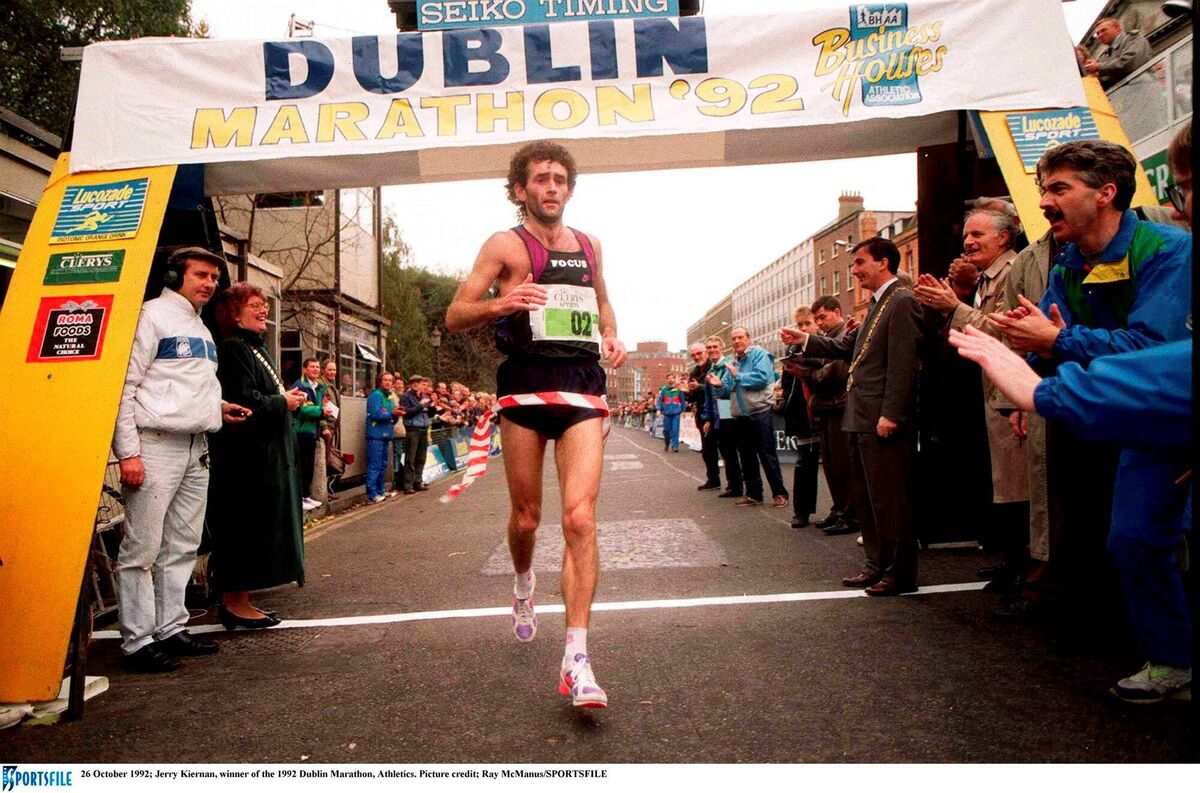
Kiernan himself has occasionally been critical of athletes, most notably James Nolan in Athens. He justified that stance on the premise that Nolan didn’t make the maximum use of his exceptional talent. Nearly every other Irish international athlete he knows is giving it their best. Their biggest problem is often trying too hard. That best effort deserves to be respected, not mocked or derided.
“There are athletes there – like David, Derval, Olive – that we expect and we expect great things from because they’ve done it for us in the past but then when they fail to replicate that we seem to think ‘Ah, they were never any good in the first place’ when in fact they were great.”
The best Irish athletes are now, he reckons. He might have been a part of a golden generation of Irish middle-distance runners but he reminds you that Irish kids these days would blitz the likes of himself, Coghlan and Marcus and O’Meara.
“We have three or four lads of 17, 18 up in Donegal alone that would make us look like plodders. There’s an extraordinary level of talent in this country. But the problem is they’re up against the best in the world! They’re running against Ethiopians and Kenyans from altitude which is like pitting a welterweight against a heavyweight.
“Our boxers more than likely will win a few medals but they’re only amateurs. If they were pro we wouldn’t be in the reckoning. If there were amateur runners we’d bring home a lorryload of medals because we have a load of good athletes but the standard worldwide is so frightening.”
It’s nearly time to leave. Joe Coughlan, one of the athletes he coaches, has breezed in to join us for a coffee before they head off for a walk and a run. You wouldn’t recognise Joe the way you would a Dublin footballer but last year he was among the three fastest white men in the European cross-country championships. An Ethiopian running for Belgium came first. Second was a Moroccan running for Spain. Joe finished fifth.
He’s not heading to the Olympics. At 26, he and Jerry feel he’s still that bit young for the marathon. But he plans to go to the next one.
They get up to go. After their two-hour walk, Kiernan will go for a jog himself. He’s 59 now but still has the mullet only its now grey while he’s only seven pounds heavier than when he ran that world-class time in LA.
“When I saw the clock beginning to get slower for me I thought I’d have a problem. But I didn’t. I still run most days. I love the aftermath of running. I love sweating. I love walking for a couple of hours. I just want to be fit.
“I suppose,” he smiles softly, “I’m pretty vain really.” And away he goes. Forever young, forever on the run.


CONNECT WITH US TODAY



Be the first to know the latest news and updates