It’s Miller time for all-time
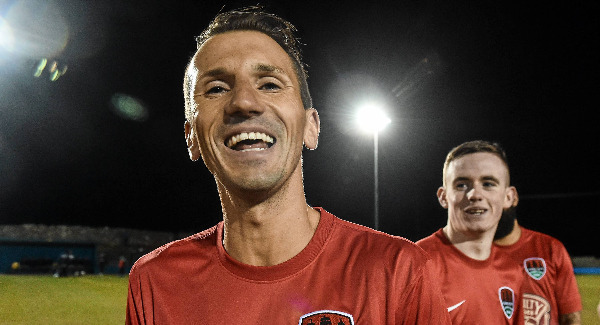

Back in the noughties, it seemed to be “Miller Time” all the time on the back pages, and with every good reason, as Liam Miller shook up Europe with Celtic or headed for the even brighter lights of Old Trafford or brought Lansdowne Road to its feet with a screamer against Sweden which will rank as one of the greatest goals scored by any boy in green.
And, nine years later, it was Miller time all over again when he returned home from Australia to sign for Cork City in 2015.
“We did 40 press conferences last year and the crowd was never as big as this,” said John Caulfield with a grin at the International Airport Hotel in late January of that year, as a huge media contingent turned up for Miller’s official unveiling as a Rebel. And the man of the moment left no-one there in any doubt that home was definitely where his heart was, the priorities, demands and rewards of the professional footballer and the family man now seeming to dovetail beautifully in what was his 34th year.
“This was the perfect time for me and the family to come back,” he said. “I have my family and friends here. I have three kids. It was what I wanted. Australia was something different and fresh and everything else but to return home was always on the agenda.
“And when I say home, I mean Cork. I’m a Cork lad and if I was going to play for any club in the country, why wouldn’t it be Cork?”
The headlines generated by his arrival in the League of Ireland confirmed that the boy from Ballincollig was still box-office but off the pitch he was never one to go courting the limelight.
He was one of those footballers who always seemed infinitely more comfortable and composed in the heat of a midfield battle than sitting behind a microphone having to field questions instead of tackles.
Still, more in hope than expectation, I’d put in a request to City for a one-on-one interview and, after what I suspect was a little gentle persuasion from John Caufield, it duly came to pass the following morning out at the club’s training base in Bishopstown. My previous encounters with Liam had been confined to a few brief pitchside huddles and the like over the years so, in spending the guts of an hour in his company, as the conversation ranged right across an eventful, globe-trotting career, it came as a lovely revelation to get at least a glimpse of the personal qualities which, we now know, those who knew him best had always held in high esteem.
For one who’d hit such heights in the football world, there was an engaging humility in the way he reflected on the many stellar moments — “I’m very quiet anyway, you know?” he said at one point — but also hints of the steely determination which he had needed to cope with the rigours and the setbacks of the professional game.
And the dry sense of humour which his friends and colleagues prized was in evidence too, not least when I suggested that he’d surely faced almost a mission impossible in trying to dislodge the midfield axis Roy Keane and Paul Scholes when he moved from Celtic Park to Old Trafford.
“Overrated those two,” he grinned before going on to concede, just for the record, like, that “they were the two best midfielders in the world at the time.”
I won’t pretend to make any claims that the lengthy piece which came out of our conversation that day was ‘the definitive’ Liam Miller interview, or anything even close to that kind of journalistic holy grail, but simply because he generally much preferred to let his feet do the talking, it has been widely circulated and quoted in the days since the terrible news broke of his death at the age of just 37.
ne quote, in particular, continues to resonate, as Miller directly confronted the perception that his career hadn’t fully lived up to the greatest of expectations.
“I genuinely look back and think, ‘I played for Celtic’, my boyhood club,” he said. “I dreamed of playing for Man United and I got that opportunity as well. I don’t know how many other people can say they played for their two childhood clubs, or even one childhood club.
“Of course, I would have loved to play more games, don’t get me wrong, but I got to learn from some of the best players ever. Looking back, it was wonderful.
“Growing up, for me, I just wanted to play football. And as I got better and better, the opportunities came around for me
“Nothing’s ever guaranteed — you could get an injury in the morning, touch wood — but, I worked my socks off and the hard work paid off for me.”
Then the words that are the hardest to read now.
“I feel I’ve still got plenty of years ahead of me,” he said. “I’ve had good times and bad times but I never fell out of love with football. I still love the game.”
As the exceptional warmth and poignancy of the tributes paid to Liam Miller over the last week have made clear, the game loved him too, not just as a player but, more importantly, as a man.
One of the consolations of sporting success is that it can confer a kind of immortality, which is why, in the memories of so many who never even met him but who were thrilled by what he could do with a football, it will now be Miller time for all-time.
CONNECT WITH US TODAY



Be the first to know the latest news and updates