PICS & VIDEO: Humble Skibbereen rowing club manages to produce Olympians against all the odds
“It’s a hotel really. They have everything. Chefs. Guys to check the angles of their oars. You name it, they have it. When you compare it to Skibbereen Rowing Club — well, what can I say. It makes us look like something from Cool Runnings.”
Cool Runnings, for those not in the know, is a movie where a Jamaican bobsleigh team competes for Olympic selection despite never having seen snow. A quick trip around Ireland’s now most famous rowing club justifies the comparison.
Kenny, a senior rower with the club and medallist a number of years ago at U-23 level in the World Championships, leads me to the clubhouse gym which he jokingly describes as a “medieval torture chamber”. Except that it’s not really a joke. Because the equipment in that gym, much of it made by Dominic Casey, coach to Ireland’s newest Olympic silver medallists, is truly something you would not see in any gym today, least of all a gym that has produced our first podium finish of the Rio Olympics.
In fact it’s a throw-back to the sort of equipment you might have expected to see in the time of Crusher Casey, the famous Kerry wrestler of the 1930s.
The walls of that same gym are plastered with Dominic’s handwritten exercise sheets; and the hallway outside is a bit like a scrap yard — full of bits of metal Kenny assures me Dominic can transform into more mean exercise machines.
In another long narrow room, which used to be the boat house — I have no idea how they got boats in and out — there are computers hooked up to a type of rowing machine called ‘row perfect’. The computers record the arc of the oar stroke on a graph. When I say computers, I don’t mean anything our kids would recognise. These are relics from the ’80s.
The clubhouse itself is dishevelled and Kenny said there were plans to paint and powerhose the outside this weekend. On the plus side, there is a new boat house thanks to some lottery money and the stretch of Ilen River at their disposal is incomparable to what you might find at Henley-on-Thames because it’s essentially all theirs.
“You could have 10 rowing clubs using this size stretch of water in the UK, but we have it all to ourselves here,” Kenny says. “We can row 8km downriver to Baltimore and not have to watch out for anyone, and that makes all the difference.”
The two things Kenny wants me to take from my tour of the clubhouse are: firstly, the need for sponsorship and investment — the club has produced five Olympians since 2000, and trust me, it’s against the odds.
Secondly, the incredible role Dominic Casey has played in producing so many world class rowers from a club a million miles from the glamour and resources of Leander.
“If you think about it, the club is only around since the 1970s. And Dominic has always been involved. Anytime any of us are out on the river, we never know when Dominic will show up. You could hear a shout from the bushes and then you know he’s been watching,” Kenny says.
He reckons Dominic got his love of the river and rowing from his father whom Kenny says used to row heavy sandboats up and down the Ilen, transporting sand for building.
“His family lives on the river. His kids are all into rowing. One of his daughter’s, Aoife, is heading to the Junior World Championships in Rotterdam next week,” Kenny says.
Upstairs in the clubhouse is a space that could operate as a function room — with a little bit of TLC. It’s hung with winning pennants and pictures of previous club Olympians, including Timmy Harnedy and Eugene Coakley from 2004. Downstairs in the hall is a framed photo of former Team GB Olympic gold medallists, including Steve Redgrave. It was given to the club by movie director David Puttnam who lives locally. It may soon have to make way for the club’s own successful Olympians.
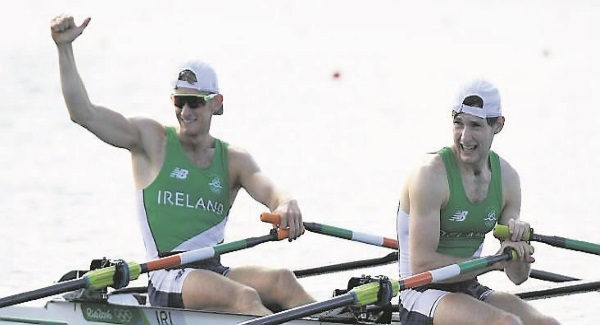
Later on in the day, I meet two of the club’s founders, Dick Roycroft and Richard Hosford, who are gathered with the masses to view their sporting heroes, Gary and Paul O’Donovan, compete in the lightweight double sculls Olympic final.
Richard says they started in 1970 with nothing and bought their first rig courtesy of a bit of money from Bank of Ireland. “The following year, we got into river rowing and joined the rowing union and I suppose it really mushroomed from there.”
They’ve been fundraising forever: Richard recalls buses transporting people to dances between Skibb and Lisheen — from where the O’Donovan brothers hail — in an effort to raise funds. Dick says in February 1974, they had just two free nights, what with all the fundraising and training.
“And today, with what Gary and Paul have done, all of the hard work has paid off,” he says.

CONNECT WITH US TODAY



Be the first to know the latest news and updates