The long, lonely road to Athens

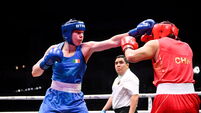
IT IS 7am on St. Patrick’s Day and three young men climb out of their beds in a Dublin B&B. While the nation snoozes, taking advantage of the holiday for a lie-in, this trio is off to work.

The long, lonely road to Athens

Not even the country's national holiday can stop them from attempting to realise their dreams of boxing for Ireland at the Athens Olympics.

Andy Lee in the 75kg middleweight division has already qualified having booked his ticket with a bronze medal at the European Championship in Croatia last month.

The other seven fighters went out in the early stages of the championships and now have just two chances left to make the team.

So Kenneth Egan, Eric Donovan and Paul McCloskey will be three of a group of 10 Irish boxers aged between 18 and 26 who will this week be in Plovdiv, Bulgaria, or Warsaw, Poland, at the European region Olympic qualification tournaments.

The last two remaining fighters in each category at the end of the championships next Monday will have earned their ticket to Athens in August while the rest will have to try again at the last-chance saloons in Baku, Azerbaijan or Gothenburg, Sweden on April 19-26.

Dubliner Egan, 24, watched the heroics on television when Michael Carruth and Wayne McCullough brought the country to a standstill at the 1992 Olympics in Barcelona and was soon on his way to winning national titles all the way up through the ranks. He currently holds four senior titles.

Antrim native McCloskey, also 24, was another who cheered when Carruth out-battled Hernandez and McCullough claimed the most gallant of silver medals. He recovered from losing three National Senior finals to go on and win three and is now rated by many as one of the most talented around.

One of the youngsters in the group, Donovan was seven in 1992 and does not remember the fuss, but he has watched it on video enough times for it to have left an indelible mark.

Connected memories from Barcelona, then, and all three share the same ambition to reach Athens.

"The last Olympics we didn't get Michael Roche qualified until the last second so there was no momentum," said Donovan, who earlier this month was named an Irish Examiner Junior Sports Star of the Year for 2003. "But we have Andy Lee qualified now and the rest of us have two chances left, so the ball's rolling, we've seen it can be done.

"The possibility of getting there is unreal, and to get there when I would be just turned 19 would be a bonus. My real goal is Beijing 2008, but Athens is crucial if I can get there for the experience of the whole thing. To be honest, I fancy my chances of qualifying."

The three boxers are all part of the Irish Amateur Boxing Association's High Performance programme. It was set up last year with the aim of giving Irish amateurs every chance of fulfilling their goals, of realising their potential, and the boxers were placed under the stewardship of Gary Keegan. The programme has had a huge impact and the support system it provides is something which former Irish amateurs could have only dreamed of.

Featherweight Bernard Dunne never followed his father Brendan into an Olympic ring. While Dunne senior fought in Montreal in 1976, Bernard just failed to make the cut at Sydney in 2000 after travelling to Australia with Ireland's sole representative Roche as a tournament first reserve.

He felt bitter at the lack of support he received, not just in the build-up to the Games but while he was in Australia itself. The experience went a long way to persuading him to turn pro rather than remain an amateur for another four years.

Now 24, he is a pro based in Los Angeles, California, with renowned trainer Freddie Roach, and quickly climbing the featherweight rankings, he thinks the I.A.B.A. has definitely gone down the right road to helping its boxers realise their potential.

"I keep in touch with all the lads back home from my amateur days and to be honest the set-up they have right now is an awful lot better than what it was when I was an amateur," Dunne said.

"They are a lot more professional about their training, they go away to training camps, they have to handle themselves well, report for training on time and so on, and they are getting sparring partners set up for them.

"There's a lot more effort now being put into it compared to when I was around. Back then it really was amateur, but now the association have got their act together and are putting a lot of time and dedication into it. They've got their game-plan right this time.

"It's great to see Andy Lee qualified already and hopefully more will follow. You have to give Kenny Egan a chance; he has that computer style of boxing which will win him fights as an amateur; while of the smaller guys Donovan looks pretty special.

"And what's really important is that the way they are training them they are giving their fighters every opportunity to qualify. That's the way it should be."

Of course, the programme also demands much of its members. All of the squad, regardless of where they come from, live under the same roof. They share rooms, train together, hang out together. It could have been a policy full of complications but the boxers, with their common drive and shared goals, have made sure it's worked out well.

"It's great," Egan said, "I'm from over the road in Clondalkin, but I'm still in there in the B&B with the rest of the lads. I take my hat off to the boys who come from the North, they're up and down all the time, it can't be easy, but we're all of one mind here, I think that's why we all get on so well.

"In the B & B we have our own sitting room, our own telly, we hang out at night and watch DVDs, or sometimes go into town to the cinema. I'd say it's some sight, all of us landing in together!"

On Dublin's South Circular Road, Terry and Maie McCabe have been taking in boxers for the last nine years, though Terry is far from a boxing fan.

"I think boxing is a cruel sport," he said. "But I do go to support the lads when they're fighting in the National Stadium because it's important to them. I've known many of them for nine years, I've seen them grow up.

"I went down to the stadium once and stood in the ring. The place was empty but for me. And it was a frightening experience putting yourself in their shoes, knowing all these people are watching, knowing there's another guy in the other corner waiting to come out and throw punches at you. You have to be a brave man, and I've a lot of respect for them."

The boxers themselves have similar tales to tell about how they got to this point.

"I was good at soccer, gaelic and boxing," Donovan said. "But with boxing I felt I was going somewhere with it. I had an advantage in that I was born a citeóg, a natural southpaw. Plus I was on my own, which is what I wanted. When you're in the ring, you've no one to pass to."

Donovan's initial attempts at the sport were a rude introduction to the noble art. At the age of nine he was thrown into the ring by coach, and now IABA President, Dominic Rourke.

"My first spar I remember I nearly got killed. I was brought up to Crumlin and put in against a huge lad who had been boxing for two years, he was three years older than me. He knocked me out in the first round, and I started thinking twice about boxing. But I learned my lesson, and decided to give it another go, and I've won everything all the way up from 11 years of age, including the senior title last year (where he beat Brian Gillen in a thriller in arguably the country's most competitive weight division) and a European bronze at youth level. Just as well I stuck to it!"

Likewise Egan, now a light heavy.

"Being in the position I am in now, you look back at key moments. My first fight is an obvious one. I was 10 and it was a club show in Darndale. Before the fight the lad I was in against came over and started giving it loads, saying he was going to beat me up and all that. I was only a baby, but I went in, beat him and knocked one of his teeth out in the process. I'll never forget it. I knew then that boxing was for me."

The next big leap of faith came more recently, in 2001, when Egan boxed at the Worlds in Belfast and was beaten in the quarter-finals by the Cuban who went on to win a silver medal. "It was a good fight. From then I knew I had a chance of fulfilling my dream, of getting to an Olympic games.

"I'm going to Bulgaria, hopefully I'll do it there. If not I'm off to Azerbaijan, but I've a good feeling about the first one. If I get to the final in Bulgaria and have my hand raised it will mean everything will have been worth it. Not just the last three years but the last 13 and all the sacrifices that have gone with it."

The sacrifices are multiplied for McCloskey, for whom every training camp means separation from his girlfriend and two-month-old son Cian.

"I'm very lucky in that I've a very understanding girlfriend, Emma," he said. "She's studying to be a teacher. She and my family realise that I've been chasing this since I was a kid. The same as every other guy here. We all realise we're here for the same thing. That's what makes us such a tight group."

He added: "Living together is fine, we all get on well. That's part of the High Performance programme which I think has been hugely significant for us all. Before you were lucky if you were abroad at a tournament once a year but between tournaments and training camps we're now out there once a month. That experience is huge. It gets you right mentally as well. I now know all of the top 10 in my division I've twice fought the French guy who's world champion, as well as sparring with the Russian Alexander Maletin who's the current European champion. We also have a Georgian coach now (Zauri Antia) and he brings new ideas, new approaches, a different viewpoint."

Egan concurs with McCloskey's assessment.

"Before High Performance came in last year we never, for example, had our own doctor. Now if you feel a little sick, they're right there for us. We also have a nutritionist, physiotherapist, psychologist as well as top coaches in Billy Walsh, Zauri Antia and Cathal O'Grady.

"We're realistic though. We know we've only had these things for a year whereas the Russians have been in that situation for the last 20 years. So not alone are we looking to Athens but further down the line to Beijing. The main aim is to keep this team together the average age of the Russian team that won nine of the 11 golds last month was 26, 27 for us it's under 23."

McCloskey continued: "Everyone knows it isn't easy being in the situation we're in, but when Michael Carruth came in to us before we went to Croatia and told us what he went through in the 18 months before he won the gold, breaking hands, fighting Billy Walsh over and over, it put in our minds that it can be done regardless of what you go through. And that's why we're here."

"For all of us here," Egan concluded, "it's all come down to the next month. We have to make the Olympic Games."

Andy Lee already has. Now the rest of the Irish travel to Bulgaria, Poland, maybe Azerbaijan, wherever. Anywhere as long as it leads to Athens.

Additional reporting by Simon Lewis in New York.

x

More in this section

Sport

Newsletter

Latest news from the world of sport, along with the best in opinion from our outstanding team of sports writers. and reporters

Cookie Policy Privacy Policy Brand Safety FAQ Help Contact Us Terms and Conditions

© Examiner Echo Group Limited