The evolution at Ireland's most feared and revered golf course

Beautiful Brittas: Looking out over the 13th at the old European Club. Kevin Markham feature
NO ONE would deny that what Pat Ruddy created at the European Club was a one-man odyssey of imagination and individuality. Anyone who has played it will remember it for its freedom, its character and its challenges. And no one forgets those bunkers. It was unique, the brainchild of a man with no formal architectural training who implemented a completely personal vision of how a modern links golf course could look and play. It looked fabulous; it played hard.
The European Club opened in 1987 and quickly found its place in links folklore. It became a bucket list destination, one where you knew you might be in for a beating. I played it many times, chalking up my worst ever round of golf. Losing 13 balls is the sort of penalty that burns a spot in your brain which can never be erased. And still I loved it.
So did others and, over the years, Pat was approached about selling the club. Many times he said no but, in May 2025 as he slipped into his 80s, he finally said goodbye to his beloved links and sold the European Club to the father and son duo of Raymond and Nicky Conlan. Pat’s retirement is well-earned.
The question now on every links-lover’s lips is: what’s next for this beautiful, monstrous beast of a golf course?
Course evolution is always exciting and while there will be nostalgia for the course of old there is already an anticipation of what is to come. The announcement last week that the Conlans have brought on board the highly respected architect Kyle Phillips, signals the potential they see for the site.
“When we spoke to Kyle, right at the start, he understood what we are trying to achieve, explained Nicky Conlan. “Then, when he came on site and explained his vision for the golf course, he won us over with his imagination… not to mention his reputation. It was meant to be. I think he is the best person to do this job and he’s going to deliver something for everyone.”
Finding the right word to describe golf course evolution can be tricky. Is it a restoration or renovation, a reimagining or a reconstruction, an upgrade, a redesign, a new vision? Each has its own balance of intertwining old and new ideas. Take St Patrick’s Links, at Rosapenna: even though the site of the Tom Doak 18-hole masterpiece used the terrain where 36 holes had previously existed, the opening holes mirror Eddie Hackett’s original routing. And yet it is a completely different course. It was a new vision. The Ballybunion Cashen course, meanwhile, is in the final stages of an overhaul by Watson and Webster. The routing is essentially the same but just about everything else has changed. I’d call that a redesign.
The European Club will fall somewhere in between. There are roughly 200 acres here and they were well used in the original layout, allowing Ruddy to squeeze in those two extra par-3s (7a and 12a) to match his charming eccentricities. The same land will be used for this iteration, making the new course a restoration – and a reimagining.
“Pat developed something that you have to give him huge credit for,” says Nicky. “To build it from the ground up is the stuff of dreams and what he achieved here will probably never happen anywhere again. The European Club was Pat Ruddy… and Pat Ruddy was the European Club.”
It is no surprise therefore that one of the first things to change is the club name and its emblem.
Say hello to the Brittas Bay Club, and its logo of the tern. Both firmly anchor the links in Co. Wicklow, and embrace its environment. During the terns’ migration, this white bird with a forked tail and black cap, finds a home on the 13th fairway. The new owners acknowledge the site’s importance in the bird’s journey, and a percentage of every green fee will be donated to wildlife conservation bodies.
It is the changes to the golf course, however, which will stimulate post-round conversations in the weeks and months ahead.
So what does the new design hold? The specifics of the layout are still being kept under wraps but the brief to prospective architects – there were five – focused on three essential areas: more variety; improved playability; and top-level conditioning.
Key to variety is the par/balance of the course. The Brittas Bay Club will be a par 72, of 7,300 yards from the back tees, with four (not three) par-3s, four (not two) par-5s and 12 (not 14) par-4s. Most of Ruddy’s par-4s were over 400 yards but the new design will mix that up to offer some short par-4s to make the holes more fun. That will also introduce more strategy, embracing the ground game.
The existing dune corridors will be well used, but the layout will be very different.
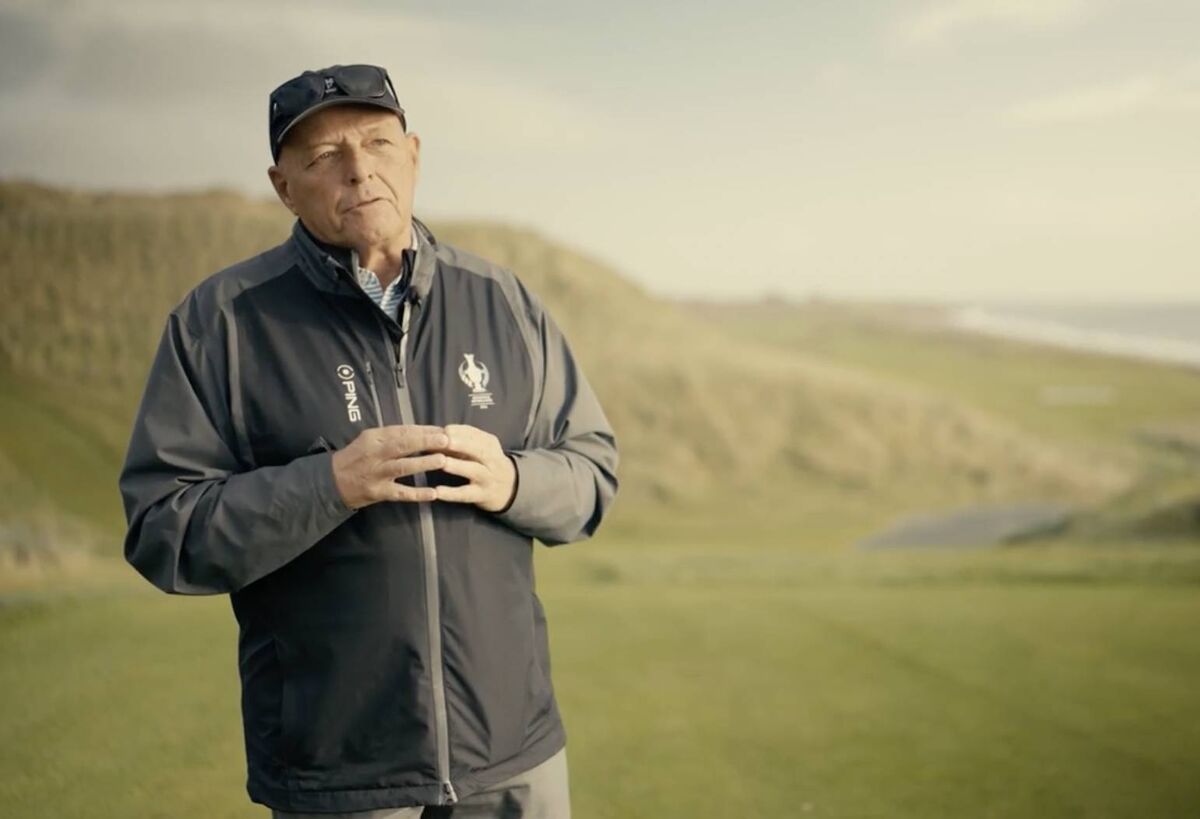
“Really, there wasn’t an intention at the start to either maintain the existing routing, or an intention to start all over,” Kyle Phillips said on an early site visit. “It was an intention to get the most out of the land and the best result we could within this beautiful property.”
Read More
There will be holes that play in reverse, e.g. the 18th, and a key part of that is the desire to take golfers to the beach on both nines. It is also worth noting that there will be improved sightlines, specifically with views of the sea.
“One thing that will feel significantly different is that, at the moment, all the coastal holes play in one direction. In the new design that is not the case,” says Nicky.
Think about it: after playing the original 13th and 15th you’d turn around and look back at the beautiful coastal views behind you. In the new design, there will be holes playing towards those views. It will lift the experience.
On top of all this, every green will be replaced. Some may move only marginally from their existing location but, topographically, they will all be new.
The European Club was a course that suited the low-handicap golfer. The links could, usually did, and took great pleasure in beating you up – 13 lost balls attests to that – and it was revered and feared in equal measure. Close to 100 deep bunkers were the death sentence for many a ball and the rough was cripplingly close to fairways. In a ranking of Ireland’s 10 Toughest Courses, I rated the European Club at number two.
The bunkering will be changed completely – and reduced in number. I can’t deny that Ruddy’s railway sleepered-bunkers made an impressive impact – a bit like a fire alarm in your hotel room at 3am – but despite their attractive aesthetics there will be few who actually miss them.
The Brittas Bay Club will cater to every level of golfer, with increased room to play, improved sight lines and repositioned bunkers offering more strategic options from the different tees. And with a good mix of holes, including two more par-5s, there will also be the additional element of fun.
“We have already cleared away the non-native trees and scrubland, as we get it back to what it should be,” says Nicky, of the site. “We’re replacing grasses which are not fescue-dominant to enhance the course’s playability and condition. There’s a certain expectation when people come to play a tier one golf course and we want to fulfil that.”
The work also embraces the sustainability aspect of the site but the quality of course conditioning will be improved considerably. The renowned Turfgrass will be involved and the lines, edges and surrounds will be razor sharp.
Many will miss Mrs Ruddy’s famous apple pie as the clubhouse receives a massive overhaul. Everything within the new clubhouse – positioned on the existing site – will be several steps up in quality. Pat Ruddy favoured the family approach, which worked well with him at the helm and often on site to greet golfers, but that element of the European Club is no more. Visitors can now expect a different experience from start to finish, be it around the clubhouse, while using the upgraded facilities, or out on the course.
Timelines In terms of timelines, golfers can expect a drip-feed of intrigue and information as the course takes shape in the months ahead.
The heavy lifting is due to begin shortly. All the changes, by Co. Offaly-based Golflink Evolve, and seeding are due to be completed by August. If the weather behaves and the grow-in goes to plan, the new Brittas Bay Club will open for play in April/May 2027.
“We’re not trying to re-imagine the wheel,” Nicky concludes. “We want to create a club that caters to everyone and one that people will return to, time and time again.”
CONNECT WITH US TODAY



Be the first to know the latest news and updates