The fan experience doesn't get buried in the hills of Rome, for a change
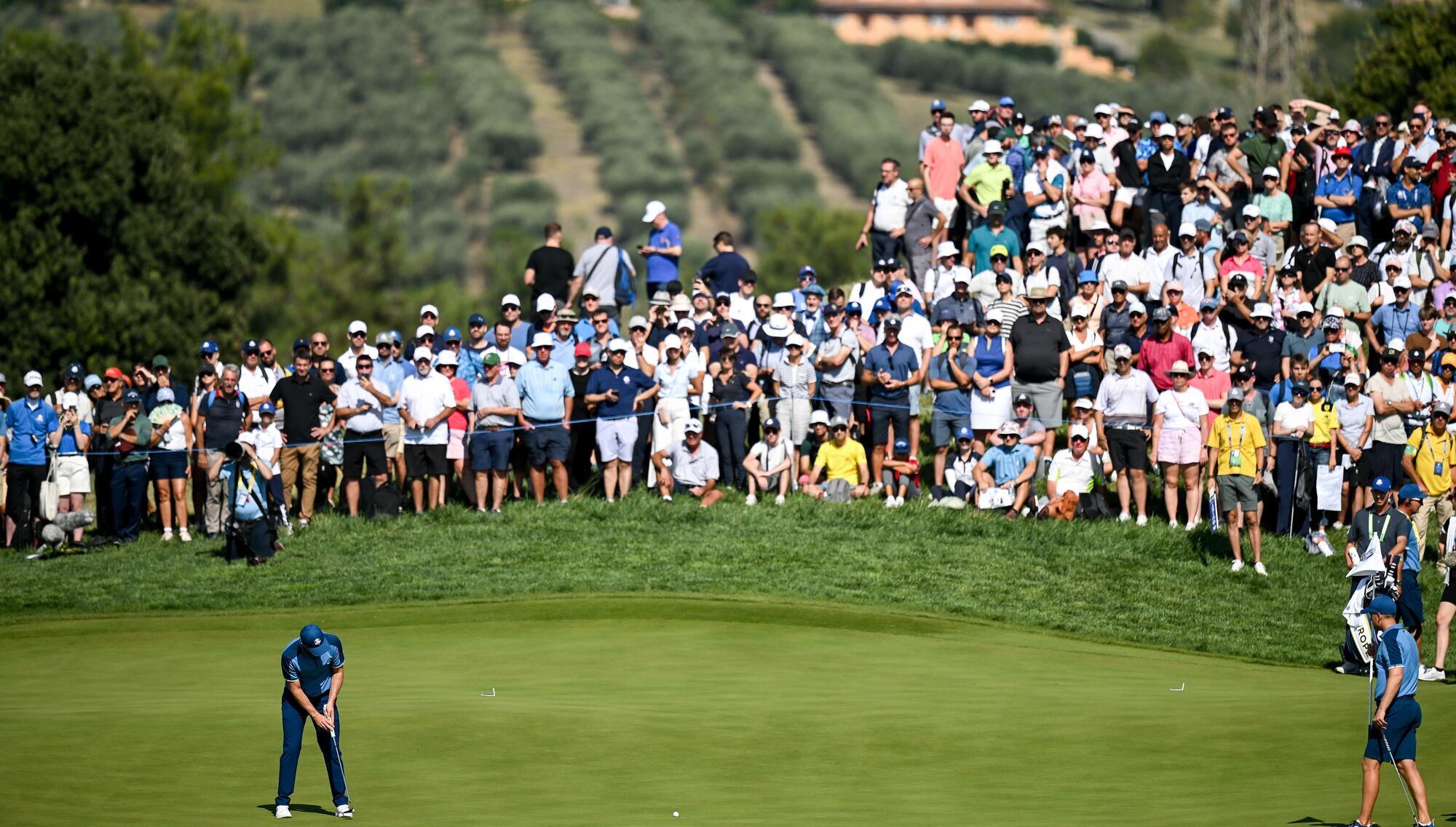
HILL OF A VIEW: Justin Rose of Europe putts on the 12th green during a practice round before the 2023 Ryder Cup at Marco Simone Golf and Country Club in Rome, Italy. Pic: Brendan Moran/Sportsfile
Freed From Desire. Phones hoisted high in search of shoddy pictures. The Viking clap. Things major sporting events can’t do without, apparently. As Shane Lowry found out to his determinant on Wednesday.
Lowry was in a fourball with Tyrrell Hatton, Ludvig Aberg and Robert MacIntyre on the back nine and losing heavily. Hatton had been his partner at Whistling Straits and they teamed up again to take on the rookies. To add intrigue to their round, they’d bet 200 quid a man on the outcome. By the time they reached the 16th, a short downhill par-4 to a reachable green, the Irishman was striving for some damage control. Any chance of double or nothing?
Swedish ‘stud’ Åberg nodded agreeably and then drained a shot to the green, close enough to putt for eagle. For the next three tee shots, patrons started that slow clap, accelerating until each shot was struck. None of them came close to matching that first effort.
“You had to start that f*cking clap after his shot,” Lowry jibbed loudly to the crowd. Raucous laughter was quickly interrupted by a wailing alarm from all over the course. It turns out Italian emergency services were testing their alert system in the event that they needed to advise attendees of a weather warning.
The official app for anyone on-site provides valuable updates throughout the day. Fans can check in real-time who is on which hole, what the crowds are like in each location and how every round is going. It makes navigating the Rome course significantly easier.
There is a strange sort of ‘elephant in the room’ element in how various golfers have talked about the course this week. It’s undeniably different. But do they think it’s good? Hard to say. Well, hard to say while they stand in the carefully constructed interview room, which sits atop Marco Simone’s swimming pool, while surrounded by workers who have toiled tirelessly to get a specifically designed course ready for this week. True feelings might come later.
There is a long-held theory that Europe opts for tight fairways and penal rough to suit their style of play during home Ryder Cups. The game’s ever-increasing homogeneity now weakens that premise. Look at the numbers. The contrast in driving range and accuracy isn’t extreme. Most of the European players studied or live in America now. This is a global game.
That doesn’t mean there aren't advantages to be found, as Rory McIlroy explained on Wednesday.
“The way the golf is going, the majority of the Europeans, we are playing the majority of our golf in the United States and we are playing all the same tournaments and the same course setups,” he said.
“You can't really set Whistling Straits up a certain way. It just is what it is. You can do stuff here and grow the rough up and try to pinch the fairways in at 320 so you're hitting more mid and long irons into greens and stuff like that. That's all just looking at statistics and seeing as a whole what the team does better than the other team.
“I think there is a reason playing, whether it be in Europe for us or in the U.S. for the American team, there has to be an advantage to that. That's why I've said this in the last number of years winning an away Ryder Cup is probably one of the biggest achievements in golf right now.”
Whatever about its quality, what is undeniably true is the promise to deliver a spectator-friendly course has been honoured. The original had 27 holes, essentially one almighty blank canvas. Dave Sampson, the European Golf Design architect, led the three-year revamp. It was all done with the Ryder Cup in mind. It was all done with the paying public in mind.
“One of the things about Marco Simone for the people watching on TV, they may not fully appreciate how much elevation change is across the site. We really saw it as an opportunity and a lot of potential for the spectators. Maybe not so much for the players and caddies having to walk up and down all those hills, but for the spectators I think it will be immense,” Sampson told the Fried Egg Golf Podcast.
Collin Morikawa said he noticed changes to the rough since his visit two weeks ago. He also said he knows why: “They've definitely cut it out. They've taken out a lot of bushes for spectating.” Amphitheatre-like banks provide views of several holes. The interactive app and hundreds of water-filling stations ensure traipsing around in the heat is manageable. Golf is not a spectator sport and the Ryder Cup is that difficulty on steroids. Crowds are too big. The number of matches is too small to spread them. Here they endeavour to deal with that challenge. At least they care about it.
That’s not to say planners deserve a thankful pat on the back either. Tickets were still outrageously expensive and merchandise shops remain determined to leave customers with a Lowry-Hatton losing round-sized hole in their pocket. A standard fish and chips with a soft drink will set you back €24. Peroni is available for €8, Coke is €4. What do they think this is, Temple Bar?
But the point remains that the involvement of 250,000 ticket holders matters. That should be a basic requirement for any functioning organisation that truly values its punters. Instead, others disincentivise being there. Why is it still tolerable that Croke Park refuses to show replays of flashpoints or big decisions during games? How hasn’t the Rugby World Cup come up with a better way of keeping the stands informed of what is going on during the TMO discussions and bunker reviews?
As society becomes increasingly dependent on technology, organisers must work towards adding to the live experience. Everyone saw how soulless sport without fans was during the pandemic. If sports truly value its followers, they should show it.


CONNECT WITH US TODAY



Be the first to know the latest news and updates