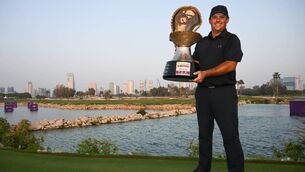
Harrington fears DP Tour could lose out in golf's shake-up
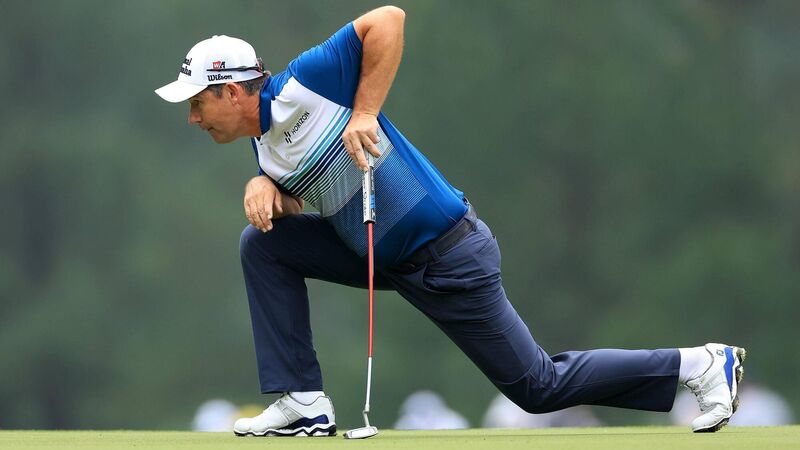
FEARFUL: Padraig Harrington. (Photo by David Cannon/Getty Images)
Padraig Harrington is fearful that the DP World Tour will be “squeezed out” by golf’s civil war.
The arrival onto the scene of LIV Golf has created a firestorm due to the concept’s Saudi Arabian backing and that country’s horrendous human rights record, but the project rumbles on regardless this week with Portland, Oregon the venue for its second event.
Harrington spoke effusively of the role the European Tour (now renamed as the DP World Tour) played in his own career in serving as a finishing school between 1996 and 2004 before he took out his PGA card in America and ultimately went on to win three majors.
That was then. LIV’s entry onto the scene has ripped up the natural order with its backers capturing a number of high-profile players, any number of lower-ranked pros, and with even recent college graduates being offered staggering sums to sign up.
It’s his belief that there is only room for two tours at the front of the game’s grid and that the DP might be the one that has to “take a back seat” despite his own conviction that the game needs it to remain strong.
“I feel for the European Tour because there is definitely room for two tours, there is no doubt about it, but is there room for more?” asked Harrington who was speaking from Dublin just two days after winning the US Senior Open.
“It looks like the European Tour is the one that could come under pressure and be squeezed. LIV looks like it will be here to stay and three, four, five years’ time all of this could be very normalised.
“There could be the US Tour and the LIV tour kind of thing contending for the hearts and minds of the players. Yeah, competition definitely pushes things on, as we have seen with the PGA Tour. Let’s hope that the European Tour can keep up.” The potential for transformational change extends to all corners of the golfing environment, not least the Ryder Cup where decisions are required sooner rather than later as to what players should and should not be eligible for the biennial shindig.
Harrington expects to speak with the relevant officials at this week’s Irish Open and next week’s Scottish counterpart. His status as a player and as a former European captain means his views will carry weight.
His own debut in the event was in 1999 when there was far less crossover between European players and Stateside events and with the result that he had to be introduced to most of the Americans at Brookline that year.
Players are better acquainted these days and he suggested that any division of the world’s best into two effectively rival camps could work to the advantage of the four majors, which would be the only fields combining the two, and maybe even the Ryder Cup.
"It could add spice to the Ryder Cup but I don’t know how that is going to end up in terms of where the players can play or certainly with captains and vice-captains. It really is hard to know what is going to be the future of it.
“As I said, time will normalise things, there is no doubt about that, but it is very up in the air at the minute. The LIV tour certainly seem to have, how do I put this, a point to prove that they can go and do it.” Harrington’s sense is that the LIV project will 'get done' in some shape or form but he reiterated the point that he had not been among those approached to sign on to the new venture and praised those players performing below the very best who had ignored the temptation to date.
“As much as the media talks about the players that have gone, some of the players who haven’t gone don’t get enough credit, and we’re not talking the very top but the Ryder Cup players who has just turned down the 30 million-plus figures.
“It’s very impressive at the moment that the players who are staying are those who feel their careers are on an upward spiral. They want to win the majors and they think that’s their futures. Fair play to them for turning it down and backing their careers.”