Even in death, golf's great architect Ross keeps an eye on Brookline — and a missed chance
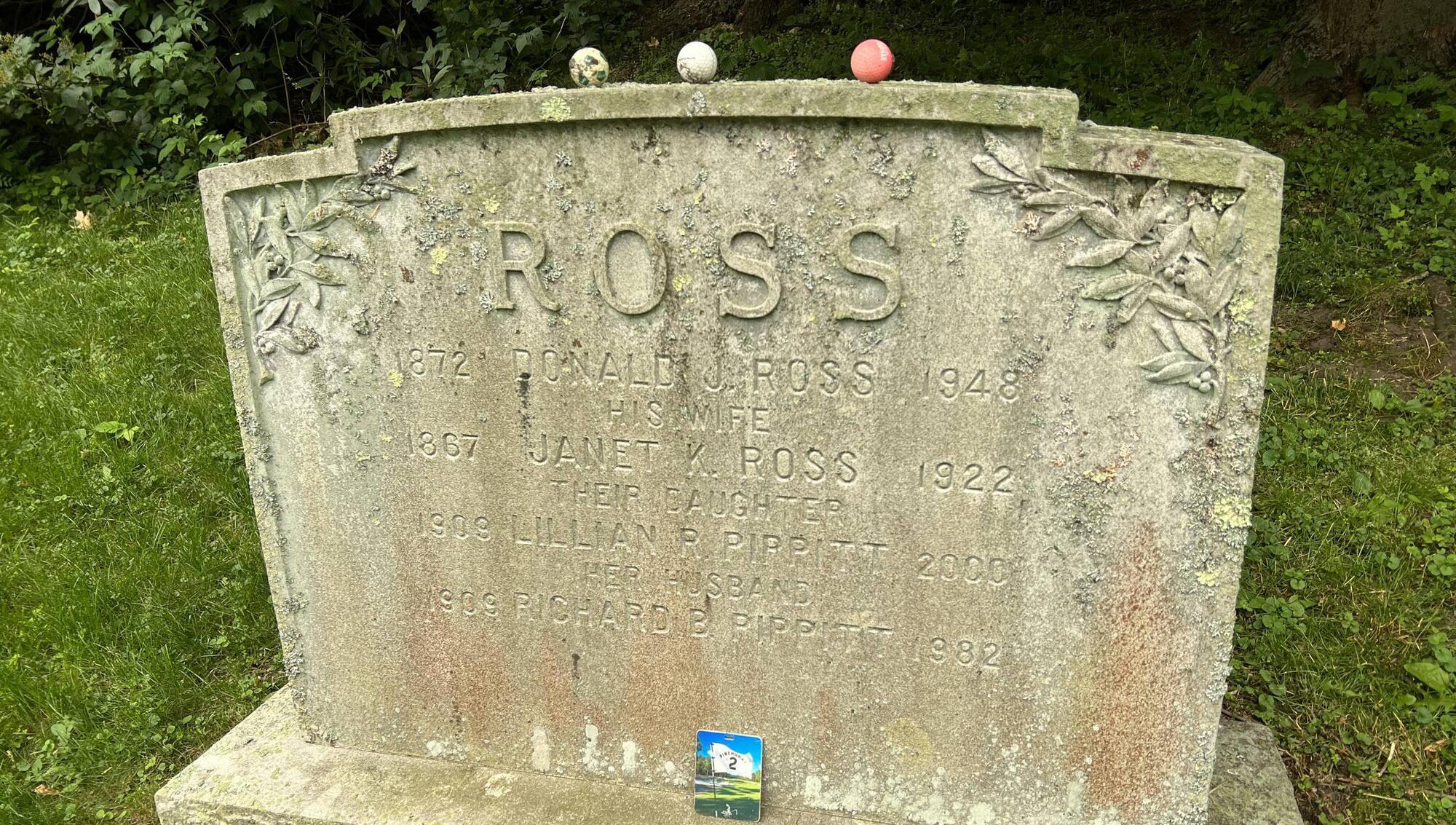
Where he lies: Golf architect Donald Ross is buried nearby Brookline's Country Club in the same cemetery as Edward "Stimpmeter" Stimpson.
BROOKLINE, Mass. – Just a few miles as the crow flies from The Country Club, Donald Ross rests in peace at the bucolic Newton Cemetery and Arboretum. The Scottish-born father of American golf architecture, with more than 400 courses boasting his designs in the States, is buried with his wife, Janet, and was later joined by daughter, Lillian, and her husband, Richard Pippitt.
The Dornoch-born Ross moved to America to work first in Massachusetts at the turn of the 20th century and rode the wave of golf’s growing popularity in the U.S. that only grew after Francis Ouimet’s historic victory in the 1913 U.S. Open at The Country Club.
Seven years on from Ouimet’s win, the golfing membership at TCC had grown to 700 and the club president believed it had outgrown its 18-hole course. When the financial crisis of 1921 struck, the club had the opportunity to purchase the adjacent 78.5-acre Douglass estate for $445,000 – which was more than the value of TCC itself.
In its effort to convince the membership that it should raise money to buy the land, Ross was commissioned to draw plans for a second 18-hole course alongside the Squirrel and Clyde nines where Ouimet had won. He sketched out a 6,271-yard course comparable to the original.
With 690 names on the club’s waiting list, it was proposed the capital could be raised by expanding the membership to 1,000. Opponents of the plan proposed reducing the membership instead to ease the over-crowding issues on the current course.
In 1922, TCC members voted down the acquisition plan and Ross’ design was scuttled. It only exists as a sketch on the wall inside the clubhouse.
Eventually, the club did reach a compromise with its dissenting faction and purchased a smaller 55-acre parcel that could fit nine holes. William Flynn was selected as the architect for what became the Primrose nine, of which four holes are used to account for three of the holes (9, 13 and 14) on the composite Open Course being used for this week’s U.S. Open.
While Ross didn’t get to leave his famous imprint on The Country Club, he did return to his old neighborhood when he died in 1948 while building his final design at Raleigh Country Club in North Carolina. His wife had preceded him in death in 1922 and was already buried in the family plot in Newton, so he was brought back for his interment beside her on a hillside below leafy bushes and the shade of large hardwood trees.
Tom Pashley – the president of Pinehurst Resort where Ross lived most of his later years at Dornoch Cottage on the third hole of his famous No. 2 course that he tinkered with until his death – wondered why Ross wasn’t buried in the quaint village in North Carolina’s sandhills. He sought to find his gravesite and see if it was possible to bring him “home” to Pinehurst.
But Pashley’s quest ended when he finally found Ross lying in Section J, Lot 294 in Newton Cemetery, under the headstone listing Ross’ whole family adorned with golf balls and trinkets left behind by visitors.
Not far away in Section D lies Edward Stimpson, the late TCC member and Massachusetts State Amateur champion who was so concerned upon hearing tales about the dramatic inconsistency of the greens at Oakmont in the 1935 U.S. Open that he set about inventing the “Stimpmeter,” which has been used to measure green speeds by the USGA since 1976 and turned his surname into a verb. Stimpson’s original Stimpmeter hangs on the wall on TCC’s clubhouse.
CONNECT WITH US TODAY



Be the first to know the latest news and updates