The pivotal holes for Irish Open success at Mount Juliet
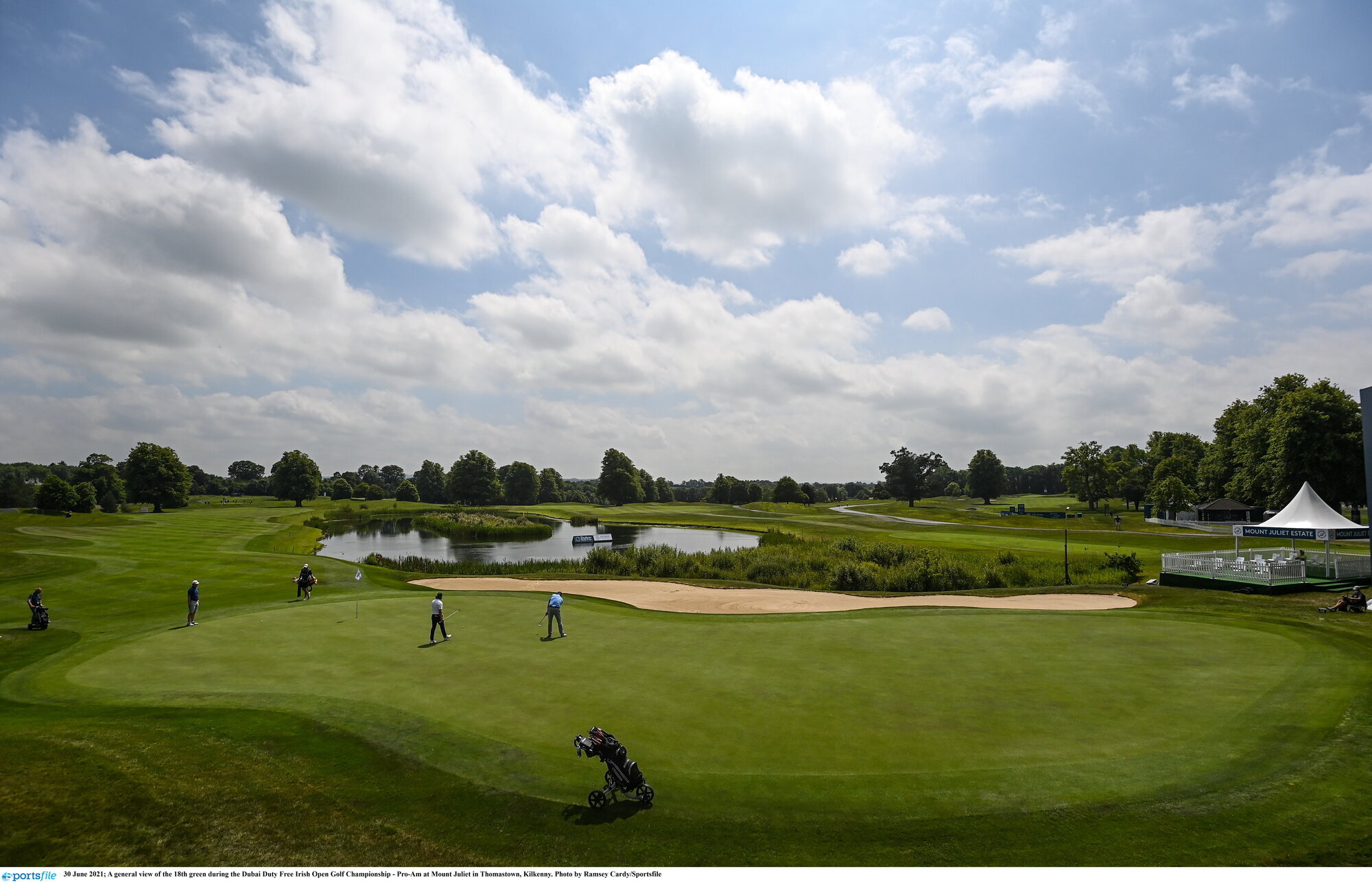
A general view of the 18th green during the Dubai Duty Free Irish Open Pro-Am at Mount Juliet in Thomastown, Kilkenny. Photo by Ramsey Cardy/Sportsfile
The European Tour pros will be treated to a 7,250-yard test that will have a little bit of everything lying in wait for them. That’s according to one of Mount Juliet’s PGA Professionals Brian Doheny. He knows every wrinkle of this par-72 championship course and he promised both armchair viewers and those lucky enough to bag a ticket there will be plenty of intrigue over the course of the weekend as it challenges the European Tour pros.

If there is a hole that members and visitors familiar with Mount Juliet may be surprised by the way the pros approach it, Doheny believes it is the par-four fourth.
“Trees line both sides of the fairway, out of bounds right, wood to the left. It’s okay for the members, they can probably hit their driver and they won’t go down too far. The pros are probably just going to knock an iron off it and go in with a mid-iron.
“If the tees get forward on Sunday and the Tour are looking for someone to come from behind I can see pros having a go at this.
It’s a narrow chute into the green, water on the right-hand side and I can see if someone has something going early on in the round that they could have a go at it. So that will be the hole for risk-reward early in the round. If it was me in a situation where I was chasing and I had something going early I would be having a go.”
“This stretch is going to be key,” Doheny said. “That will be a stretch of holes that are going to test the golfer. Two long par-fours, one of them being the index one on the golf course, and a long par three that are all fairly close so if it’s a tight scoreboard the rumbles will work through that tight corner there and they will be noted.”
“It is a par-four, dogleg left. Second shot into a green below fairway level so distance control becomes important there. It’s a two-tier green and you’ve got to hit the right part.”
“This is a slight dogleg right, downhill with water on the front. The green slopes back to front and it is the toughest hole on the golf course in terms of the members playing.”
“And then a long par-three surrounded by bunkers, slightly downhill with another big two-tier green. So again, club selection, wind direction, hitting the right tier, it’s all going to be important.”
“Then you have two fantastic holes to finish in, 17, a par-five, and 18, a long par-four.
If it gets tight down there there’s going to be shots that are going to have to be hit. It could swing on those two holes at the end and that leads to a good finish.”
“A long par-five, two big trees either side of the fairway. So a slight right to left shot would be ideal to set you up to go for the green surrounded by bunkers in two. It’s one of the trickiest greens on the golf course with a strong two tiers and a slight slope going left to right.”
“Tee shot, water down the left, big tree on the right so that you’re trying to work off one or the other into maybe a mid- to long-iron second shot.
The green is surrounded by bunkers and we have mounds along the right-hand side which will be probably up to 100mm rough so if you miss the 60-foot long green it’s going to be a tough up and down either side. It tends to lead to a good finish.”