Matthew Wolff on return from mental health break: ‘I just realised I need to enjoy myself and be happy’
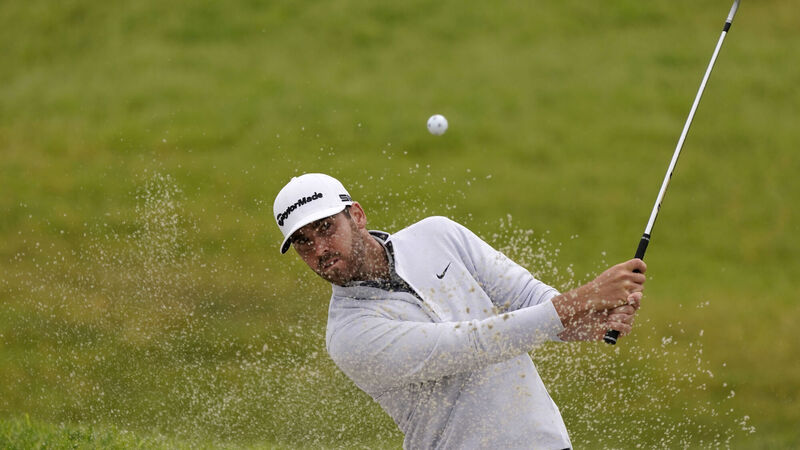
Matthew Wolff plays a shot from a bunker on the 11th hole during the first round of the US Open. Picture: AP Photo/Marcio Jose Sanchez
Before Naomi Osaka decided to not speak to the media before taking a mental health sabbatical from professional tennis, professional golfer Matthew Wolff was already in the midst of his own break.
Wolff missed the cut with partner Collin Morikawa at the Zurich Classic on April 23 and then disappeared. He withdrew in advance of the PGA Championship at Kiawah last month and didn’t return until this week at the US Open – 55 days between competitive rounds.
He said the decision to walk away and take a mental health break was difficult for a 21-year-old who had realised such immediate success on the PGA Tour by winning his fourth professional start just months after win the NCAA Championship to end his college career.
“It was really hard,” Wolff said Thursday at Torrey Pines. “Like I said, I love the fans, I love being out here and I want to play golf for everyone and I just, I think I just put too much pressure on myself. And it was a hard decision because I'm so new on the tour and it's my first or second year and I didn't want to walk away, I didn't think it was … I don't even think I could, to be honest.
“And then when I finally started to get to a bad enough spot, honestly I was like, you know what, I need some time.”
There certainly had been competitive warning signs for the young pro during a strange run for Wolff since taking the 54-hole lead and finishing runner-up at last September’s US Open and following that with another runner-up a few weeks later in Las Vegas tour event.
He started 2021 with a video-reviewed rules infraction at the American Express and withdrew citing a hand injury a week later after shooting a wild 78 that included a pair of triple bogeys in the first round at Torrey Pines.
He withdrew again after an opening-round 83 in the WGC event at the Concession and skipped the Players Championship he was qualified for. Before failing to advance out of pool play at the WGC Match Play, he gave a clue as to his state of mind.
“I think internally I put so much pressure on myself,” Wolff said in Texas, in March. “And on top of that – I'm not saying anyone in particular – but I think there's just a lot of pressure on everyone out here to play well in front of the fans and for their family and everything like that.
At the Masters, Wolff was disqualified for signing an incorrect scorecard after a second round that started with a snowman on the first hole and would have been a missed cut anyway. Two weeks later, he walked away to reset himself.
“And I just, I think the biggest thing right now that I'm trying to do is enjoy myself again and just take care of myself really,” he said. “I mean, I love these fans and I want to play well for them, but right now I'm just really trying to be happy and I, like I said, I live a great life and I want to enjoy it.”
When someone wants to enjoy golf again, the US Open seems like the last place for that. But Wolff had good reasoning for it coming back at Torrey, where he was last seen shooting 78 in January.
“Well, I figure if I shoot 78 there's going to be a lot of people that do it as well, so it won't look, I won't stand out quite as much,” he said.
“I mean, not an easy decision to come back at this time, but I thought it was the best thing, I talked with my team and I'm glad that I did.” All he did at Torrey on Thursday was make eight birdies, two doubles, three bogeys and five pars in a 1-under 71 – at one point holding the lead again in the US Open.
“Stuff's going to happen and things aren't always going to go your way and I think I handled it pretty well today and a lot better than I have in the past,” he said.
“I turned to my caddie after I birdied the par-5 13th (his fourth hole of the day), and I was like, ‘Dude, I'm 3-under right now.’ And he's like, I know. And I just didn't even realise it. And then I started to fall back a little bit, but that's kind of when I realised like all right, well, I fell back a little bit and things weren't always going good, but I'm still enjoying myself and having fun and being happy and in my opinion right now that's kind of what I'm working on and the most important thing for me regardless of how it goes out there I just want to make sure that I'm enjoying myself and enjoying my time out here because it's awesome to be out there.”
Wolff gave a frank glimpse into his state of mental health, illustrating that even the best athletes in the world have issues going on that we can’t see. It’s not always as easy as they sometimes make it look – even when things are very hard like they always are on a US Open stage. Wolff admitted he’ll likely struggle to handle bad shots for the rest of his career, which the best golfers do.
While he was quietly sitting at home, Osaka was putting a spotlight on athletes’ mental health at the French Open. Wolff appreciates the many other athletes who have stepped up as well and brought the issue to the forefront.
“I think like seeing that all these other athletes coming out and being like mental health is such an important thing and whether it's something that's going on personally or you're not playing well or you're not enjoying it or family or anything, it's just like, in this life, it's just so important to be happy,” he said. “And I live an amazing life. So many millions and millions and millions of people would trade me in a heartbeat.
“And I needed to just kind of get back and be like, ‘Dude, you live an unbelievable life, like you don't always have to play good.’ I know I want to, I want to always play good, I want to always please the fans, but I just kind of realised that the more I've been taking a little bit of time off, the more I just realised I was like, I just need to enjoy myself and be happy.
"And mental health is a really big problem and we play a lot of golf and/or we play a lot of games – any professional athlete has to deal with a lot more stress and pressure than most people and it's, it just kind of got to me. But I've been working on it, I've been learning and I think that's all I can do.”


CONNECT WITH US TODAY



Be the first to know the latest news and updates