How Chambers Bay put them in sick bay
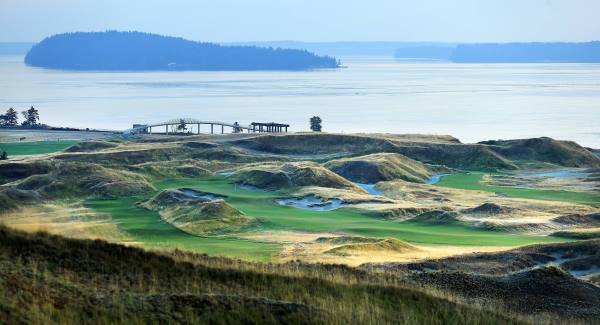
The US Open is renowned as the toughest examination in championship golf but the USGA came up with a way to make it even tougher when it selected the 7,900-yard Chambers Bay course as this year’s host for the second major of the season.
Firm, fast and with great variation in elevation all wrapped up in links aesthetic by the shores of Puget Sound in the Pacific Northwest of America, the challenge is a rigorous one of both mind and body.
Two caddies fell and were injured during practice on Wednesday and American golfer Gary Woodland finished the opening day on an intravenous drip, while the physical demands were shared by all.
Scotland’s Marc Warren needed no introduction to links golf when he arrived here and he looked right at home as he shot an opening, two-under-par 68 on Thursday.
Yet as he signed for his round, the 34-year-old knew he had been through the wringer out on the course.
“For links style golf, which is obviously really firm, your legs will feel it and your feet will feel it at the end of the day.
The elevation change around here is unusual for links golf. You are going to feel it,” Warren said.
“I said to my caddie, Ken, that come Sunday you are going to know you have been in a golf tournament the last week.
“Your legs are definitely going to know.
“It’s tough walking. You have actually got to be quite careful as well. There’s been a couple of injuries already.
“The grass being so shiny, it becomes slippy when it dries out. You have really got to be on the ball with everything around you. That’s what the USGA wants and expects in a US Open and that’s what the players expect as well.”
Woodland would not have expected to close day one in Tacoma General Hospital but the signs he was severely dehydrated were kicking in as he faded dramatically down the inward nine of his opening round.
He bogeyed four holes in a row between 12 and 15 as a promising round deteriorated along with his health into a four-over-par 74.
“Gary has been under the weather since last Sunday, and has been severely dehydrated,” Woodland’s agent Mark Steinberg said yesterday.
While Gary felt he had turned the corner earlier this week, he experienced a significant relapse within the last 36 hours.
“He received IV fluids this morning, and was admitted to Tacoma General Hospital following his round for further testing. The hospital confirmed Gary has a virus.”
It is not just physical fitness and all-round well-being that is the key to US Open survival, mental strength most of all can prove to be the determining factor that separates the champion from the field.
That is certainly the way Sweden’s Henrik Stenson was thinking as he came into the tournament and a five-under-par opening round of 65 did him no harm in that respect either.
“Mentally, I was in a good place,” Stenson said of his first round at Chambers Bay. “I kept very level-headed and had good patience out there.
It’s going to remain the same for the remainder of the week. That’s really one of the things I need to try and keep in mind for the rest of the week.” A lack of mental fortitude could have meant the injury to his caddie Gareth Lord having a detrimental effect on Stenson’s challenge. Lord was one of two caddies injured in falls at Chambers Bay on Wednesday. Stephen Gallacher’s caddie Damian Moore suffered ankle damage as the Scot played a practice round with Stenson and Lord joined his fellow bagman in the physio room after slipping on dry grass as he walked off a tee box.
Moore was unable to work on Thursday, forcing Gallacher to enlist local caddie Rick Harris, but Lord soldiered on, his wrist heavily strapped.
“I was worried,” Stenson said. “He took the fall and I asked him if he was okay and he said he was okay.
Because I know especially carrying a bag and if you take a fall, the first reaction you put your hands out to try to save yourself. And like he did, he got his wrist in a funky position.
“He said he was okay, but he was a little quiet. And then five minutes later, it just started getting black and blue up the lower part of his arm. So we knew something wasn’t right. He went to ice it out on the 17th tee box straight away and then he went to see the physio.
He spent a couple of hours at the emergency room getting it x-rayed and he’s in a cast.
“It’s definitely dangerous with those slopes and the grass gets shiny and lays down. It gets a bit like ice skating out there. So I’m sure the spectators are going to have to watch themselves, as well.”