Captain’s call: Paul McGinley opens up on Ryder Cup
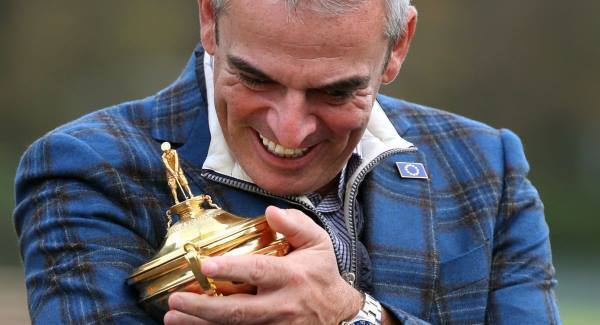
Paul McGinleyās combination of science and psychology was successful at the Ryder Cup last September, and the Dubliner outlined his approach last week in the RDS.
Take the approach of the players on the course as a starting point. He trusted the caddy-player dynamic.
āAs captain, I made a big point of the player and caddy being a unit, and I respected that.
āThey perform together, and much as I know the players, Iām not going up to them to tell them itās five iron or whatever when the caddyās there. I trust their dynamic together.
āIf there was information a player needed, rather than disturbing him, Iād tell the caddy ā then it was up to him to decide whether that information was relevant to the player hitting a better shot.
āWe won seven of the last nine Ryder Cups. Iād seen what worked, what didnāt, and though we never talked about it, there was a template there and six or seven important dynamics were involved.
āStatistics were one.ā
McGinley said heād been asked a lot since the tournament about balancing statistics and gut instinct in his decisions.
āItās probably 60% gut instinct and your psychological idea of a player, but behind that are statistics.
āIām a believer in trends, performance analysis, finding out as much data as possible to educate you when it comes to making a decision.
āOne thing I did as Ryder Cup captain which hadnāt been done before was to get a full-time stats team to watch the players for the previous two years and to analyse their play, to provide a league table of their form.
āIt was colour-coded so you could pick out the players, and I used that as a basis.
āI also had a 10-year analysis done of the Johnny Walker tournament played in Gleneagles ā what had players done there in the past, whoād won, had they attacked early, how had they done on the par fives ā and then, along with my gut instincts, I hoped to come up with good decisions.ā
Interestingly, McGinley didnāt inform the players of the level of scrutiny he subjected them to: āNo, I didnāt because a player doesnāt like to feel heās being watched.
āTheyāre probably aware at a deep level that itās going on, but the information was for me and the vice-captains, to enable us to make our decisions.
āI have all the data, a file on each player, and itās very important ā itās a trend not just in golf but in sports generally. As a sports lover Iām certainly interested in data, trends and stats and I see it in GAA and in soccer, for instance.
āHaving worked with Alex Ferguson to pick his brains for the Ryder Cup, one thing people forget about him, and dismiss about him, is how he was on the cutting edge of sports science.
āFor a guy who left school early, he was up to date with all the sports science available, and when he was with Manchester United he got them to invest heavily in that area.ā
He stressed that statistics had also been used in previous Ryder Cups: āThere were general stats used, and as a vice-captain Iād bring them in, general stuff off the computer.
āBut as captain I got those full-time stats people on board, and that helped us make good decisions.
āThat was a dynamic I enhanced but didnāt change, and Iād be surprised if those arenāt brought on by the next captain, but heāll put his identity on his captaincy too, and thatās very important in order to move it forward.
āThatās why weāve succeeded ā weāve learned from mistakes and from successes in previous tournaments.ā
McGinleyās approach to strength and conditioning illustrated that: āOne challenge I faced is that in a Ryder Cup cycle, 104 weeks, they are individuals, and being selfish ā playing, trying to win tournaments for themselves ā for 103 weeks.
āYou have to mould them into a team that one week and thatās a big challenge.
āTake Rory (McIlroy). My conversations with him were that I wanted him to bring anyone he had with him to prepare him ā masseur, strength coach ā and weād look after the expense. The same for all of them, they all brought their individual teams with them.
āThen, if I wanted to know about Roryās fitness, Iād talk to his conditioning coach and trust him to give me the right information, and Rory was happy he was dealing with the same guys he normally would in terms of conditioning, and so on, the week of the Ryder Cup.
āI think that one mistake Ryder Cup captains have made is trying too hard to make people friends and so on, so I brought them in as individuals with their teams, though I brought in a nutritionist as well to look at our food and a doctor as well for overall health and so forth.
āBut the rest they looked after as individuals.ā
The man-management skills needed for such different personalities shouldnāt be underestimated, though. His handling of Ian Poulter is a good case study.
āHe only lost one match in the Ryder Cup, people forget that,ā said the captain.
āHe didnāt have a great Ryder Cup last year but his record with Justin Rose was almost 100% in foursomes. Phenomenal.
āPart of my overall plan was for him to play Saturday afternoon. He played with Rory the second day, his form wasnāt great and I made a call, as I handed in the team, that Poulter would come out.
āI communicated that to Des Smyth, who was following the game, to tell Poulter he wasnāt playing, which was important.
āAs I handed in the team, Poulter went on to play the last holes very well, and I wanted to see him. I saw him after lunch and wanted to be completely clear: I put my arms out and said āsorry Poults, I had to make a late callā.
āHe put me in a headlock and whispered, āYouāre the captain, and you make the decisions. Iāll be ready tomorrowā.
āHe saw the bigger picture. He halved his match, he didnāt win it, but that says a lot about him. It tells you why heās special.ā
The affable Dubliner is āpast the captaincyā now, though.
āIāve left that, Iāve moved on and the sooner a new captain comes in, the better.
āI donāt know what the future holds for me. Iām 48, second oldest to Miguel Angel Jimenez but I enjoy playing still.
āIām committed to eight companies on a long-term basis and I do some TV commentary as well. One opportunity thatās grown out of the Ryder Cup is talking to businesses and leaders, and Iāve had inquiries from America about doing something similar.
āI enjoy that because I get a chance to learn, and mixing with like-minded people is invigorating.
āWhen I turn 50, will I play the Senior Tour? I donāt know. Iām a great believer in having a passion for doing something and if I have a passion for the Senior Tour, Iāll pursue that.
āIāve a number of balls in the air and weāll see where it goes.ā